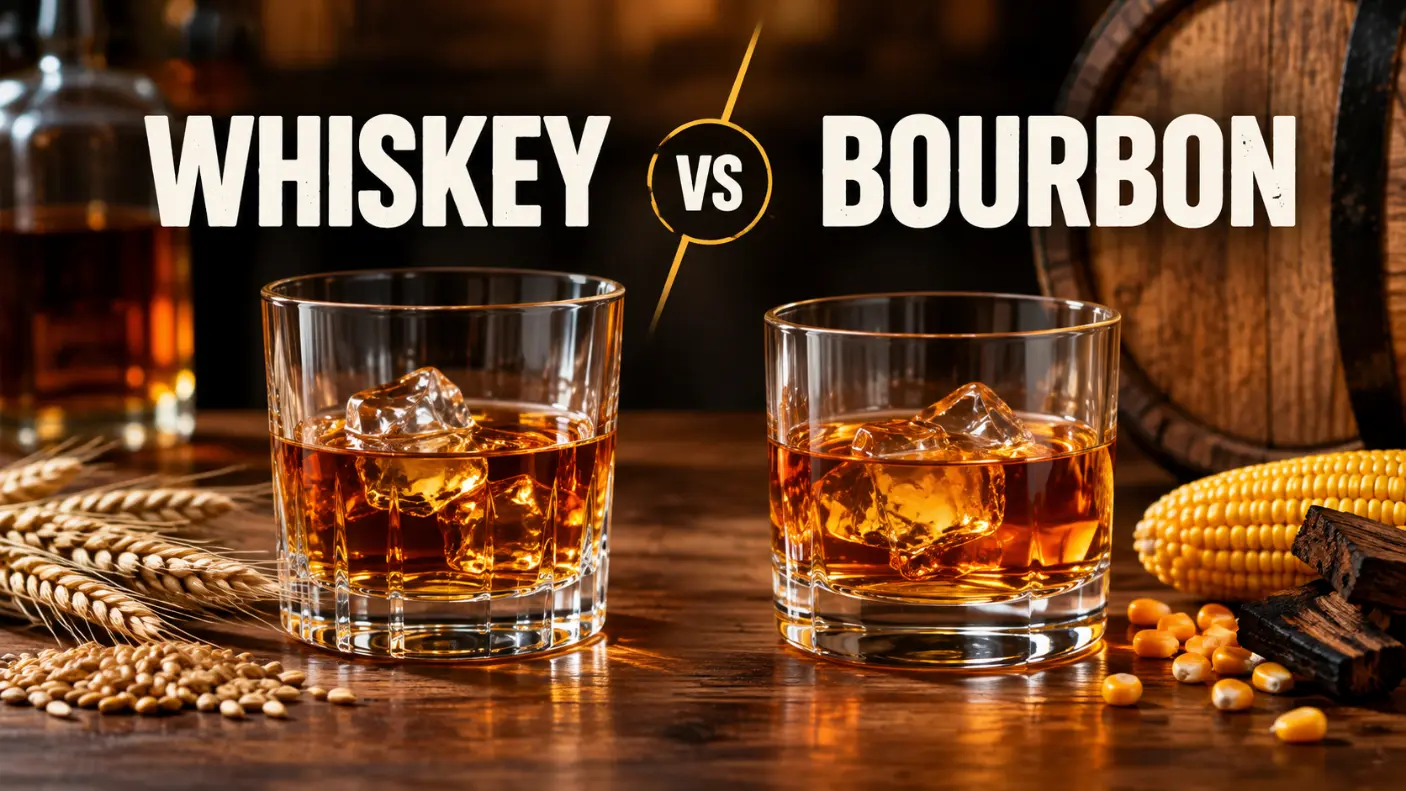
Whiskey is the broad category, while bourbon is a specific type of American whiskey.
Bourbon must be produced in the United States from a fermented grain mash containing at least 51% corn and stored in new charred oak containers under specific proof limits.
So, all bourbon is whiskey, but not all whiskey is bourbon.
Key Takeaways
- Whiskey is a broad family of distilled spirits made from fermented grain mash.
- Bourbon is a specific type of American whiskey with legally defined production requirements.
- Bourbon must contain at least 51% corn in its mash.
- Bourbon must be stored in new charred oak containers and produced in the United States.
- Bourbon often has sweet, vanilla, caramel, and oak notes, but whiskey flavors vary widely depending on the style.
1. What Is Whiskey?
Whiskey is a broad category of distilled spirits made from a fermented grain mash. Depending on the style, the grains can include corn, rye, wheat, barley, or malted barley.
Whiskey is produced in several countries, and each major style can have its own production traditions and legal requirements. American whiskey, Scotch whisky, Irish whiskey, Canadian whisky, and Japanese whisky are examples of different members of the larger whiskey family.
This is why comparing whiskey vs bourbon can be confusing: bourbon is not a completely separate drink from whiskey. Instead, it is one particular type within the whiskey category.
Whiskey as a Broad Category
Think of whiskey as the larger category.
Inside that category are different styles, including:
- Bourbon
- Rye whiskey
- Tennessee whiskey
- Scotch whisky
- Irish whiskey
- Canadian whisky
- American single malt whisky
The exact rules vary by style. For example, bourbon has a minimum corn requirement, while rye whiskey has different grain requirements.
The U.S. Alcohol and Tobacco Tax and Trade Bureau (TTB) defines whisky as spirits distilled from fermented grain mash that have the characteristics generally associated with whisky and are bottled at at least 80 proof.
2. What Is Bourbon?
Bourbon is a specific type of American whiskey.
The important distinction is that bourbon has a defined set of production requirements. Under U.S. standards, bourbon must be produced in the United States from a fermented mash containing at least 51% corn. It must also be distilled at no more than 160 proof and stored in new charred oak containers at no more than 125 proof.
The 51% Corn Rule
The mash bill is the recipe of grains used to make the whiskey.
For bourbon, at least 51% of the grain mash must be corn. The remaining grains can include ingredients such as rye, wheat, or malted barley.
The choice of those other grains can influence the finished whiskey’s character.
For example:
- A bourbon with more rye may have a spicier character.
- A wheated bourbon may have softer, sweeter-feeling notes.
- A traditional corn-heavy bourbon can emphasize sweet grain and oak flavors.
The exact flavor depends on much more than the grain recipe, including fermentation, distillation, barrel aging, and blending.
New Charred Oak Barrels
One of bourbon’s defining requirements is its use of charred new oak containers.
This matters because the new oak contributes many of the familiar flavors associated with bourbon, including vanilla, caramel, toasted oak, and spice.
The TTB specifically defines bourbon as whiskey produced in the United States and stored in charred new oak containers within specified proof limits.
U.S. Production and Proof Rules
Bourbon must be produced in the United States. It does not have to be made in Kentucky.
Federal standards also limit the proof at which bourbon is distilled and placed into its barrels. The whiskey must ultimately be bottled at no less than 80 proof under the general whisky standard.
3. Whiskey vs Bourbon: Key Differences
The easiest way to understand the difference is to remember:
Whiskey is the category. Bourbon is one type of whiskey.
Here is a simple comparison:
| Feature | Whiskey | Bourbon |
|---|---|---|
| Category | Broad family | Specific whiskey type |
| Main grain rule | Depends on style | At least 51% corn |
| Production location | Depends on style | United States |
| Barrel requirements | Vary by style | New charred oak |
| Distillation rules | Vary by style | No more than 160 proof |
| Barrel entry proof | Varies | No more than 125 proof |
| Minimum aging | Depends on style | No general minimum for bourbon |
| Straight designation | Depends on style | Straight bourbon requires at least 2 years |
Bourbon’s federal standards are more specific than the general category of whiskey.
Grain and Mash Bill
The grain recipe is one of the biggest differences.
Whiskey can be made from different combinations of grains depending on its type. Bourbon, however, must have at least 51% corn.
That corn requirement is one reason bourbon often develops a sweeter profile compared with some other whiskey styles.
Location
Bourbon must be made in the United States.
However, it is a common misconception that bourbon must come from Kentucky.
Kentucky has a famous bourbon-making tradition, but the federal definition does not restrict bourbon production to Kentucky.
Barrel and Aging
Bourbon must be stored in new charred oak containers.
The word “straight” adds another requirement. Straight bourbon must have been stored in charred new oak containers for at least two years.
That does not mean every bourbon must legally be two years old.
4. Does Bourbon Taste Different From Whiskey?
Usually, yes-but the comparison is not as simple as saying whiskey has one flavor and bourbon has another.
That’s because bourbon is whiskey.
Instead, bourbon is often associated with flavors such as:
- Vanilla
- Caramel
- Oak
- Brown sugar
- Toasted wood
- Baking spice
- Dried fruit
These characteristics are influenced by its corn-heavy mash and new charred oak aging.
Other whiskeys can taste very different.
A rye whiskey may be more peppery or spicy. Scotch whisky can range from light and fruity to intensely smoky and peaty. Irish whiskey can have a lighter, smooth, fruity, or cereal-driven character depending on the style.
So when someone asks whether bourbon tastes different from whiskey, the better answer is that bourbon has a recognizable style, while whiskey includes many different styles.
5. Is Bourbon Stronger Than Whiskey?
Not necessarily.
“Whiskey” includes many different products with different alcohol levels, so there is no single alcohol percentage for whiskey as a whole.
Bourbon can also come in different proofs.
For reference, TTB defines proof as twice the alcohol-by-volume percentage. Therefore, 40% ABV equals 80 proof.
A bourbon may be 80 proof, while another bourbon may be bottled at a substantially higher proof.
The same basic idea applies to other whiskey styles.
Proof tells you how much alcohol is in the specific bottle-not whether the drink is bourbon or whiskey.
6. Does Bourbon Have to Be Made in Kentucky?
No.
Bourbon must be produced in the United States, but federal bourbon standards do not require production in Kentucky.
Kentucky is strongly associated with bourbon because of its long history and major role in the bourbon industry. But bourbon is also produced in other U.S. states.
So:
Kentucky bourbon = bourbon made in Kentucky.
But:
Bourbon does not automatically mean Kentucky bourbon.
This distinction is useful when reading bottle labels or comparing different American whiskey producers.
7. Bourbon vs Whiskey for Cocktails
Bourbon and other whiskeys can both work well in cocktails, but changing the whiskey can change the drink’s character.
Bourbon is commonly used in cocktails such as:
- Old Fashioned
- Whiskey Sour
- Mint Julep
- Manhattan variations
Bourbon’s sweeter, corn-forward character can pair especially well with sugar, citrus, bitters, and other cocktail ingredients.
Rye whiskey is another popular choice for classic whiskey cocktails and can provide a spicier profile.
There is no universal rule that one whiskey style is always better for every cocktail. The choice depends on the flavor profile you want.
8. Bourbon, Rye, Scotch, and Irish Whiskey
Bourbon is only one branch of the larger whiskey family.
Bourbon
Made in the United States with at least 51% corn and stored in new charred oak containers.
Rye Whiskey
American rye whiskey must contain at least 51% rye under the applicable U.S. standard, creating a distinctly different grain profile from bourbon.
Scotch Whisky
Scotch is produced in Scotland and follows its own production and aging rules. It can range from delicate and fruity to strongly smoky and peaty.
Irish Whiskey
Irish whiskey is produced under Irish regulations and includes several styles with different production characteristics.
This variety explains why “whiskey” cannot be treated as one single flavor or production method.
9. Common Misconceptions About Whiskey vs Bourbon
“Bourbon and whiskey are completely different drinks.”
Not exactly. Bourbon is a type of whiskey.
“All bourbon comes from Kentucky.”
False. Bourbon must be produced in the United States, but it can be made outside Kentucky.
“Every bourbon must be aged for at least two years.”
Not quite. The two-year requirement applies to straight bourbon. The general bourbon standard does not impose the same two-year minimum.
“Whiskey always tastes the same.”
No. Whiskey includes many styles, so flavor can vary dramatically depending on the grains, production method, location, and aging.
“Bourbon is always stronger.”
No. Alcohol strength depends on the individual bottle’s ABV or proof, not simply on whether it is bourbon.
10. Frequently Asked Questions
Is bourbon a whiskey?
Yes. Bourbon is a specific type of American whiskey. To qualify as bourbon under U.S. standards, it must meet requirements involving its corn content, production location, distillation, proof, and new charred oak storage.
What is the main difference between whiskey and bourbon?
The biggest difference is that whiskey is the broader category, while bourbon is a legally defined type of whiskey. Bourbon must be made in the United States with at least 51% corn and stored in new charred oak containers under specific proof requirements.
Is bourbon sweeter than whiskey?
Bourbon is often perceived as sweeter because of its corn-heavy mash and interaction with new charred oak. However, whiskey is a broad category, so some whiskey styles can also be sweet, fruity, rich, or smoky.
Does bourbon have to be made in Kentucky?
No. Bourbon can be produced anywhere in the United States as long as it meets the applicable federal standards. Kentucky is historically important to bourbon, but it is not the only state where bourbon can be made.
Does bourbon have to be aged for two years?
No. Straight bourbon must be stored in charred new oak for at least two years, but the general bourbon category does not have that same two-year minimum.
Can you use bourbon instead of whiskey in a cocktail?
Often, yes. Since bourbon is whiskey, it can replace another whiskey in many recipes. However, the flavor will change. Bourbon generally brings more corn-driven sweetness and oak character, while rye or another whiskey style may create a different balance.
Conclusion
The simplest answer to whiskey vs bourbon is that bourbon belongs to the whiskey family.
All bourbon is whiskey, but not all whiskey is bourbon.
Whiskey is the broader category, while bourbon has specific U.S. production requirements.
Bourbon must be made in the United States, contain at least 51% corn in its mash, and be stored in new charred oak containers under defined proof limits.
The result is a distinctive American whiskey style that is often associated with sweet, vanilla, caramel, oak, and spice notes.
Understanding this relationship makes whiskey labels much easier to read: bourbon tells you something specific about how the whiskey was made, while whiskey by itself can refer to many different styles from around the world.