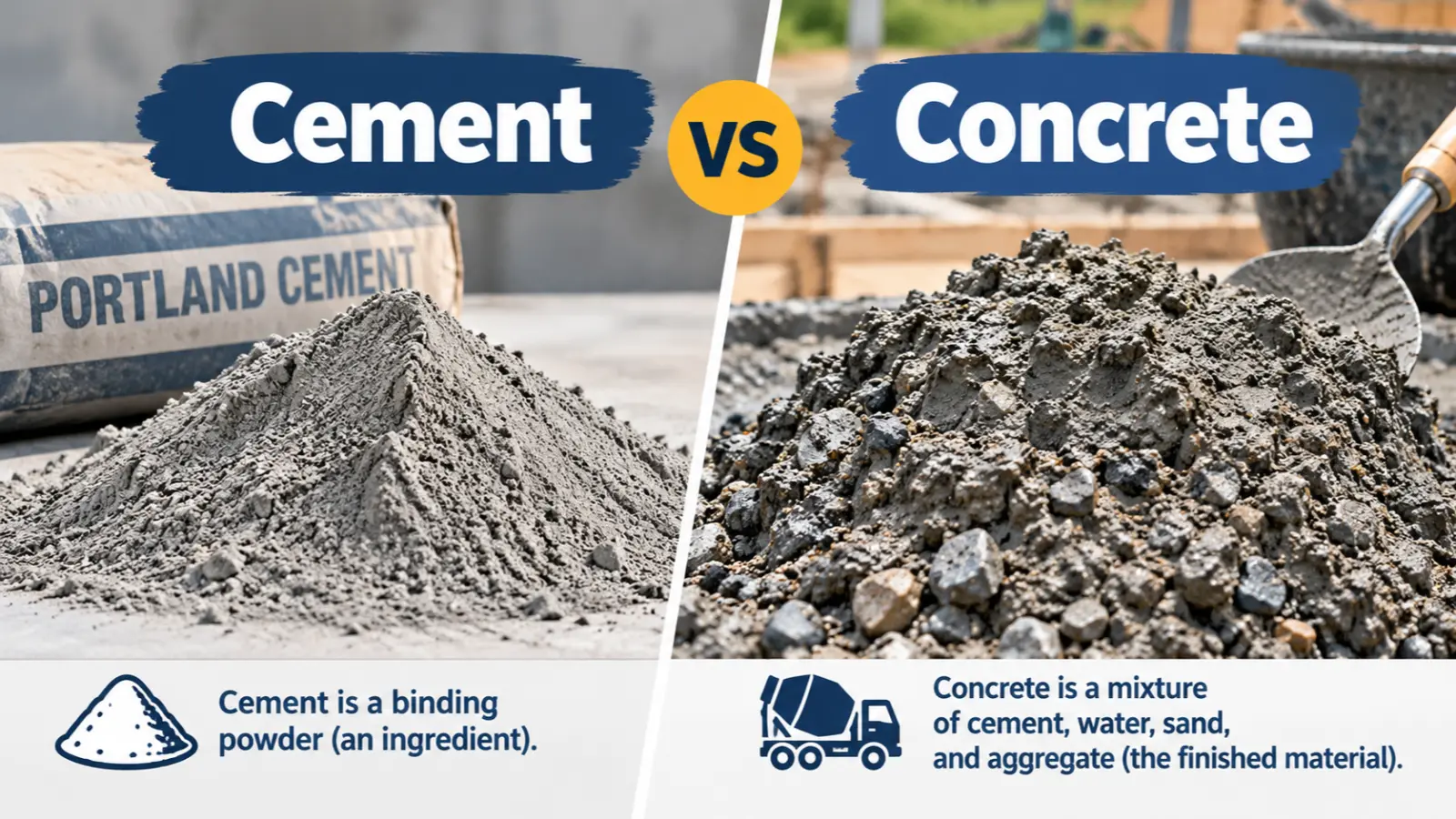
Cement and concrete are not the same thing. Cement is a fine binding powder that acts as one ingredient in concrete.
Concrete is the finished mixture of cement, water, sand, and coarse aggregate such as gravel or crushed stone. In simple terms, cement is the binder; concrete is the complete construction material used for driveways, sidewalks, foundations, slabs, and many other projects.
Key Takeaways
- Cement is an ingredient; concrete is a finished material.
- Cement reacts with water through a process called hydration and helps bind aggregate together.
- Concrete contains cement, water, sand, and coarse aggregate such as gravel or crushed stone.
- Concrete is commonly used for driveways, patios, sidewalks, foundations, slabs, and structural construction.
- “Cement driveway” is common everyday language, but “concrete driveway” is the technically correct term.
1. Cement vs Concrete: The Basic Difference
The easiest way to understand concrete vs cement is to think of cement as an ingredient and concrete as the finished product.
Cement is a fine powder used as a binding agent. When cement is combined with water, it undergoes a chemical reaction and forms a paste that binds other materials together.
Concrete is made by combining cement paste with fine and coarse aggregates. After the mixture is placed and hardens, it becomes the solid material used throughout residential, commercial, and infrastructure construction.
A simple analogy is flour and cake:
- Flour is an ingredient.
- Cake is the finished product made from several ingredients.
In the same way:
- Cement = ingredient
- Concrete = finished construction material
What Is Cement?
Cement is a fine powder that acts as a binder in concrete and other cement-based materials.
Portland cement is one of the primary cement types used in general concrete construction in the United States. Cement manufacturing involves heating carefully selected raw materials to produce clinker, which is then finely ground with other materials.
Cement is rarely the material you would choose by itself for a structural project. Instead, it performs its most important job by binding aggregate together in concrete.
What Is Concrete?
Concrete is a composite material made primarily from cement, water, fine aggregate, and coarse aggregate.
Sand generally serves as the fine aggregate, while gravel or crushed stone provides coarse aggregate. When water activates the cement, the resulting paste coats and binds the aggregate particles together.
Concrete can be placed while it is workable and then allowed to harden and gain strength over time.
💡 Tip: Remember this simple rule: cement goes into concrete, but concrete does not simply mean cement.
2. What Is Cement Made Of?
Cement is manufactured from mineral materials that provide compounds containing elements such as calcium, silicon, aluminum, and iron.
For common Portland cement production, materials such as limestone and clay are processed at high temperatures to form clinker. The clinker is then ground into a fine powder, with other materials used as appropriate to produce the final cement.
Portland Cement and Blended Cement
Portland cement and blended cements are important cement types used in concrete.
The American Cement Association notes that Portland and blended cements are key ingredients in concrete used for general construction. Cement types are produced to meet established standards and specifications for different applications.
The specific cement used in a project depends on factors such as the required performance, environmental conditions, specifications, and applicable standards.
How Cement Hardens
Cement does not simply “dry” like wet paint.
When cement comes into contact with water, a chemical reaction called hydration occurs. This reaction produces new compounds that cause the cement paste to harden and develop strength.
That hardened paste is what helps lock the aggregates together in concrete.
3. What Is Concrete Made Of?
Concrete is more than wet cement. It is a carefully proportioned mixture of several components.
Cement
Cement is the binder. It reacts with water and helps hold the aggregate particles together.
Cement typically represents about 10% to 15% of concrete by volume, according to the American Cement Association.
Water
Water activates the cement and allows hydration to occur.
The amount of water used matters because concrete performance depends heavily on the proportions and design of the mixture. Adding water casually at the job site can change the properties of the finished concrete.
Fine and Coarse Aggregate
Aggregate makes up most of the volume of typical concrete.
- Fine aggregate: usually sand
- Coarse aggregate: usually gravel or crushed stone
Aggregate provides bulk and contributes to the physical properties and load-bearing performance of concrete. Cement paste surrounds and binds these particles together.
Admixtures
Some concrete mixtures also contain admixtures designed to modify specific properties, such as setting time, workability, or other performance characteristics.
The exact ingredients and proportions depend on the concrete mix and the requirements of the project.
🔑 Key Takeaway: Concrete gets its overall performance from the complete mix, not from cement alone.
4. Concrete vs Cement: Side-by-Side Comparison
| Feature | Cement | Concrete |
|---|---|---|
| What is it? | Binding powder | Complete composite material |
| Main role | Binds other materials | Provides the finished construction material |
| Main components | Cementitious compounds | Cement, water, sand, and coarse aggregate |
| Appearance | Fine gray powder | Gray mixture that hardens into a solid mass |
| Used alone? | Rarely for structural construction | Yes, as the finished material |
| Common uses | Binder in concrete, mortar, grout, and cement-based products | Driveways, slabs, sidewalks, foundations, patios, structures |
| Strength | Cement paste alone is not equivalent to structural concrete | Designed mixes can provide substantial compressive strength |
| Physical form before hardening | Powder, then paste when mixed with water | Flowable or workable mixture |
The key difference is purpose. Cement supplies the binding action, while concrete combines that binder with aggregate and water to create the material used for construction.
5. Why Is Concrete Stronger and More Useful for Construction?
It is common to hear that concrete is “stronger than cement,” but this comparison needs some context.
Cement paste and concrete are different materials with different purposes. Concrete is engineered as a complete mixture, and the aggregate provides much of its bulk and contributes to its strength and stability.
The Role of Aggregate
Imagine trying to build a large wall out of only a thin adhesive. The adhesive can bond things together, but it is not the same as having a complete structural system.
Concrete uses cement paste to bind sand and larger aggregate particles into a solid mass.
The aggregate is not simply cheap filler. It forms a major portion of the concrete volume and plays an important role in its physical behavior.
Hydration and Curing
When cement and water react, hydration begins.
Concrete then continues to develop its properties as it hardens and cures. Most strength development occurs during the early weeks, although concrete can continue to harden and gain strength over time.
This is one reason concrete should not be treated as simply “cement that has dried.”
6. When Do You Use Cement vs Concrete?
The right choice depends on what you are trying to accomplish.
Common Cement-Based Uses
Cement is commonly used as an ingredient in:
- Concrete
- Mortar
- Grout
- Cement-based repair materials
- Cementitious overlays
- Other cement-based construction products
Cement’s primary job is generally to provide binding properties rather than serve as the complete material for a driveway or foundation.
Common Concrete Uses
Concrete is commonly used for:
- Driveways
- Sidewalks
- Patios
- Foundations
- Structural slabs
- Floors
- Roads
- Bridges
- Walls
- Other structural and decorative applications
Its ability to be placed in a workable state and then harden into a durable material makes concrete extremely versatile.
⚠️ Important: For structural work such as foundations, slabs, or load-bearing construction, the appropriate concrete mix and project specifications matter. Do not assume that substituting plain cement will provide equivalent performance.
7. Cement vs Mortar vs Grout vs Concrete
These terms are often confused because they are all related.
| Material | Basic idea | Common use |
|---|---|---|
| Cement | Binding powder | Ingredient in construction materials |
| Mortar | Cement-based mixture with fine aggregate | Laying and bonding masonry units |
| Grout | Flowable cement-based material | Filling joints and spaces |
| Concrete | Cement, water, fine aggregate, and coarse aggregate | Slabs, foundations, driveways, structures |
The major difference is the composition and intended application.
Mortar is commonly used to bond bricks or blocks. Grout is designed to flow into and fill spaces. Concrete incorporates coarse aggregate and is commonly used for larger, load-bearing or wear-resistant construction applications.
8. Is a Driveway Made of Cement or Concrete?
A typical driveway is made of concrete, not cement alone.
People often say “cement driveway” in everyday conversation, but the technically accurate term is concrete driveway.
A concrete driveway contains cement as one of its ingredients. The finished surface gets its properties from the complete concrete mixture, including cement, water, and aggregates.
The same applies to many everyday phrases:
- “Cement sidewalk” → concrete sidewalk
- “Cement patio” → concrete patio
- “Cement slab” → concrete slab
Using “cement” in casual conversation is common, but understanding the distinction is useful when buying materials or discussing a construction project.
9. Common Mistakes People Make About Cement and Concrete
Mistake 1: Thinking Cement and Concrete Are the Same
They are related, but they are not identical.
Cement is a component of concrete.
Mistake 2: Thinking Concrete Is Just Wet Cement
Concrete contains much more than cement. Its mixture includes aggregate and water, with other materials sometimes added depending on the desired properties.
Mistake 3: Assuming More Cement Always Means Better Concrete
More cement is not automatically the answer to every concrete-performance problem. Concrete mix design involves balancing different components to achieve the required properties and workability.
Mistake 4: Using Cement Instead of Concrete for a Slab
A slab generally requires an appropriate concrete mixture rather than cement paste alone.
For structural applications, the mix needs to be selected according to the project’s requirements rather than simply replacing concrete with cement.
10. Frequently Asked Questions
Is cement the same as concrete?
No. Cement is an ingredient used to make concrete. Cement acts as the binder, while concrete is the complete mixture containing cement, water, and aggregates such as sand and gravel.
Is concrete stronger than cement?
Concrete is designed as a complete material, while cement is primarily the binder within that material. Comparing the two directly can be misleading. Concrete’s performance comes from its complete mix of cement paste and aggregates, along with the mix design and curing conditions.
Can you use cement by itself?
Cement can be used in certain small-scale or cement-based applications, but cement alone is generally not a substitute for concrete in structural projects. Concrete combines cement with aggregates to create the finished construction material.
What is concrete made of?
Concrete is primarily made from cement, water, fine aggregate such as sand, and coarse aggregate such as gravel or crushed stone. Some mixes also contain admixtures that modify particular properties.
What is cement used for?
Cement is primarily used as a binding ingredient in concrete and other cement-based materials. It is also used in products and applications involving mortar, grout, overlays, and repair materials.
Is a sidewalk made of cement or concrete?
A typical sidewalk is made of concrete. Cement is one of the ingredients within that concrete. Therefore, “concrete sidewalk” is the more technically accurate term.
Why do people call concrete cement?
The words are often used interchangeably in everyday speech because cement is an important ingredient in concrete. However, in construction terminology, cement and concrete refer to different materials.
What is the difference between cement and mortar?
Cement is the binder. Mortar is a cement-based mixture commonly used to bond masonry units such as bricks and blocks. Concrete generally contains coarse aggregate and is used for applications such as slabs, foundations, and structural construction.
11. Conclusion
The difference between concrete vs cement is simple once you understand their roles: cement is the binder, while concrete is the finished material.
Cement reacts with water and helps bind aggregate together. Concrete combines cement, water, sand, and coarse aggregate to create a hard, durable material used for everything from sidewalks and driveways to foundations and major infrastructure.
So, if you are talking about the gray material poured for a driveway, patio, sidewalk, or foundation, you are generally talking about concrete, not cement. Cement is an important ingredient inside that concrete.
Knowing the difference also makes it easier to choose the correct product, communicate with contractors, and understand construction instructions.