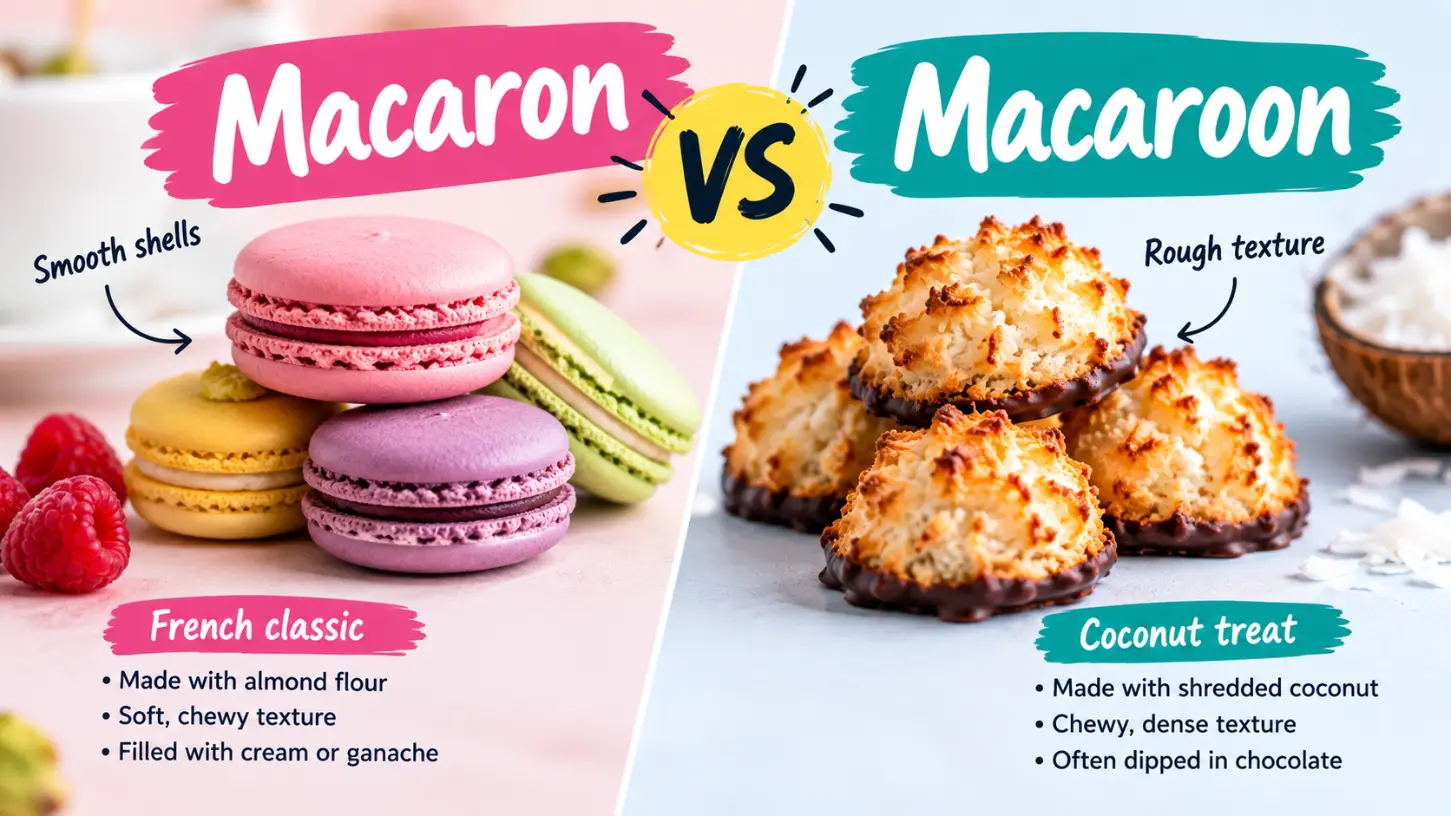
A macaron is a delicate French-style sandwich cookie made primarily with almond flour, egg whites, and sugar, usually with a filling between two shells.
A macaroon is typically a dense, chewy coconut cookie made with shredded coconut, egg whites, and sugar. Despite their similar names, they are different desserts with distinct ingredients, textures, shapes, and preparation methods.
Key Takeaways
- Macarons are usually made with almond flour and have two smooth shells joined by a filling.
- Macaroons are usually coconut-based and are commonly shaped as small, rough mounds or clusters.
- Macarons are typically crisp on the outside and soft or chewy inside, while macaroons are generally dense and chewy.
- Macaron is commonly pronounced roughly “mack-ah-ROHN,” while macaroon ends with an “oon” sound.
- The two names have a shared historical connection, but the desserts developed into distinctly different treats.
1. Macaron vs Macaroon: The Main Difference
The easiest way to remember the difference is to look at the main ingredient and shape.
A macaron is the colorful, round, sandwich-style pastry commonly associated with French patisseries. It is made from an almond-based meringue mixture and typically consists of two shells with buttercream, ganache, jam, or another filling between them.
A macaroon, especially in the United States, is usually a coconut-based cookie. It is often formed into a mound or cluster and has a rougher appearance with a dense, moist, chewy texture.
Macaron
Think:
Almond flour + meringue + two shells + filling
Macarons are usually smooth, colorful, and carefully shaped. Their shells can have the characteristic ruffled edge called a “foot” or “pied.”
Macaroon
Think:
Coconut + egg whites/sugar + one chewy mound
American coconut macaroons are usually much more rustic. They may be golden brown, lumpy, or textured because of the shredded coconut.
Easy memory trick:
👉 Macaron = almond sandwich cookie
👉 Macaroon = coconut cookie
2. Macaron vs Macaroon Comparison Table
| Feature | Macaron | Macaroon |
|---|---|---|
| Common style | French-style sandwich cookie | Coconut cookie |
| Main ingredient | Almond flour | Shredded coconut |
| Shape | Two round shells | Single mound or cluster |
| Filling | Usually yes | Usually no |
| Texture | Crisp shell, soft/chewy center | Dense, moist, chewy |
| Appearance | Smooth and colorful | Rough and often golden |
| Common flavors | Pistachio, chocolate, vanilla, raspberry | Coconut, chocolate, almond |
| Preparation | Precise meringue and folding technique | Generally simpler mixing process |
| Pronunciation | Roughly “mack-ah-ROHN” | Roughly “mack-ah-ROON” |
The exact ingredients can vary by recipe, but this table reflects the common distinction used in modern American English and baking.
3. What Is a Macaron?
A macaron is a delicate sandwich cookie associated with French pastry. Modern French-style macarons are generally made with finely ground almonds, confectioners’ sugar, egg whites, and sugar.
The batter is piped into small rounds and baked into smooth shells. After baking, two shells are paired with a filling.
Main Ingredients
Typical macaron recipes include:
- Almond flour
- Egg whites
- Granulated sugar
- Confectioners’ sugar
- Food coloring, when desired
- Flavoring
- Buttercream, ganache, curd, jam, or another filling
The almond flour gives macarons their distinctive nutty base, while the whipped egg whites help create the meringue structure. Wilton describes the modern macaron as a sandwich cookie made with almond flour, egg whites, and confectioners’ sugar.
Appearance and Texture
A properly made macaron usually has a smooth, rounded top and a recognizable ruffled edge around the bottom of the shell.
The outside can be delicate and slightly crisp, while the inside is often soft, chewy, or tender. The filling adds another layer of flavor and texture.
Macarons are also famous for their wide range of colors and flavors. A bakery display might include vanilla, chocolate, pistachio, coffee, raspberry, lemon, salted caramel, or seasonal combinations.
Common Fillings
The filling is one of the major features that separates a macaron from a traditional coconut macaroon.
Common macaron fillings include:
- Buttercream
- Chocolate ganache
- Fruit jam
- Lemon or other citrus curd
- Caramel
- Chocolate cream
Because the filling sits between two shells, a macaron can look almost like a tiny colorful sandwich.
4. What Is a Macaroon?
A macaroon is usually a coconut-based cookie, particularly in the United States.
Unlike the smooth sandwich structure of a macaron, a coconut macaroon is generally made as a single portion. Shredded or flaked coconut gives the cookie its characteristic rough texture and strong coconut flavor.
Main Ingredients
A coconut macaroon may contain:
- Shredded coconut
- Egg whites
- Sugar
- Vanilla
- Salt
- Sweetened condensed milk in some recipes
Recipes differ, so not every macaroon uses exactly the same ingredients. Some rely heavily on egg whites, while others use condensed milk to bind and sweeten the coconut.
Appearance and Texture
Macaroons are usually much more rustic than macarons.
They may look like:
- Small coconut mounds
- Rough clusters
- Golden-brown cookies
- Coconut pyramids or domes
Their texture is commonly moist, dense, and chewy, with toasted coconut providing additional flavor.
Some coconut macaroons are dipped or drizzled with chocolate, creating the familiar chocolate-and-coconut combination found in many American bakeries.
Common Variations
Macaroons can vary considerably.
Some are:
- Plain coconut
- Chocolate-dipped
- Chocolate-flavored
- Almond or nut enhanced
- Made with condensed milk
- Made primarily with egg whites
So while coconut is the strongest modern association with “macaroon” in the United States, the broader history of the word and recipes is more complicated.
5. How Do Macaron and Macaroon Taste Different?
The biggest taste difference comes from their primary ingredients.
A macaron usually has a delicate almond flavor. Depending on its filling, it can taste fruity, chocolaty, nutty, creamy, citrusy, or caramel-like.
A macaroon usually has a much stronger coconut flavor. The shredded coconut also gives it a more substantial bite.
In simple terms:
Macaron: delicate, sweet, almond-based, with a filling.
Macaroon: coconut-forward, rich, moist, and chewy.
The filling means macarons can also have much more flavor contrast. For example, a crisp almond shell with raspberry filling tastes very different from a chewy toasted-coconut macaroon.
6. How Do You Pronounce Macaron and Macaroon?
Pronunciation is another reason these two desserts are frequently confused.
Macaron
Macaron is commonly pronounced approximately:
mack-ah-ROHN
The final syllable sounds closer to “ron” than “roon.”
Macaroon
Macaroon is commonly pronounced:
mack-ah-ROON
The final syllable sounds like “roon.”
The spelling provides a useful clue:
- Macaron → “ron”
- Macaroon → “roon”
Food Network and other culinary references specifically highlight pronunciation as part of the confusion between these two names.
7. Why Are They Called Macaron and Macaroon?
The similar names are not simply a coincidence.
Both terms have a shared historical connection and are related to older European words associated with almond-based preparations. Over time, the terminology and recipes developed differently in different places.
Ladurée explains that the words are connected to the Italian maccarone or maccherone, while modern French usage settled on “macaron” for the almond-based pastry. In English, “macaroon” became associated particularly with the coconut cookie.
Earlier forms of these sweets were not necessarily identical to the modern French macaron or American coconut macaroon.
The important point is that the two modern cookies evolved from related culinary traditions but eventually developed different ingredients, shapes, and preparation methods.
That is why their names still look almost identical even though the finished desserts look completely different.
How They Became Different Desserts
The modern French macaron became associated with finely made almond-meringue shells and fillings.
Meanwhile, the coconut macaroon developed as a different style of cookie, especially in American baking.
So the extra “o” is more than a spelling detail-it helps distinguish two different modern desserts.
8. Which One Is Easier to Make?
For most home bakers, macaroons are generally easier to make than macarons.
Macarons can be technically demanding because the baker has to manage the meringue, almond mixture, folding technique, piping, resting, oven temperature, and baking time carefully.
Small changes can affect the final shells.
Macaroons are usually more forgiving. The ingredients can often be mixed, shaped into portions, and baked without the same level of precision required for French-style macarons. Culinary sources commonly describe macaroons as the simpler of the two preparations.
If you’re new to baking: coconut macaroons are often the more approachable starting point.
9. How to Tell a Macaron From a Macaroon
If you see both desserts in front of you, you can usually identify them within seconds.
Look at the shape
Two smooth, round cookies with filling in the middle?
That’s probably a macaron.
One rough coconut mound?
That’s probably a macaroon.
Look at the main ingredient
Almond flavor or almond flour?
Think macaron.
Shredded coconut?
Think macaroon.
Look at the texture
Delicate shell with a soft or chewy center?
Likely a macaron.
Dense, moist, chewy coconut texture?
Likely a macaroon.
Look for a filling
A visible filling sandwiched between two shells is one of the clearest signs that you’re looking at a macaron.
10. Are Macarons and Macaroons Gluten-Free?
Traditional versions of both desserts are often gluten-free, because their primary ingredients do not require wheat flour.
Macarons are generally based on almond flour, egg whites, and sugar. Coconut macaroons are generally based on coconut, egg whites and/or condensed milk, and sugar.
However, if you need to avoid gluten for medical reasons, don’t assume that every bakery version is safe. Fillings, flavorings, coatings, or cross-contact during preparation can change the situation.
Always check the ingredient list and ask the bakery about preparation practices when gluten avoidance is important.
11. Frequently Asked Questions
Is a macaron the same as a macaroon?
No. A macaron is generally an almond-based French-style sandwich cookie with two shells and a filling. A macaroon is usually a coconut-based cookie with a dense, chewy texture. Their names are related historically, but the modern desserts are different.
Is a macaron made with coconut?
Traditional French-style macarons are made primarily with almond flour, not coconut. Some modern recipes may use coconut or other ingredients for special variations, but coconut is not what normally defines a macaron.
Is a macaroon made with almonds?
Some macaroon recipes can include almonds or almond paste, but the American macaroon is most commonly associated with shredded coconut. The recipe can vary depending on the region and baker.
Which is chewy, macaron or macaroon?
Both can have some chewiness, but they are chewy in different ways. A macaron usually has a delicate shell with a soft or chewy interior, while a coconut macaroon is typically denser and chewy throughout.
Why are macarons so difficult to make?
Macarons require careful control of the meringue and batter. Mixing too much or too little, incorrect piping, moisture, or unsuitable baking conditions can affect the shells. Their smooth appearance and characteristic feet also require more precision than many simple cookies.
Are macaroons easier than macarons?
Generally, yes. Coconut macaroons usually require fewer delicate techniques, while French-style macarons involve more precise mixing, piping, resting, and baking.
12. Conclusion
The difference between a macaron vs macaroon becomes much easier to remember once you focus on the ingredients and shape.
A macaron is typically a delicate French-style sandwich cookie made with almond flour and meringue. It has two smooth shells and is usually filled with buttercream, ganache, jam, or another flavorful filling.
A macaroon, particularly in the United States, is usually a coconut-based cookie. It is generally shaped as a single mound or cluster and has a denser, moister, and chewier texture.
The names are similar because the two desserts have a shared culinary history, but their modern forms are quite different. So the next time you see these two words, remember the simplest distinction:
Macaron = almond, smooth shells, and filling.
Macaroon = coconut, chewy mound, and usually no filling.
That one association is enough to keep the two treats straight.