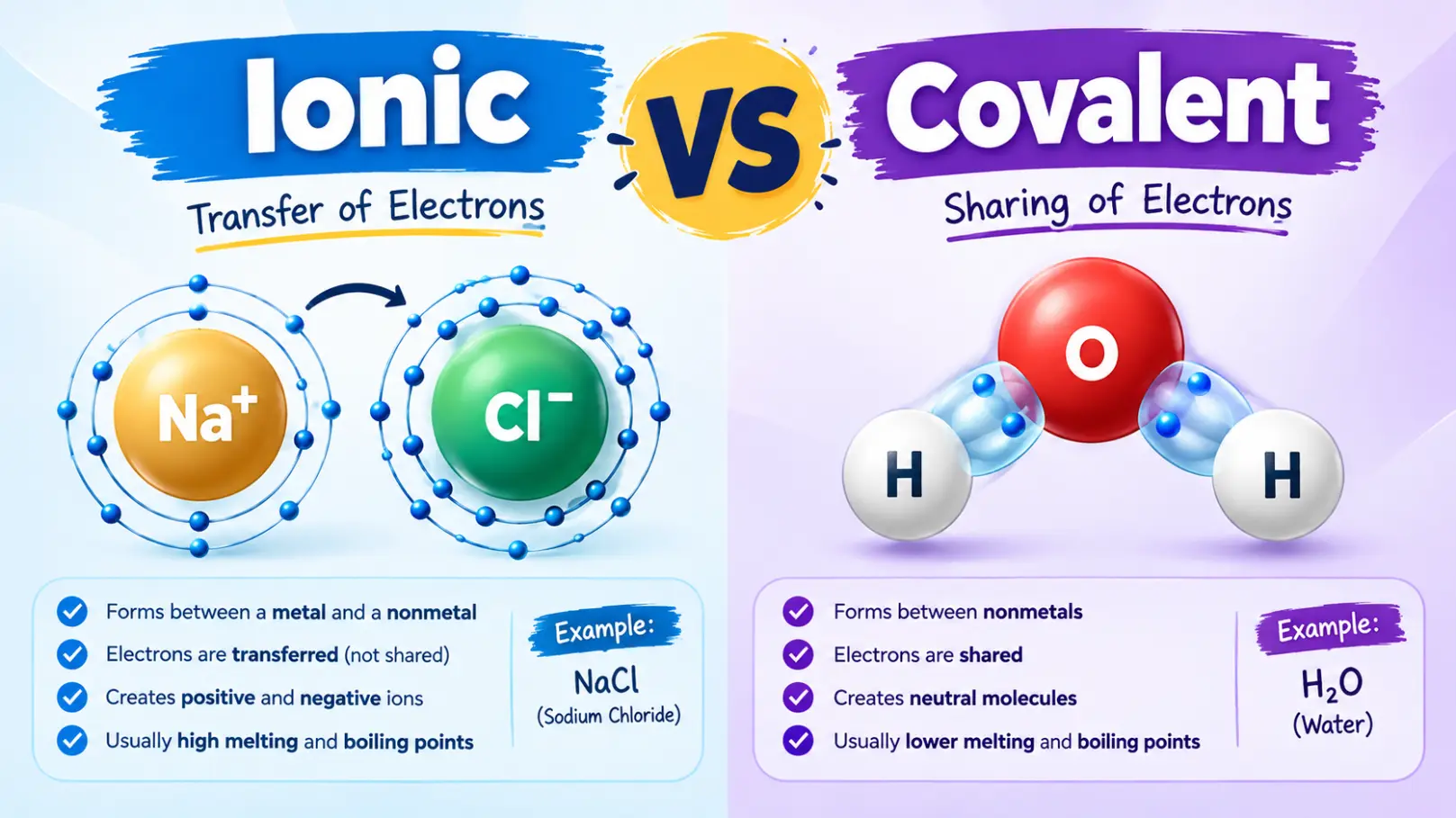
Ionic vs covalent bonds differ mainly in how electrons behave. Ionic bonds form when electrons are transferred from one atom to another, creating oppositely charged ions that attract each other.
Covalent bonds form when atoms share electrons. Ionic bonding commonly occurs between metals and nonmetals, while covalent bonding is common between nonmetals.
Key Takeaways
- Ionic bonds transfer electrons and create positively and negatively charged ions.
- Covalent bonds share electrons between atoms.
- Ionic bonding commonly involves a metal and a nonmetal.
- Covalent bonding commonly occurs between nonmetals.
- Polar covalent bonds involve unequal sharing of electrons and fall between purely covalent and ionic bonding in character.
- NaCl is ionic, while H₂O and O₂ are covalent.
1. What Is an Ionic Bond?
An ionic bond is a chemical bond formed through the transfer of one or more electrons from one atom to another. This electron transfer creates charged particles called ions.
The atom that loses electrons becomes a positively charged cation, while the atom that gains electrons becomes a negatively charged anion. The attraction between these opposite charges creates the ionic bond.
Ionic bonding commonly occurs between a metal and a nonmetal because metals generally tend to lose valence electrons, while nonmetals tend to gain them.
How Ionic Bonds Form
Consider sodium chloride (NaCl).
Sodium has one valence electron that it can lose relatively easily. Chlorine needs one additional electron to complete its outer electron shell.
When sodium transfers an electron to chlorine:
- Sodium becomes Na⁺.
- Chlorine becomes Cl⁻.
- The opposite charges attract.
- The resulting compound is NaCl.
Ionic compounds are generally arranged as repeating structures called crystal lattices, rather than as separate molecules like many covalent substances.
Ionic Bond Example
Common examples of ionic compounds include:
- NaCl – sodium chloride
- MgCl₂ – magnesium chloride
- CaO – calcium oxide
- KBr – potassium bromide
The exact ratio of ions depends on the charges of the ions involved. For example, magnesium forms Mg²⁺ while chlorine forms Cl⁻, so two chloride ions are needed to balance one magnesium ion in MgCl₂.
2. What Is a Covalent Bond?
A covalent bond forms when atoms share electrons rather than transferring them completely from one atom to another.
Covalent bonding is especially common between nonmetal atoms. Because the atoms have relatively similar tendencies to attract electrons, neither atom completely takes control of the shared electrons.
The shared electrons help hold the atoms together and can allow each atom to reach a more stable electron arrangement.
How Covalent Bonds Form
Consider hydrogen gas (H₂).
Each hydrogen atom has one electron and needs another electron to fill its first electron shell. The two hydrogen atoms share their electrons.
The shared pair forms a covalent bond:
H-H
Covalent bonds can involve different numbers of shared electron pairs.
- Single bond: one shared pair
- Double bond: two shared pairs
- Triple bond: three shared pairs
For example:
- H₂ contains a single covalent bond.
- O₂ contains a double covalent bond.
- N₂ contains a triple covalent bond.
Covalent Bond Examples
Common covalent substances include:
- H₂O – water
- CO₂ – carbon dioxide
- CH₄ – methane
- O₂ – oxygen
- N₂ – nitrogen
Many covalent substances exist as individual molecules, although some covalent substances form large network structures instead.
3. Ionic vs Covalent: Key Differences
The easiest way to understand ionic vs covalent bonding is to focus on what happens to the electrons.
| Feature | Ionic Bond | Covalent Bond |
|---|---|---|
| Electron behavior | Electrons are transferred | Electrons are shared |
| Common atoms | Metal + nonmetal | Nonmetal + nonmetal |
| Charged ions formed? | Yes | Usually no |
| Typical structure | Crystal lattice | Molecules or networks |
| Example | NaCl | H₂O |
| Electronegativity difference | Generally larger | Generally smaller |
| Electrical conductivity | Often conducts when molten or dissolved | Usually poor as a molecular substance |
| Typical physical form | Many are crystalline solids | May be solids, liquids, or gases |
Ionic compounds have strong electrostatic attractions between their ions. As a result, many ionic solids have relatively high melting and boiling points and are rigid and brittle.
Covalent substances have different properties depending on their molecular structure and intermolecular forces. Many molecular covalent substances have lower melting and boiling points than typical ionic compounds.
Electron Behavior
The biggest difference is simple:
Ionic = transfer
Covalent = sharing
This distinction is useful when solving introductory chemistry problems.
For example:
Na → Cl
An electron is transferred, producing Na⁺ and Cl⁻.
By contrast:
H-H
The electrons are shared between the two hydrogen atoms.
4. How to Tell If a Bond Is Ionic or Covalent
A quick method is to look at the types of elements involved.
Metal and Nonmetal
A compound made from a metal and a nonmetal is often ionic.
Examples include:
- NaCl
- MgO
- CaCl₂
- KBr
The metal generally forms the cation, while the nonmetal forms the anion.
Nonmetal and Nonmetal
A bond between two nonmetals is generally covalent.
Examples include:
- H₂O
- CO₂
- CH₄
- SO₂
- O₂
However, this is a general rule rather than an absolute one. Chemistry contains exceptions, so the elements involved and their electronegativities should be considered together.
Using Electronegativity
Electronegativity describes how strongly an atom attracts electrons in a chemical bond.
As the difference in electronegativity between two atoms increases, the bond tends to have more ionic character. When atoms have similar electronegativities, electron sharing is more characteristic of covalent bonding.
There is no universal cutoff that perfectly classifies every chemical bond. Bonding is better understood as a continuum, with nonpolar covalent, polar covalent, and ionic character representing different regions of that continuum.
5. Polar Covalent Bonds: The Middle Ground
Not every covalent bond shares electrons equally.
A polar covalent bond occurs when two atoms share electrons unequally because one atom attracts the shared electrons more strongly.
For example, in H₂O, oxygen attracts the shared electrons more strongly than hydrogen. This creates partial charges within the O-H bonds.
This is different from a fully ionic bond because the electrons are still being shared rather than completely transferred.
A useful way to picture bonding is:
Nonpolar covalent → Polar covalent → Ionic
The boundaries are not perfectly sharp. Real chemical bonding can have characteristics of more than one simplified category.
6. Ionic vs Covalent Examples
Here are several common examples to make the difference easier to recognize:
| Compound | Elements Involved | Bond Type | Why? |
|---|---|---|---|
| NaCl | Sodium + chlorine | Ionic | Electron transfer produces Na⁺ and Cl⁻ |
| MgCl₂ | Magnesium + chlorine | Ionic | Metal transfers electrons to nonmetal |
| CaO | Calcium + oxygen | Ionic | Oppositely charged ions form |
| H₂O | Hydrogen + oxygen | Covalent | Nonmetals share electrons |
| CO₂ | Carbon + oxygen | Covalent | Electrons are shared |
| CH₄ | Carbon + hydrogen | Covalent | Atoms form shared-electron bonds |
| O₂ | Oxygen + oxygen | Nonpolar covalent | Identical atoms share electrons equally |
| N₂ | Nitrogen + nitrogen | Nonpolar covalent | Identical atoms share electrons equally |
One important detail is that some compounds contain both ionic and covalent bonding.
For example, potassium nitrate (KNO₃) contains an ionic attraction between K⁺ and NO₃⁻, while the nitrogen and oxygen atoms inside the nitrate ion are connected by covalent bonds.
7. Common Questions About Ionic and Covalent Bonds
Is NaCl Ionic or Covalent?
NaCl is an ionic compound. Sodium transfers an electron to chlorine, forming Na⁺ and Cl⁻. The electrostatic attraction between these oppositely charged ions produces the ionic structure of sodium chloride.
Is H₂O Ionic or Covalent?
H₂O is a covalent compound. Hydrogen and oxygen are nonmetals that share electrons. However, the O-H bonds are polar covalent because oxygen attracts the shared electrons more strongly than hydrogen.
Which Bond Is Stronger: Ionic or Covalent?
It is not accurate to say that one type is always stronger in every situation. The strength of a chemical bond depends on the atoms, structure, environment, and type of bonding involved.
For introductory chemistry, it is more useful to remember that ionic compounds are held together by electrostatic attractions between ions, while covalent bonds involve shared electron pairs.
Can a Compound Have Both Ionic and Covalent Bonds?
Yes. Polyatomic ionic compounds can contain both types.
In KNO₃, for example, the potassium ion and nitrate ion have an ionic attraction, while the atoms within the nitrate ion are connected through covalent bonding.
8. FAQ
What is the easiest way to remember ionic vs covalent?
Remember “ionic = transfer” and “covalent = share.” Ionic bonding commonly involves a metal transferring electrons to a nonmetal. Covalent bonding commonly involves nonmetals sharing electrons.
Are ionic compounds always made of metals and nonmetals?
Many ionic compounds contain a metal cation and a nonmetal anion, but ionic compounds can also contain polyatomic ions. For example, KNO₃ contains K⁺ and NO₃⁻. The nitrate ion itself contains covalent bonds.
Are covalent bonds always between two nonmetals?
Covalent bonds are most commonly associated with nonmetal atoms, but the simple metal/nonmetal rule has exceptions. Bonding is better understood by considering electron sharing, electronegativity, and the structure of the substance.
Why do ionic compounds conduct electricity?
Ionic compounds contain charged ions. In a solid crystal, those ions are largely fixed in place, so the solid generally does not conduct electricity well. When an ionic compound is melted or dissolved under suitable conditions, its ions can move and carry electrical charge.
What is the main difference between ionic and covalent compounds?
The main difference is how their atoms achieve bonding. Ionic compounds involve attraction between oppositely charged ions produced by electron transfer, while covalent compounds involve atoms sharing electrons.
Conclusion
Understanding ionic vs covalent bonding becomes much easier when you focus on the electrons.
In ionic bonding, electrons are transferred from one atom to another, producing positive and negative ions that attract each other. In covalent bonding, atoms share electrons to form a bond.
As a quick guide, a metal and nonmetal often form an ionic compound, while two nonmetals commonly form covalent bonds.
However, electronegativity and molecular structure provide a more complete picture because bonding exists along a spectrum rather than in perfectly separated categories.
Examples make the distinction clearer: NaCl is ionic, H₂O is polar covalent, and O₂ is nonpolar covalent. Some substances, such as KNO₃, even contain both ionic and covalent bonding.
Once you remember transfer versus sharing, along with the role of electronegativity, you can identify many common ionic and covalent bonds much more confidently.