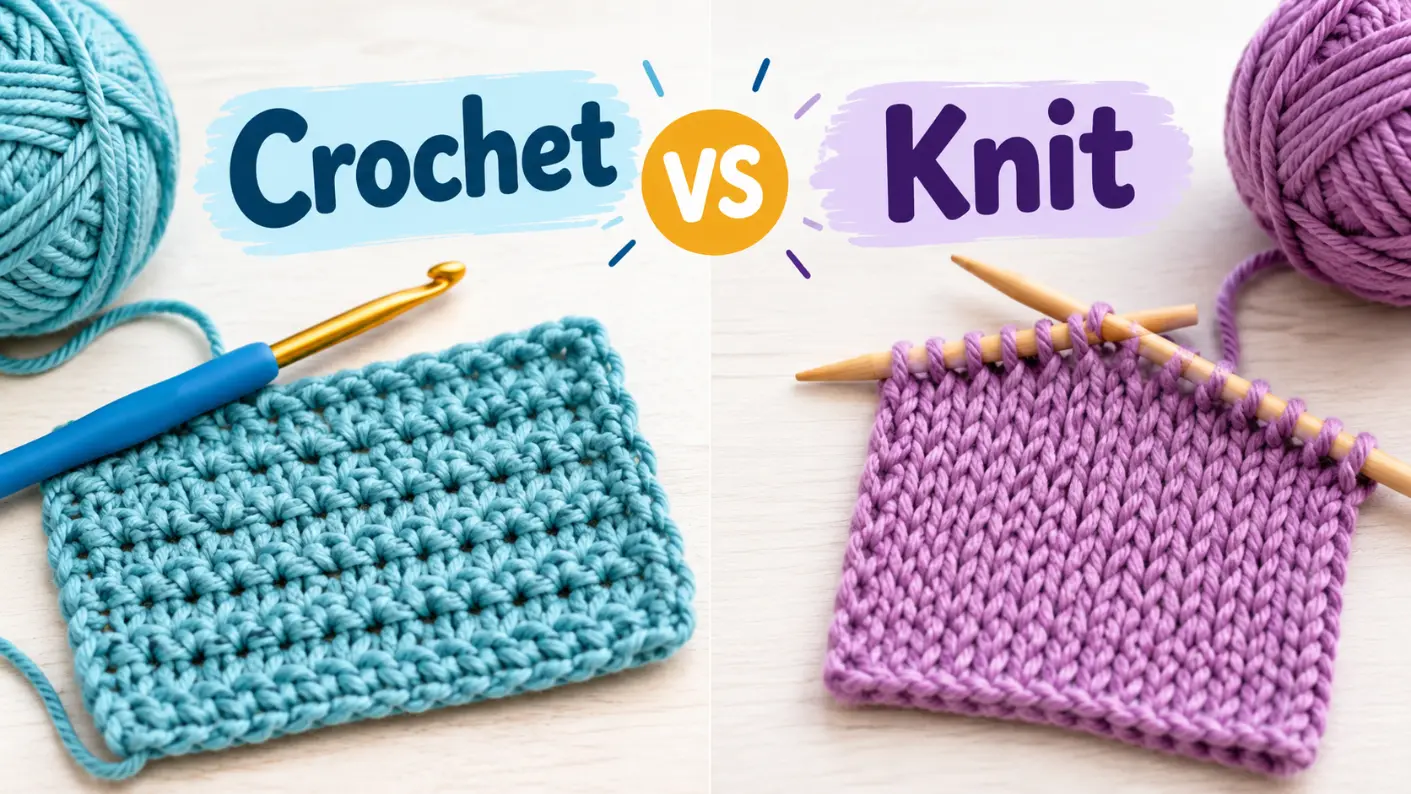
Crochet and knitting both use yarn to create fabric, but they work differently. Crochet uses one hook and generally one active loop at a time, while knitting uses two needles and multiple live stitches.
Crochet often feels easier for beginners and can be quicker for some projects, while knitting usually creates stretchier, more drapey fabric that works especially well for sweaters, socks, and fitted garments.
Key Takeaways
- Crochet uses one hook, while knitting typically uses two needles.
- Crochet is often easier for beginners because fewer live stitches need to be managed at once.
- Knitting usually creates stretchier, more flexible fabric with greater drape.
- Crochet is excellent for blankets, amigurumi, bags, granny squares, and structured projects.
- Knitting is especially popular for sweaters, socks, cardigans, and lightweight garments.
- Neither craft is universally better-the best choice depends on what you want to make.
1. Crochet vs Knit: What’s the Difference?
At first glance, crochet and knitting can look almost identical. Both use yarn, both create fabric from loops, and both can produce clothing, accessories, blankets, and home décor.
The biggest difference is how those loops are created and managed.
How Crochet Works
Crochet is worked with a single crochet hook. You generally work with one active loop on the hook and pull yarn through existing stitches to create new ones.
Because completed stitches are usually secured as you work, the fabric can feel relatively stable while you are making it.
Crochet can be worked back and forth in rows or continuously in rounds. This makes it especially useful for projects that require shaping, motifs, borders, or three-dimensional forms.
How Knitting Works
Knitting generally uses two needles. Multiple live stitches remain on the needles while you work across a row.
The two basic knitting stitches are the knit stitch and purl stitch. By combining them with other techniques, knitters can create many textures, patterns, cables, colorwork designs, and types of fabric.
Circular needles can also be used when knitting in the round.
In simple terms:
Crochet = one hook + generally one active loop.
Knitting = two needles + multiple live stitches.
That basic difference affects almost everything else.
2. Crochet vs Knitting: Side-by-Side Comparison
| Feature | Crochet | Knitting |
|---|---|---|
| Main tool | One crochet hook | Two needles or circular needles |
| Active stitches | Generally one active loop | Multiple live stitches |
| Learning curve | Often easier initially | May require more coordination |
| Mistake recovery | Usually more forgiving | Dropped stitches can be more challenging |
| Fabric | Often thicker and more structured | Often thinner, stretchier, and drapier |
| Texture | Strong textures are easy to create | Smooth and detailed textures are possible |
| Garments | Excellent for many styles | Particularly strong for fitted garments |
| Amigurumi | Excellent choice | Possible, but less commonly used |
| Blankets | Excellent choice | Also works very well |
| Socks | Possible | Particularly well suited |
| Yarn use | Often higher for the same area | Often lower, depending on stitch |
| Best choice | Depends on the project | Depends on the project |
There is no universal winner. Even yarn consumption can change significantly depending on the stitch pattern, tension, yarn weight, and finished dimensions. An Interweave experiment, for example, found substantial differences among specific knit and crochet stitches rather than one fixed ratio that applies to every project.
3. Is Crochet Easier Than Knitting?
For many beginners, crochet feels easier to learn at first.
The main reason is the number of active stitches you need to control. With crochet, you generally have one active loop on the hook. With knitting, you need to keep track of multiple live stitches on the needles.
If you accidentally make a mistake in crochet, you can often pull the work back to the problem area and continue.
Knitting mistakes can require more attention because a dropped stitch may travel down several rows if it is not caught.
However, “easier” is personal.
Someone who enjoys the rhythm of knitting may find knitting more natural. Another beginner may prefer the single-hook movement of crochet.
The Craft Yarn Council also emphasizes that both crafts have beginner-level techniques and encourages learners to explore both rather than treating one as universally superior.
Bottom line: If you have never worked with yarn before, crochet is often a comfortable starting point-but that does not mean knitting is difficult.
4. Which Is Faster: Crochet or Knitting?
Crochet is often faster for certain projects, but there is no universal speed winner.
Crochet stitches can cover more area, particularly when using taller stitches such as double crochet. This can make some blankets, accessories, and larger projects progress quickly.
Knitting can also become extremely fast once you develop consistent tension and muscle memory.
The stitch pattern matters enormously. A simple knit stitch can be faster than a complicated crochet stitch, while a large crochet stitch may work up faster than a dense knitted pattern.
So instead of asking:
“Which craft is always faster?”
A better question is:
“Which technique is faster for the specific project I want to make?”
For a beginner making a chunky blanket, crochet may provide faster visible progress. For a fine-gauge garment, knitting may be a better fit.
5. Which Uses More Yarn?
Crochet often uses more yarn than knitting for comparable pieces, but the exact amount depends on the stitch and construction.
Crochet creates a particular type of loop structure that can require more yarn to cover the same area. Dense crochet stitches can be especially yarn-hungry.
However, you should not rely on a simple rule such as “crochet always uses 30% more yarn.”
Different stitches can produce very different results. Interweave’s yarn-use experiment demonstrated noticeable differences not only between crochet and knitting but also among individual crochet and knitting stitches.
If you’re making a large project such as a blanket, always check the pattern’s recommended yardage rather than estimating based only on whether it is crochet or knit.
6. How the Finished Fabric Differs
The finished fabric is one of the most important reasons to choose one craft over the other.
Crochet Fabric
Crochet commonly produces fabric that is:
- More structured
- Thicker
- Textured
- Good at holding its shape
- Excellent for three-dimensional projects
But crochet is not limited to thick or stiff fabric. Fine yarn, delicate stitches, and open patterns can create lightweight and drapey crochet fabrics too. The Craft Yarn Council notes that yarn choice and stitch combinations can produce a wide range of crochet fabrics.
Knitted Fabric
Knitting is especially known for fabric that is:
- Stretchy
- Flexible
- Smooth
- Drapey
- Comfortable for fitted garments
This is one reason knitting has traditionally been popular for sweaters and other clothing.
The difference is not simply about appearance. Fabric behavior matters when a project needs to stretch, conform to the body, or hang softly.
7. Which Craft Is Better for Different Projects?
Your project is probably the best way to decide between crochet and knitting.
Blankets
Crochet: Excellent choice.
Crochet blankets can build quickly, especially with larger stitches or granny squares. The structured fabric can also create a cozy, substantial feel.
Knitting: Also excellent.
Knitted blankets tend to have a softer, more flexible drape.
Winner: It depends on whether you prefer structure and texture or softer drape.
Sweaters and Cardigans
Knitting: Often the better starting choice.
Knitted fabric’s stretch and drape make it especially useful for fitted clothing.
Crochet can absolutely be used for sweaters and cardigans, particularly when a textured or more structured appearance is desired.
Socks
Knitting: Usually the more natural choice.
Socks benefit from stretch and a relatively thin fabric that fits comfortably inside shoes.
Crochet socks are possible, but knitting is more traditionally suited to this type of project.
Amigurumi
Crochet: The clear choice for most beginners.
Crochet is particularly useful for creating small stuffed animals, figures, and other three-dimensional objects.
The dense fabric can help create a firm exterior around stuffing.
Bags and Home Décor
Crochet: Often an excellent choice.
Crochet works well when you want structure, texture, and decorative stitch patterns. Bags, baskets, coasters, potholders, and similar projects are popular applications.
Scarves and Hats
Either can work.
Choose knitting if you want a soft, stretchy scarf with plenty of drape.
Choose crochet if you want more texture, structure, or a project that works up quickly.
8. Which Should Beginners Learn First?
If you’re completely undecided, crochet is often the easier place to start.
A single hook and generally one active loop can make the first learning steps feel more manageable. You can begin with basic techniques such as the chain stitch and single crochet before progressing to more advanced patterns. The Craft Yarn Council recommends basic stitches and practice swatches as part of learning crochet.
But your desired project should matter more than the idea that one craft is easier.
Choose crochet first if you want to make:
- Amigurumi
- Granny squares
- Blankets
- Bags
- Baskets
- Textured accessories
- Quick beginner projects
Choose knitting first if your main goals are:
- Sweaters
- Cardigans
- Socks
- Stretchy scarves
- Lightweight garments
- Soft, drapey fabric
The best beginner craft is the one that keeps you interested enough to practice.
9. Can You Learn Both Crochet and Knitting?
Absolutely.
In fact, learning one can make it easier to understand the basic concepts behind the other. Both crafts teach you about yarn, tension, gauge, patterns, stitch structure, and how fabric is constructed.
You also do not need separate yarn stashes for every craft. Many yarns can be used for both crochet and knitting, although the recommended hook or needle size and the finished fabric may differ.
Some crafters eventually use both depending on the project.
For example, someone might knit a sweater but use crochet to create a decorative border. Others may crochet blankets and amigurumi while knitting socks and clothing.
There is no requirement to choose only one.
10. Frequently Asked Questions
Is crochet easier than knitting?
For many beginners, yes. Crochet generally requires managing one active loop at a time, while knitting keeps multiple live stitches on the needles. However, individual learning styles vary, so the craft that feels easier depends on the person.
Is crochet faster than knitting?
Often, but not always. Crochet can work up quickly with taller stitches, while knitting speed depends heavily on stitch type, yarn weight, tension, and experience. A simple knitting pattern can be faster than a complicated crochet pattern.
Can you use the same yarn for crochet and knitting?
Yes. Most yarn can be used for either craft. What changes is the hook or needle size, stitch structure, gauge, and finished fabric. Always check the pattern instructions because the same yarn can behave very differently in crochet and knitting.
Which is better for sweaters?
Knitting is often the better choice when you want a stretchy, lightweight, drapey sweater. Crochet can also produce attractive sweaters, especially when you want texture or a more structured design.
Which is better for blankets?
Both are excellent. Crochet is a popular choice when you want texture, granny squares, or relatively quick progress. Knitting is a good option when you prefer soft, flexible fabric with more drape.
Conclusion
The biggest difference in crochet vs knit comes down to how stitches are formed and managed.
Crochet generally uses one hook and one active loop, while knitting uses two needles and multiple live stitches.
For many beginners, crochet offers a gentler starting point. It is particularly useful for blankets, amigurumi, bags, granny squares, and textured projects. Knitting shines when you want stretchy, drapey fabric for sweaters, socks, cardigans, and other fitted garments.
But neither craft is objectively better.
If you already know what you want to make, let the project decide. If you simply want the easiest introduction to yarn crafting, crochet is a practical place to begin. And once you’re comfortable, learning the other craft can give you even more creative options.