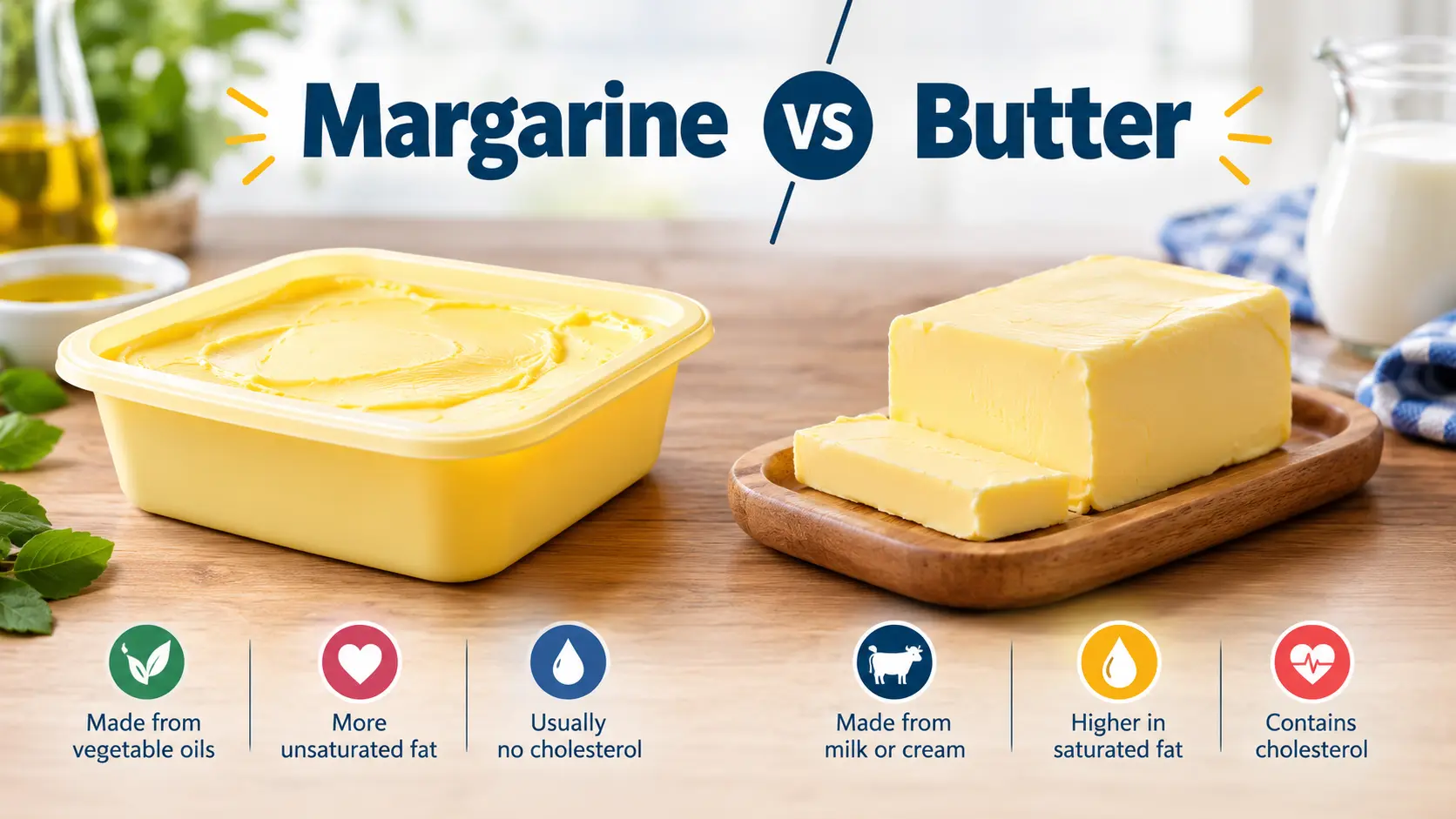
Margarine and butter differ mainly in their sources and types of fat. Butter is made from milk or cream and is relatively high in saturated fat.
Margarine is generally made from vegetable oils and can contain more unsaturated fat. For heart health, a soft margarine made primarily from unsaturated oils and with no partially hydrogenated oils is generally a better choice than butter.
Key Takeaways
- Butter is a dairy product and contains a relatively high proportion of saturated fat.
- Margarine is made primarily from vegetable oils, but different products can have very different fat profiles.
- Modern U.S. margarines generally do not contain added partially hydrogenated oils, the major historical source of artificial trans fat.
- Replacing saturated fat with unsaturated fat can be beneficial for heart health.
- For everyday use, look for a soft or tub spread made with unsaturated vegetable oils, while keeping portions reasonable.
1. What Is the Difference Between Margarine and Butter?
At first glance, butter and margarine seem almost identical. Both can be spread on toast, added to vegetables, used for cooking, or included in baked goods.
The biggest difference is where they come from.
Butter
Butter is made from cream or milk. Because it comes from dairy, its fat is predominantly saturated fat. Harvard’s nutrition guidance lists butter as a concentrated source of saturated fat.
Butter also contains naturally occurring cholesterol and small amounts of naturally occurring trans fat from dairy fat.
Its biggest advantages are often practical: a rich flavor, familiar texture, and useful performance in many baking recipes.
Margarine
Margarine is generally made from vegetable oils. Manufacturers process and blend oils to create a spreadable product with a texture similar to butter.
The nutritional profile depends heavily on the oils and formulation used. Some margarines contain considerably more unsaturated fat than butter, while others can contain more saturated fat or sodium.
That means simply asking whether “margarine” is healthy does not tell the whole story.
Key Takeaway: The specific margarine matters. Check its Nutrition Facts panel and ingredient list rather than judging every margarine by the same standard.
2. Margarine vs Butter: Nutrition and Fat
The most important nutritional difference is the type of fat.
Butter is relatively high in saturated fat. Harvard’s comparison of common fats shows butter containing about 60% saturated fat as a percentage of its total fat. Some older margarines, meanwhile, contained substantial trans fat because they were made with partially hydrogenated oils. Modern formulations can be very different.
| Feature | Butter | Margarine |
|---|---|---|
| Main source | Milk or cream | Vegetable oils |
| Saturated fat | Relatively high | Varies by product |
| Unsaturated fat | Lower | Often higher |
| Trans fat | Small naturally occurring amount | Modern U.S. products generally have no added PHOs |
| Cholesterol | Contains cholesterol | Usually little or none |
| Flavor | Rich, dairy flavor | Varies by product |
| Best use | Baking, flavor, spreading | Spreading, cooking, some baking |
The table illustrates why there is no single answer for every brand. A soft tub margarine based on canola, soybean, or similar oils can have a very different fat profile from a firm stick spread.
3. Which Is Better for Heart Health?
For heart health, the important question isn’t simply “butter or margarine?”
It’s what type of fat are you replacing, and what is replacing it?
Saturated Fat
Butter contains a substantial amount of saturated fat. Diets higher in saturated fat can raise LDL cholesterol, particularly when saturated fat replaces unsaturated fat. Harvard’s nutrition guidance emphasizes replacing saturated fat with healthier unsaturated fats rather than simply replacing it with refined carbohydrates.
The American Heart Association also recommends choosing foods and cooking fats that are higher in unsaturated fats and lower in saturated and trans fats.
Unsaturated Fat
Unsaturated fats include monounsaturated and polyunsaturated fats.
Many vegetable oils used in margarines provide these types of fat. When unsaturated fats replace saturated fats in the diet, they can help lower LDL cholesterol and support cardiovascular health.
This is one reason a properly formulated soft margarine can have a nutritional advantage over butter.
Trans Fat
Trans fat is another important part of the story.
Artificial trans fats were historically common in some margarines because manufacturers used partially hydrogenated oils (PHOs) to turn liquid oils into more solid fats.
The FDA determined that PHOs were not generally recognized as safe and took regulatory action to remove them from the U.S. food supply.
So the old idea that all margarine is automatically high in trans fat does not accurately describe modern U.S. margarine.
4. Is Margarine Still High in Trans Fat?
Generally, modern U.S. margarine is not made with added partially hydrogenated oils.
The FDA explains that partially hydrogenated oils were the primary dietary source of artificial trans fat in processed foods. Most uses of PHOs were prohibited beginning in 2018, with remaining transition periods extending for certain products.
However, it’s still smart to read the label.
Look at:
- Trans Fat on the Nutrition Facts label
- The ingredient list
- Whether the product contains partially hydrogenated oil
- The amount of saturated fat
- The primary oils used
The FDA notes that trans fat can still occur naturally in small amounts in meat and dairy products.
Important: Don’t judge a modern margarine using outdated assumptions about the trans-fat-heavy margarines of decades ago.
5. Butter vs Margarine for Cholesterol
If you’re concerned about cholesterol, the type of fat becomes especially relevant.
Butter contains saturated fat, and replacing saturated fat with unsaturated fat can help lower LDL cholesterol. Mayo Clinic notes that margarines made primarily from unsaturated oils often compare favorably with butter from a heart-health perspective.
However, not every margarine has the same formulation.
A soft margarine made largely from unsaturated vegetable oils may be quite different from a product that contains more saturated fat.
This is why the best approach is to compare the actual labels rather than choosing a product based only on its name.
If you have been advised to manage your cholesterol, pay particular attention to saturated fat per serving and the type of oils used.
6. Which Is Better for Cooking and Baking?
Health isn’t the only reason people compare butter and margarine. Their performance in the kitchen also matters.
Cooking
For everyday cooking, liquid vegetable oils such as olive, canola, soybean, sunflower, or similar nontropical oils can provide more unsaturated fat than solid fats such as butter. The American Heart Association specifically recommends nontropical vegetable oils as healthier choices than solid fats.
A soft margarine can also work well when a spreadable or buttery-style fat is needed.
Baking
Butter is popular in baking because it contributes:
- Rich flavor
- Tenderness
- Browning
- A characteristic texture
Margarine can work in many recipes, but results depend on its water and fat content.
If you’re replacing butter in a recipe, check the product instructions. Some spreads are designed specifically for baking, while others contain more water and may produce different results.
Spreading
For toast, sandwiches, or vegetables, a soft tub margarine made with unsaturated vegetable oils can be a practical alternative to butter.
It spreads easily and can provide less saturated fat than butter, depending on the product.
7. How to Choose a Healthier Margarine
If you prefer margarine, don’t stop at the word “margarine” on the front of the package.
Check the back label.
1. Look for More Unsaturated Fat
Products made primarily from vegetable oils such as canola, soybean, sunflower, or similar oils can provide more unsaturated fat.
2. Keep Saturated Fat Lower
Compare the saturated-fat amount with other spreads.
The American Heart Association recommends choosing oils and fats that contain less saturated fat and no partially hydrogenated oils.
3. Avoid Partially Hydrogenated Oils
The FDA has taken action to eliminate PHOs as a major source of artificial trans fat in the U.S. food supply, but checking the ingredient list is still a useful habit.
4. Consider Sodium
Some spreads contain more sodium than others.
If you use a spread frequently, compare sodium amounts between products.
5. Choose the Right Texture
For spreading, a soft tub product may be more practical.
For baking, use a product designed for baking if the recipe calls for it.
Tip: The Nutrition Facts label is more useful than the words “butter” or “margarine” alone.
8. So, Which Should You Choose?
For most people, the answer depends on how the product fits into the overall diet.
If you enjoy butter, you don’t necessarily need to eliminate it. Using a modest amount can provide the flavor and cooking characteristics you want.
However, if your goal is to reduce saturated fat and replace it with unsaturated fat, a soft margarine made primarily from unsaturated vegetable oils can be a better fit than butter. Mayo Clinic and the American Heart Association both emphasize the value of replacing saturated fats with unsaturated fats.
There is also a third option worth considering: liquid vegetable oils.
Olive and canola oils, for example, are generally higher in unsaturated fats and lower in saturated fat than butter.
So the practical choice isn’t necessarily about finding one food that is universally “good” or “bad.” It’s about choosing the type of fat that best fits your dietary needs and using it in reasonable amounts.
9. Frequently Asked Questions
Is margarine healthier than butter?
Some margarines are a healthier choice than butter from a heart-health perspective, particularly soft margarines made primarily with unsaturated vegetable oils and without partially hydrogenated oils. However, margarines vary considerably, so the Nutrition Facts panel matters. Butter is relatively high in saturated fat.
Is butter or margarine better for cholesterol?
A margarine that is higher in unsaturated fat and lower in saturated fat may be preferable to butter for people trying to reduce LDL cholesterol. The benefit comes from replacing saturated fat with unsaturated fat, not simply from choosing a product labeled “margarine.”
Does margarine still contain trans fat?
Modern U.S. margarines generally do not contain added partially hydrogenated oils, which were the major source of artificial trans fat in processed foods. The FDA took regulatory action against PHOs. Always check the product label and ingredient list.
Can you substitute margarine for butter?
Often, yes, but the result can vary depending on the recipe and the type of margarine. Baking recipes can be particularly sensitive to differences in fat and water content. For best results, use a margarine intended for baking when replacing butter in baked goods.
What is the healthiest spread?
There is no single spread that is best for everyone. For heart health, look for options that are lower in saturated fat, contain no partially hydrogenated oils, and provide more unsaturated fat. Soft margarines made with healthy vegetable oils can fit this approach.
Conclusion
When comparing margarine vs butter, the most important difference is the type of fat each product provides.
Butter is made from dairy and is relatively high in saturated fat, while margarine is generally made from vegetable oils and can provide considerably more unsaturated fat.
Older concerns about margarine often focused on partially hydrogenated oils and artificial trans fats. In the modern U.S. food supply, FDA action has greatly reduced this issue, so today’s margarines should be evaluated individually rather than treated like older formulations.
For everyday heart-conscious eating, compare labels and favor products that are lower in saturated fat and higher in unsaturated fat, while avoiding partially hydrogenated oils. And remember that liquid vegetable oils can also be a useful alternative to both butter and solid spreads.