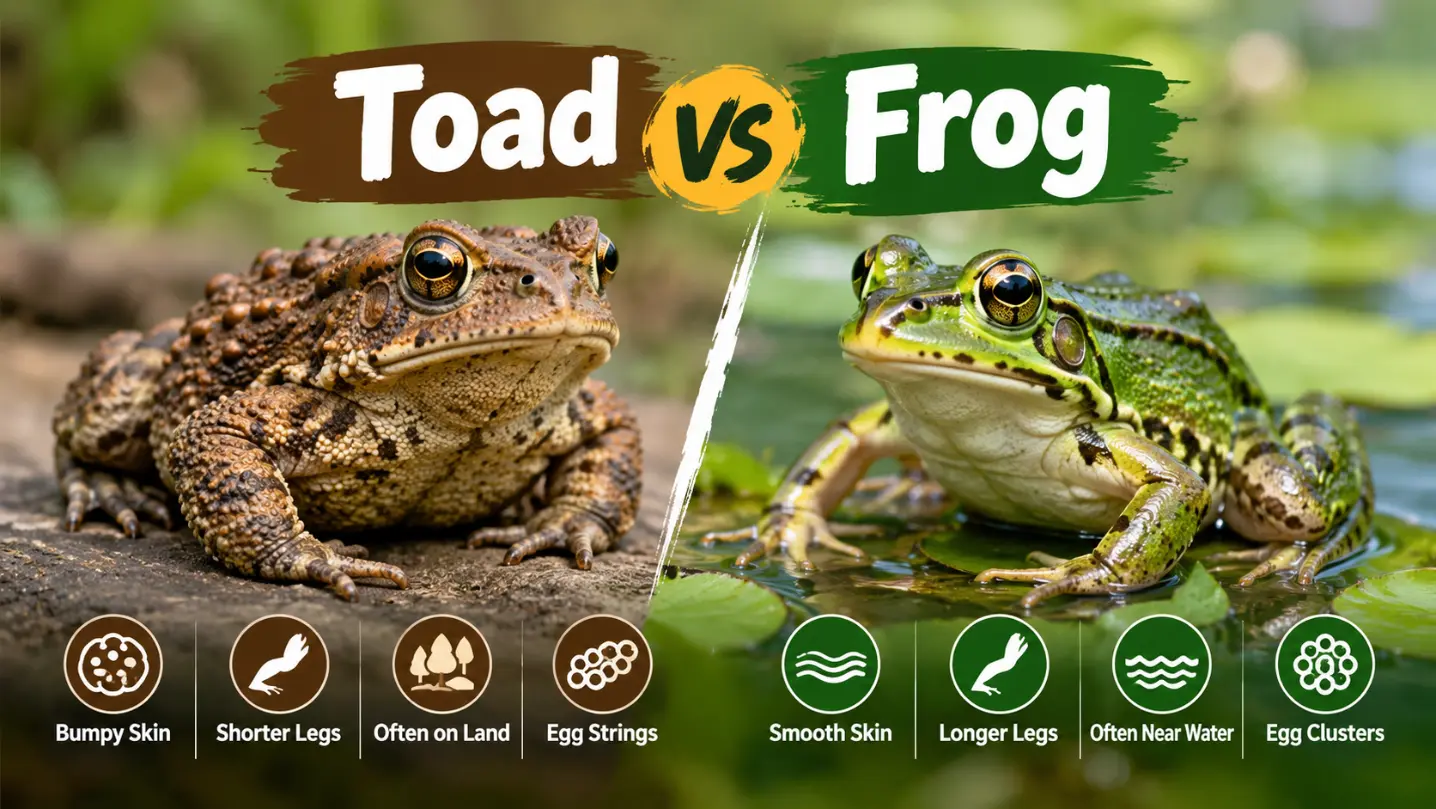
The main difference between a toad and a frog is their typical skin, body shape, legs, habitat, and movement.
Frogs generally have smooth, moist skin and long hind legs for jumping, while toads often have drier, bumpy skin, shorter legs, and spend more time on land. However, these are general patterns, not rules that apply to every species.
Key Takeaways
- Frogs and toads are both amphibians in the order Anura.
- Typical frogs have smooth, moist skin and longer hind legs.
- Typical toads have drier, bumpy skin and shorter legs.
- Frogs are often found in or near water, while many toads can live farther from water.
- Frogs commonly lay eggs in clusters, while true toads often lay eggs in strings.
- Not every animal called a frog or toad follows these typical characteristics.
What Is the Difference Between a Toad and a Frog?
At first glance, frogs and toads can look almost identical. Both are amphibians, both can hop, and both begin life as eggs that develop into aquatic young.
The easiest way to tell them apart is to look at several features together rather than relying on just one.
A typical frog has smooth, moist skin, long powerful hind legs, and a body adapted for jumping and swimming. A typical toad has drier, bumpier skin, a heavier body, and shorter legs that are better suited to crawling or short hops.
Quick Comparison Table
| Feature | Frog | Toad |
|---|---|---|
| Skin | Usually smooth and moist | Usually dry and bumpy |
| Body | Often slimmer | Often more stout |
| Hind legs | Long and powerful | Shorter |
| Movement | Large jumps | Short hops or crawling |
| Habitat | Often near water | Often on land and in drier areas |
| Feet | Many species have webbed feet | Usually less webbing |
| Eggs | Often laid in clusters | Often laid in strings |
| Defense | May flee by jumping or swimming | May use skin secretions and camouflage |
These characteristics are useful identification clues, but they are not absolute. There are unusual frog and toad species that do not match the typical appearance.
Toad vs Frog: Key Differences
Skin
Skin is one of the first things to examine.
Frogs typically have smooth, moist skin. Their skin contains mucus glands that help keep it wet. Because amphibian skin is important for water balance and can also play a role in breathing, many frogs are closely associated with moist environments.
Toads typically have drier, rougher, or bumpy-looking skin. Their skin is often covered with structures that give them the familiar “warty” appearance.
However, don’t use skin texture alone to identify an animal. Some animals commonly called toads have relatively smooth skin, while some frogs can have rough or unusual skin.
Legs and Movement
Look at the hind legs if the animal is moving.
Frogs commonly have long, strong hind legs that help them make large jumps. They may also use these legs for swimming and escaping predators.
Toads generally have shorter, sturdier legs. Instead of making long leaps, many toads walk, crawl, or make smaller hops.
So, if you see an amphibian making a surprisingly long jump, it may be a frog. If it moves with short hops or crawls across the ground, it may be a toad.
Habitat
Habitat can provide another useful clue.
Many frogs spend considerable time in or close to ponds, streams, lakes, marshes, or other moist environments. Their permeable skin makes them vulnerable to water loss, so moisture is important to many frog species.
Toads can often tolerate drier environments better. You may find them in gardens, yards, forests, and other terrestrial habitats, although they still need water for reproduction. Mississippi State University Extension notes that toads may use water for breeding without needing to remain near water to keep their skin moist.
This means finding an amphibian far from a pond does not automatically prove it is a toad. Habitat is one clue among several.
Feet and Toes
Feet can also help with identification.
Many frogs have webbing between their toes, particularly on their hind feet. Webbing can help species that spend substantial time swimming.
Toads generally have less extensive webbing and are more adapted to moving across land.
Some frogs also have specialized toe pads that help them climb. Tree frogs are a good example because their toe structures help them grip vegetation.
Eyes and Body Shape
Many typical frogs have relatively prominent or bulging eyes and a more streamlined body.
Toads often have a stockier, heavier appearance, with shorter legs and prominent glands behind the eyes.
Again, these are identification tendencies rather than strict rules. Species vary considerably in shape, color, eye structure, and body size.
Frog vs Toad Eggs and Reproduction
Frogs and toads both reproduce through eggs, but the arrangement of their eggs can provide another useful clue.
Frog Eggs
Many frogs lay eggs in clusters or masses surrounded by a jelly-like material. These egg masses are often attached to or found around aquatic vegetation or floating in water.
The eggs hatch into tadpoles, which later undergo metamorphosis and develop the features of adult amphibians.
Toad Eggs
True toads commonly lay eggs in long strings or chains rather than the rounded clusters often associated with frogs. These strings may be wrapped around aquatic plants or found in shallow water.
Egg arrangement can be especially helpful when you’re trying to identify breeding amphibians, but even this characteristic varies among species.
Key Takeaway: Egg clusters often suggest frogs, while long egg strings are commonly associated with true toads-but species exceptions exist.
Are Toads Poisonous?
This is one of the most common questions about the toad vs frog comparison.
Many true toads have parotoid glands located behind the eyes. These glands can release defensive substances that discourage predators. Some of these secretions can irritate the eyes or mouth of animals that come into contact with them.
Calling every toad simply “poisonous” can therefore be misleading. The chemical defenses and their effects vary between species.
Some frogs also produce toxic or irritating skin secretions. For example, certain poison frogs have highly potent toxins, showing that toxic skin defenses are not exclusive to animals commonly called toads.
Can Toads Give You Warts?
No. Toads do not give people warts.
The bumps on a toad’s skin are natural structures and are not human wart-causing viruses. The old belief probably developed because the texture of a toad’s skin resembles the appearance of warts.
It is still sensible to avoid touching your face or eyes after handling amphibians, and wash your hands afterward.
How to Tell a Frog From a Toad
If you encounter an amphibian outdoors, you can use this simple checklist.
A Simple Identification Checklist
1. Look at the skin.
Smooth and moist often points toward a frog. Dry and bumpy often points toward a toad.
2. Check the legs.
Long, powerful hind legs suggest a frog. Shorter legs suggest a toad.
3. Watch how it moves.
Large leaps are common among frogs. Short hops or crawling are more typical of toads.
4. Consider the habitat.
An amphibian in or beside a pond may be a frog. One found in a garden or dry terrestrial area may be a toad.
5. Look at the feet.
Webbed hind feet are common among many frogs, while toads generally have less extensive webbing.
6. If you see eggs, examine their arrangement.
Clusters often indicate frogs, while strings are common among true toads.
Using several clues together gives you a better identification than relying on color alone.
Why Identification Is Not Always Easy
Nature does not always follow the simple “smooth frog versus warty toad” rule.
Some animals called frogs have rough skin, while some animals called toads have smooth skin. The Smithsonian, for example, notes that Panamanian golden frogs are actually toads despite their smooth skin and common name.
There are also frogs that live in unusually dry environments and toads that spend significant time in water.
That’s why the safest approach is to consider skin, legs, feet, habitat, body shape, and behavior together.
Similarities Between Frogs and Toads
Despite their differences, frogs and toads have much in common.
Both are:
- Amphibians
- Members of the order Anura
- Vertebrates
- Cold-blooded animals
- Egg-laying animals
- Animals that generally begin life in an aquatic larval stage
- Important parts of many food webs
- Predators of insects and other small animals
Both can also help control populations of insects and other invertebrates. Their diets vary by species, but many frogs and toads eat insects, spiders, worms, and similar prey. Larger species can consume larger animals as well.
Are Toads Actually Frogs?
Scientifically, this question requires a little explanation.
True toads are frogs in the broad scientific sense because they belong to the order Anura. However, “toad” commonly refers to members of the family Bufonidae and some other animals given the common name toad.
So the simple statement “all toads are frogs, but not all frogs are toads” works as a broad explanation, especially when discussing true toads.
The names themselves are common names, so they do not always correspond neatly to one scientific family or evolutionary group.
Frequently Asked Questions
What is the easiest way to tell a frog from a toad?
Look at the skin and legs first. Frogs typically have smooth, moist skin and long hind legs, while toads commonly have dry, bumpy skin and shorter legs. Then consider movement and habitat. Because there are exceptions, using several characteristics together is more reliable than using one feature.
Do frogs and toads live in the same places?
They can. Both may use freshwater environments for reproduction, but many frogs spend more time in or near water, while numerous toads are comfortable living on land away from permanent water. Individual species can have very different habitat preferences.
Which jumps farther, a frog or a toad?
A typical frog can jump farther because its long, powerful hind legs are well suited to leaping. Many toads have shorter legs and tend to make smaller hops or crawl. However, jumping ability varies significantly among species.
Are toads dangerous to humans?
Most toads encountered by people are not a serious danger when left alone. Some true toads have defensive skin secretions that can irritate the eyes or mouth, so it’s best not to handle them unnecessarily. Wash your hands after touching an amphibian and avoid touching your eyes or mouth.
Can touching a toad cause warts?
No. The bumps on a toad’s skin do not cause human warts. This is a long-standing myth based largely on the toad’s rough, wart-like appearance.
Do frogs and toads both have tadpoles?
Yes. Both frogs and toads generally have aquatic young that develop through metamorphosis. Their eggs and tadpoles can differ in appearance and behavior depending on the species.
Conclusion
The easiest way to understand toad vs frog is to look for patterns rather than one perfect identifying feature.
Frogs typically have smooth, moist skin, long hind legs, and strong jumping ability, and many live in or close to water.
Toads generally have drier, bumpier skin, shorter legs, and a more terrestrial lifestyle. True toads may also have prominent parotoid glands that produce defensive secretions.
Their eggs can provide another clue: frogs often lay eggs in clusters, while true toads commonly lay them in strings.
Most importantly, these differences are general tendencies rather than strict rules. The huge variety of amphibians means some species break the usual pattern. When identifying one in the wild, consider its skin, legs, feet, movement, habitat, and other characteristics together.
Read More Articles