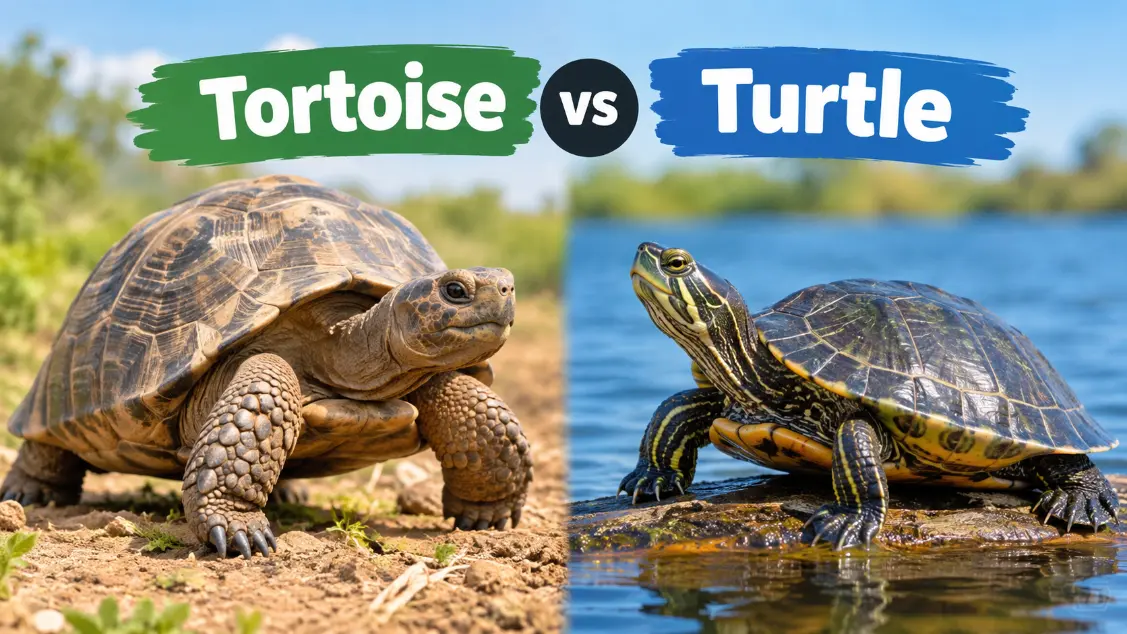
The main difference between a tortoise and a turtle is their adaptation to habitat.
Tortoises are land-dwelling turtles in the family Testudinidae, while the broader turtle group includes freshwater, semi-aquatic, and marine species.
Tortoises generally have domed shells and sturdy, column-like feet, while many aquatic turtles have flatter shells and webbed feet or flippers.
Key Takeaways
- All tortoises are turtles, but not all turtles are tortoises.
- Tortoises are primarily terrestrial, while many other turtles are aquatic or semi-aquatic.
- Tortoises usually have high, domed shells and sturdy feet designed for walking on land.
- Aquatic turtles commonly have flatter, more streamlined shells and webbed feet or flippers.
- Diet varies by species, but tortoises are generally herbivorous, while many turtles eat both plant and animal foods.
- Box turtles are turtles, not true tortoises, even though many live mostly on land.
1. Tortoise vs Turtle: What Is the Main Difference?
When comparing tortoise vs turtle, the first thing to understand is that these names do not describe two completely separate groups of reptiles.
Both belong to the order Testudines, the group of reptiles characterized by their distinctive shells. Tortoises are a particular family within this larger group: Testudinidae.
So, in simple terms:
A tortoise is a type of turtle, but a turtle is not necessarily a tortoise.
In everyday American English, however, people commonly use “turtle” for species that spend substantial time in or around water and “tortoise” for land-dwelling species.
That distinction is useful, but it is not a perfect rule. Some turtles are highly terrestrial, such as box turtles, while shell shape and habitat can vary considerably among species.
Are Tortoises Actually Turtles?
Yes. Scientifically, tortoises are part of the broader turtle group.
Tortoises belong to the family Testudinidae, whose members are adapted for life on land. Their anatomy reflects this lifestyle, including strong legs, sturdy feet, and shells suited to terrestrial movement.
The National Park Service and Animal Diversity Web both describe tortoises as terrestrial members of the turtle order.
Why the Names Cause Confusion
The confusion comes partly from everyday language.
People often see a shelled reptile and simply call it a turtle. That is reasonable in casual conversation, but “tortoise” is more specific.
There are also animals such as box turtles that spend much of their time on land but are not members of the tortoise family. This is why habitat alone cannot always determine an animal’s exact classification.
Tip: If you need a quick everyday distinction, think tortoise = land specialist and many turtles = water-associated. For exact identification, look at several features rather than just one.
2. Tortoise vs Turtle Comparison Table
| Feature | Tortoise | Many Aquatic Turtles |
|---|---|---|
| Main habitat | Land | Water or land and water |
| Scientific family | Testudinidae | Several different turtle families |
| Shell | Usually high and domed | Often flatter and streamlined |
| Feet | Sturdy, column-like feet | Often webbed or paddle-like |
| Swimming | Not adapted for sustained swimming | Generally well adapted to swimming |
| Diet | Usually mostly plant-based | Varies by species |
| Body design | Built for terrestrial movement | Often adapted for aquatic movement |
| Examples | Desert tortoise, Galápagos tortoise | Pond turtles, sliders, sea turtles |
These are general patterns, not absolute rules. Smithsonian notes that turtle shells are typically flatter than tortoise shells but also emphasizes that exceptions exist.
3. Habitat: Land vs Water
Habitat is one of the easiest ways to understand the tortoise vs turtle difference.
Where Tortoises Live
Tortoises are terrestrial, meaning they are adapted to living on land.
Different species occupy very different environments. Depending on the species, tortoises can live in deserts, grasslands, forests, scrublands, and other terrestrial habitats.
For example, desert tortoises have adaptations that help them survive hot, dry conditions. The National Park Service notes that desert tortoises can use burrows to escape extreme heat and dry-season conditions.
Their legs and feet are designed to support the body and shell while walking across land rather than propelling the animal through water.
Where Turtles Live
The word turtle covers a much wider range of lifestyles.
Many turtles are aquatic or semi-aquatic, spending substantial time in freshwater environments such as ponds, lakes, streams, and rivers. Sea turtles are adapted to marine environments.
Some species spend significant time on land, too. This is why saying “turtles live in water” is too broad.
The Smithsonian describes most turtles as aquatic or semi-aquatic while describing tortoises as land-dwelling.
Key Takeaway: Habitat is an excellent first clue, but it should not be the only feature used for identification.
4. Shell Differences
The shell is another useful clue when comparing a tortoise with a typical aquatic turtle.
Tortoise Shells
Tortoises generally have higher, more domed shells.
A domed shell provides strong protection and is well suited to a terrestrial lifestyle. The shape also contributes to the overall sturdy appearance associated with many tortoise species.
However, not every tortoise has an identical shell shape. The African pancake tortoise, for example, has an unusually flat and flexible shell compared with many other tortoises.
Turtle Shells
Many aquatic turtles have flatter, more streamlined shells.
A streamlined body can reduce resistance as the animal moves through water. Sea turtles are an especially clear example of aquatic adaptations.
But again, there are exceptions. Box turtles can have distinctly domed shells even though they are classified as turtles rather than tortoises. National Geographic specifically notes box turtles as an example of turtles with domed shells.
Important: Shell shape is helpful, but it is not a perfect “tortoise test.” Look at the feet, habitat, and overall body design as well.
5. Feet and Legs: Another Easy Way to Tell Them Apart
If you can see the animal’s feet, they can provide an excellent clue.
Tortoises typically have short, sturdy, column-like legs and feet adapted for walking and digging on land. Their limbs have a somewhat elephant-like appearance.
Aquatic turtles commonly have webbed feet, allowing them to push against water efficiently. Sea turtles have flipper-like forelimbs instead.
The National Park Service describes tortoise feet as stocky and scoop-shaped for terrestrial movement, while turtle feet are often thinner and paddle-shaped for swimming.
The University of Illinois College of Veterinary Medicine similarly explains that tortoises have broader feet while many turtles have webbing between their toes.
Tip: If you are looking at a turtle-like animal and can safely observe its feet, sturdy unwebbed feet suggest a tortoise, while webbing or flippers strongly suggest an aquatic turtle.
6. Diet: What Do Turtles and Tortoises Eat?
Diet is another area where the two groups often differ.
Most tortoises are primarily herbivorous. Their diets can include grasses, leaves, flowers, fruits, and other vegetation, depending on the species.
Turtles have a much broader range of diets.
Some turtle species eat plants, while others eat insects, snails, fish, crustaceans, or other animal foods. Some are omnivorous and consume a mixture of plant and animal matter.
The National Park Service describes tortoises as generally vegetarian and turtles as tending toward omnivorous diets, while Animal Diversity Web notes that tortoises are essentially herbivores, with some species occasionally consuming animal matter.
That means diet can help distinguish the groups, but species-specific information is still important.
Key Takeaway: Tortoises generally specialize in plant-based foods, while turtle diets vary much more widely between species.
7. Can Tortoises Swim?
This question is more complicated than it first appears.
Tortoises are land-adapted animals, not aquatic animals. Their bodies are designed primarily for walking on land, and they generally lack the webbed feet or flippers associated with strong swimming ability.
Because individual species differ, it is better not to treat every tortoise as biologically identical. The important practical point is that tortoises should be considered terrestrial rather than swimming reptiles.
The Smithsonian notes that tortoises are land-dwelling and also points out that tortoises can be capable swimmers, illustrating why absolute statements can be misleading.
For pet care, a tortoise should never be treated like an aquatic turtle simply because it can enter or tolerate shallow water.
8. What About Box Turtles?
Box turtles are one of the biggest sources of confusion in the tortoise vs turtle comparison.
They can live mostly on land and often have a rounded or domed shell. At first glance, they may look much more like tortoises than aquatic turtles.
However, North American box turtles such as Terrapene belong to the pond turtle family Emydidae, not the tortoise family Testudinidae.
Their name can therefore be misleading.
A box turtle is a turtle, even though its lifestyle may be largely terrestrial.
This is a good example of why appearance and habitat alone cannot always determine an animal’s biological classification.
9. How to Tell a Tortoise From a Turtle
If you encounter a shelled reptile and want a quick identification guide, check these features:
1. Look at the habitat
- Mostly on dry land → tortoise is possible.
- Frequently in ponds, rivers, lakes, or oceans → turtle is more likely.
2. Look at the feet
- Thick, sturdy, non-webbed feet → commonly a tortoise.
- Webbed feet or flippers → aquatic turtle.
3. Look at the shell
- High, rounded, domed shell → commonly a tortoise.
- Flatter, streamlined shell → commonly an aquatic turtle.
4. Consider the diet
- Primarily vegetation → common among tortoises.
- Mixed plant and animal foods → common among many turtles.
5. Check for exceptions
A box turtle can live primarily on land and have a domed shell while still being a turtle rather than a true tortoise.
Using several characteristics together is more reliable than relying on a single feature.
Tip: Never pick up or handle a wild turtle or tortoise just to identify it. Observe it from a safe distance whenever possible.
10. Frequently Asked Questions
Are all tortoises turtles?
Yes. Tortoises belong to the order Testudines, the broader group that includes turtles. More specifically, true tortoises belong to the family Testudinidae. So, in the broad biological sense, every tortoise is a turtle, but the reverse is not true.
Can tortoises swim?
Tortoises are terrestrial and are not adapted for life in water like aquatic turtles. Their sturdy legs and feet are designed for walking on land rather than efficient swimming. Because abilities vary among species, it is more accurate to describe tortoises as land-adapted rather than making an absolute statement about every individual tortoise.
Are box turtles tortoises?
No. Box turtles are turtles, but they are not true tortoises. For example, North American box turtles in the genus Terrapene belong to the family Emydidae, whereas tortoises belong to Testudinidae. Their terrestrial lifestyle and domed shells are what make them easy to confuse.
Do turtles live only in water?
No. Turtles occupy many different habitats. Some are aquatic, some are semi-aquatic, and some spend much of their time on land. Box turtles are a good example of turtles that are largely terrestrial. Therefore, “turtle” should not automatically be interpreted as “animal that lives entirely in water.”
Which has the more domed shell: a turtle or tortoise?
Tortoises generally have the more strongly domed shell. Many aquatic turtles have flatter, streamlined shells that help with movement through water. However, shell shape varies between species, and some turtles-including box turtles-can have noticeably domed shells.
Conclusion
The simplest way to understand tortoise vs turtle is to remember that a tortoise is a specialized land-dwelling member of the broader turtle group.
Tortoises generally have sturdy legs, land-adapted feet, domed shells, and mostly plant-based diets. Many other turtles are aquatic or semi-aquatic and have adaptations such as webbed feet, flippers, and more streamlined shells.
Still, nature does not always fit into simple categories. Box turtles, unusual shell shapes, and differences between species show why it is better to consider several characteristics together.
If you are trying to identify one, start with habitat, feet, and shell shape, then consider its diet and species. That approach gives you a much clearer answer than simply asking whether it looks like a “turtle” or a “tortoise.”