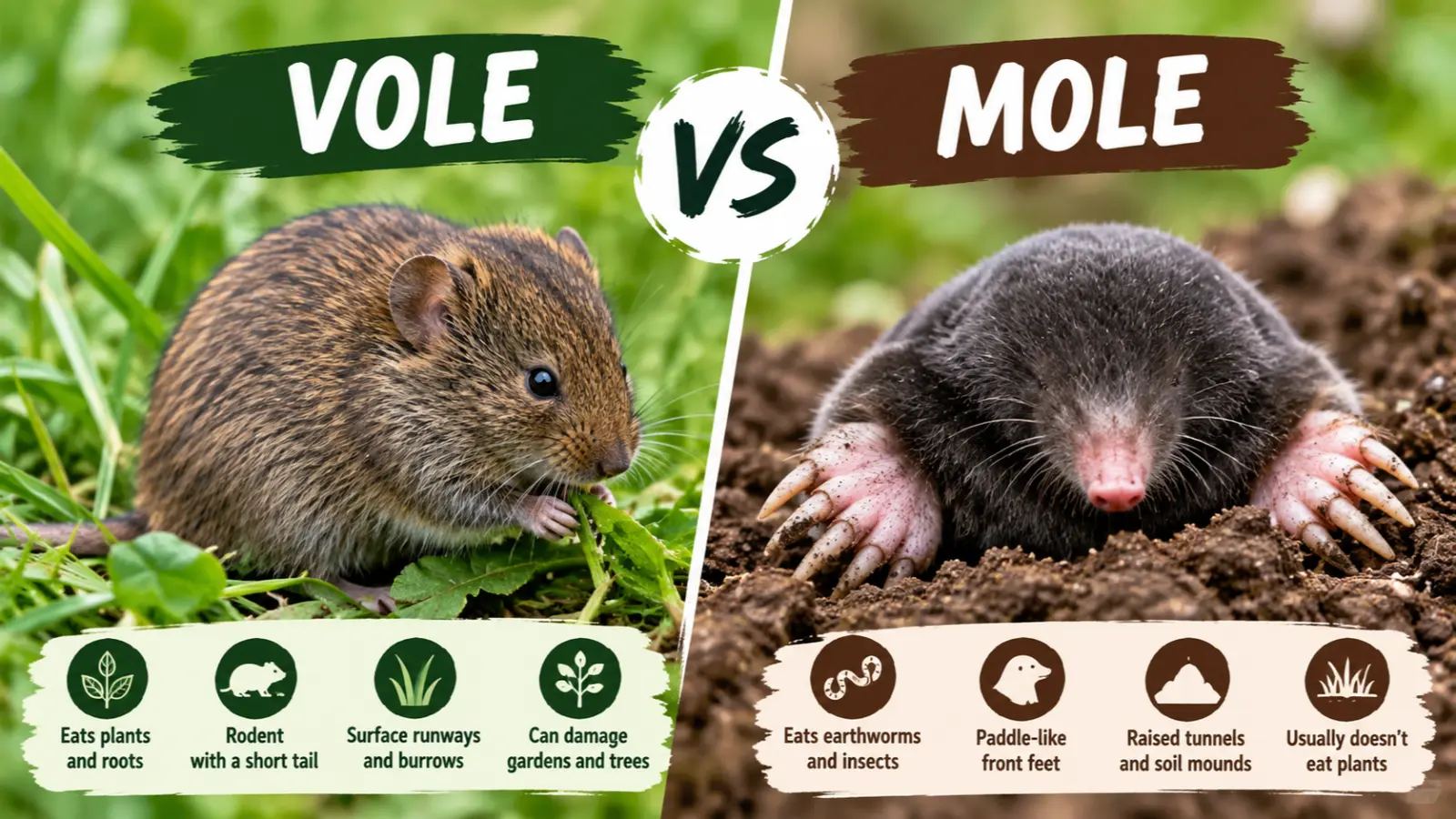
Voles and moles are completely different animals. Voles are small rodents that primarily eat plants, roots, bulbs, seeds, and bark, while moles are underground mammals that mainly eat earthworms, grubs, and other soil invertebrates.
Voles often leave surface runways and plant damage, while moles create raised tunnels and soil mounds.
Key Takeaways
- 🐭 Voles are rodents with compact, mouse-like bodies, short tails, and visible eyes and ears.
- 🦔 Moles are specialized diggers with large paddle-like front feet and a pointed snout.
- 🌱 Voles eat plants, including roots, bulbs, stems, seeds, and bark.
- 🪱 Moles mainly eat soil animals, especially earthworms, grubs, and other invertebrates.
- 🛣️ Voles commonly leave surface runways, while moles create underground tunnels, raised ridges, and soil mounds.
1. Vole vs Mole: What’s the Difference?
Although the names vole and mole sound similar, these animals are not closely related and have very different lifestyles.
A vole is a small rodent. It looks somewhat like a short-tailed, stocky mouse and spends considerable time around vegetation. Voles feed on plant material and can damage lawns, gardens, shrubs, and young trees.
A mole, by contrast, is highly adapted to life underground. Its large front feet and strong claws help it excavate tunnels through soil. Moles primarily search underground for earthworms, grubs, insects, and other invertebrates.
The easiest way to remember the basic difference is:
Voles = vegetation 🌱
Moles = mostly underground prey 🪱
This distinction is useful because the damage caused by each animal can look quite different.
Voles Are Rodents
Voles belong to the rodent group and are sometimes casually called meadow mice or field mice. However, they are not the same as ordinary house mice.
They have compact bodies, short legs, short tails, small eyes, and small ears. Their blunt faces and mouse-like appearance make them easier to recognize once you know what to look for.
Voles are primarily herbivorous. They may eat grass, roots, bulbs, seeds, stems, and bark. This feeding behavior is why vole problems can become serious for gardens and landscaping.
Moles Are Specialized Diggers
Moles have a very different body shape.
Their most obvious feature is their large, paddle-like front feet with strong claws. These feet are designed for digging through soil.
Moles also have elongated, pointed snouts and very small eyes. Their ears are not visibly exposed like those of a typical mouse.
Moles spend most of their lives underground and create tunnels while searching for food.
💡 Tip: If you see a mouse-like animal with a short tail and visible eyes, think vole. If you see large digging feet and a pointed snout, think mole.
2. Vole vs Mole Identification
If you are trying to identify an animal in your yard, you may never get a good look at it. Fortunately, the damage and tunnels can provide important clues.
What Does a Vole Look Like?
A vole generally has:
- A compact, stocky body
- Short legs
- A short tail
- Small but noticeable eyes
- Small rounded ears
- A blunt or rounded nose
- Brown, gray, or brownish-gray fur
Voles resemble small, chunky mice, but their short tails help distinguish them from many mice.
What Does a Mole Look Like?
A mole generally has:
- A cylindrical body
- Soft, velvety fur
- A long, pointed snout
- Very small eyes
- No obvious external ears
- Large paddle-like front feet
- Prominent digging claws
The front feet are one of the strongest visual clues. Moles have feet specifically adapted for pushing through soil.
3. Vole vs Mole: Quick Comparison Table
| Feature | Vole | Mole |
|---|---|---|
| Animal group | Rodent | Specialized underground mammal |
| Appearance | Mouse-like | Cylindrical, adapted for digging |
| Nose | Blunt/rounded | Long and pointed |
| Eyes | Small but visible | Very small |
| Ears | Small and noticeable | Mostly hidden |
| Feet | Small, mouse-like | Large, paddle-shaped front feet |
| Tail | Short | Short |
| Main diet | Plants, roots, bulbs, seeds, bark | Earthworms, grubs, insects, other invertebrates |
| Typical movement | Often above ground and in shallow runways | Mostly underground |
| Common lawn sign | Surface runways | Raised tunnels and soil mounds |
| Plant damage | Can be significant | Usually indirect rather than feeding on plants |
The physical and behavioral differences are documented by university extension services, including the University of Maryland, Clemson, Penn State, and Purdue.
4. How Their Damage Looks Different
One of the best ways to solve a vole vs mole mystery is to look at what has happened to your yard.
Signs of Voles
Voles commonly create shallow surface runways through grass and vegetation.
You may notice:
- Narrow paths through grass
- Chewed grass
- Small openings near vegetation
- Gnawed roots or bulbs
- Chewed stems
- Bark damage around young trees and shrubs
- Plant decline or dying vegetation
Vole runways can become especially noticeable after vegetation is flattened or after snow melts.
Because voles eat plants, damage around roots, bulbs, stems, and bark is an important clue.
Signs of Moles
Moles leave a different signature.
Common signs include:
- Raised ridges in lawns
- Shallow underground tunnels
- Soil pushed upward
- Small or larger soil mounds
- Loose soil around tunnel entrances
- Grass that becomes uneven or difficult to mow
Moles excavate tunnels while searching for underground prey. Their digging can disturb plant roots and turf even though plants are not their primary food.
⚠️ Important: A damaged plant does not automatically mean you have moles. Voles directly feed on plant material, and they may also use existing tunnels created by other animals.
5. What Do Voles and Moles Eat?
Diet is one of the simplest ways to understand the difference.
Vole Diet 🌱
Voles primarily eat plant material. Depending on the species and available food, this can include:
- Grass
- Roots
- Bulbs
- Seeds
- Stems
- Leaves
- Tree and shrub bark
This feeding behavior can make voles a concern in gardens, orchards, and landscaped areas.
Mole Diet 🪱
Moles primarily search the soil for animal-based food such as:
- Earthworms
- Beetle grubs
- Insects
- Other soil invertebrates
Although mole tunneling can disturb plants, moles generally do not eat plant roots as their main food source.
This is why treating a mole problem as though it were a vole problem can lead to the wrong approach.
6. How to Tell If You Have a Vole or Mole
If you cannot see the animal, follow these clues.
Step 1: Look at the Tunnels
Raised ridges under the lawn are more consistent with mole activity.
Narrow surface pathways through grass are more consistent with voles.
Step 2: Check Nearby Plants
Look for:
- Gnawed roots
- Missing bulbs
- Chewed stems
- Bark stripped from young trees
These signs point more strongly toward voles.
Step 3: Look for Soil Mounds
Distinctive piles of pushed-up soil are a classic sign of mole digging.
Moles excavate soil while constructing and using their underground tunnels.
Step 4: Consider the Animal’s Appearance
If you actually spot the animal, a mouse-like body with visible eyes and a short tail suggests a vole.
Large digging feet and a pointed snout suggest a mole.
7. Are Moles or Voles Bad for Your Yard?
Neither animal should automatically be considered harmful.
Moles can disturb lawns through their digging, but their feeding on soil invertebrates can also have ecological benefits. Their tunnels may aerate soil and incorporate organic material.
Voles are also part of the ecosystem and provide food for predators. However, high vole activity can cause noticeable damage to plants, roots, bulbs, shrubs, and young trees.
So the question is not simply whether moles or voles are “bad.” The more useful question is whether their activity is causing unacceptable damage to your property.
🔑 Key Takeaway: Identify the animal before choosing a control method. A mole and a vole have different diets, behaviors, and damage patterns, so treating the wrong animal can waste time and effort.
8. What Should You Do About Voles and Moles?
The first step is always accurate identification.
For voles, reducing dense vegetation and hiding places around vulnerable plants can make the area less attractive. Protecting young trees and valuable plants can also help limit damage.
For moles, identifying active tunnels is important because their problem is primarily related to underground foraging and digging.
Avoid assuming that every tunnel or damaged plant comes from the same animal. Extension guidance emphasizes identifying the animal before taking control measures.
If the damage is extensive or you are unsure what animal is responsible, a local extension service or qualified wildlife/pest professional can help with identification and appropriate management.
Frequently Asked Questions
Are voles and moles the same animal?
No. Voles are rodents, while moles are specialized underground mammals. Voles primarily eat vegetation, while moles mainly eat earthworms, grubs, insects, and other soil invertebrates. Their body shapes and the damage they leave behind are also very different.
Do moles eat plant roots?
Moles generally do not eat plant roots as their primary food. They mainly hunt soil-dwelling animals such as earthworms and grubs. However, their tunneling can disturb roots, and other animals-including voles-may use mole tunnels and cause plant damage.
Do voles make tunnels?
Yes. Voles can create shallow burrows and runways, but they commonly travel through surface-level pathways in grass and vegetation. Their tunnels and runways are generally different from the raised underground tunnels associated with moles.
Which causes more lawn damage, a mole or a vole?
It depends on the type of damage. Moles are more likely to create raised ridges, tunnels, and soil mounds, while voles are more likely to create surface runways and chew vegetation. Voles can be particularly damaging to plants, shrubs, and young trees.
Can voles use mole tunnels?
Yes. Voles and other small mammals can sometimes use existing mole tunnels as protected pathways. This is one reason why plant damage near mole tunnels does not necessarily mean that the mole is eating the plant.
Conclusion
The biggest difference in the vole vs mole comparison is simple: voles are plant-eating rodents, while moles are underground predators that primarily search for soil invertebrates.
If you see a small, mouse-like animal with a short tail and visible eyes, you may be looking at a vole. If you see large digging feet and a pointed snout, it is more likely a mole.
You can also identify them without seeing the animal. Surface runways and gnawed plants suggest voles, while raised tunnels and soil mounds suggest moles.
Correct identification matters because the two animals behave differently and require different management strategies. Before taking action, look closely at the tunnels, soil, plants, and other signs around your yard.