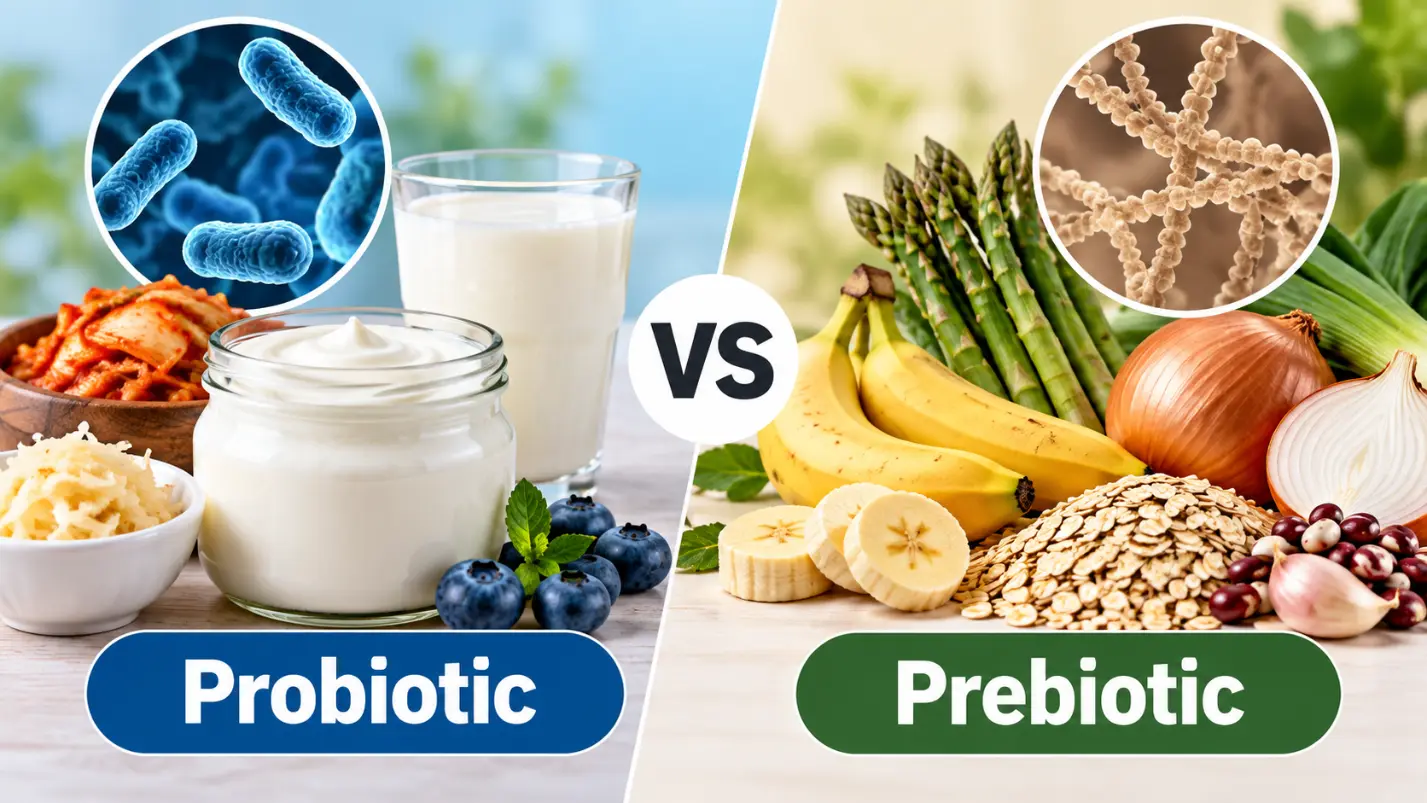
Probiotics are live microorganisms that may provide a health benefit when consumed in adequate amounts, while prebiotics are substances selectively used by microorganisms to support a health benefit.
In simple terms, probiotics provide beneficial microbes, while prebiotics provide fuel for certain microbes already in your gut. They can work together, but they are not the same thing.
Key Takeaways
- Probiotics are live microorganisms, including certain bacteria and yeasts.
- Prebiotics are substances, often certain types of fiber or carbohydrates, that beneficial microorganisms can use.
- Yogurt, kefir, kimchi, and some fermented foods can provide probiotics, while garlic, onions, asparagus, legumes, and whole grains provide common prebiotic ingredients.
- Not all fermented foods are proven probiotic foods, and not all fiber is technically prebiotic.
- Probiotics and prebiotics can be used together, but combining them does not automatically mean greater health benefits.
1. Probiotic vs Prebiotic: What’s the Difference?
The easiest way to remember the difference is:
Probiotics are the microorganisms. Prebiotics are substances that certain microorganisms use.
Your digestive tract contains a complex community of microorganisms called the gut microbiota. Probiotics are specific live microorganisms that can provide a health benefit when administered in adequate amounts. Prebiotics are substrates that are selectively used by microorganisms in a way that provides a health benefit.
What Are Probiotics?
Probiotics are live microorganisms, most commonly bacteria but sometimes yeasts, that may provide health benefits when consumed in sufficient amounts.
They can occur in certain foods and are also sold as dietary supplements. Examples include specific strains of Bifidobacterium, Lacticaseibacillus, and certain probiotic yeasts.
An important detail is that probiotic effects can be strain-specific. A benefit demonstrated for one strain does not automatically mean another strain will provide the same benefit.
What Are Prebiotics?
Prebiotics are substances that beneficial microorganisms can selectively use.
Many familiar prebiotics are carbohydrates or types of dietary fiber, including compounds such as inulin and certain oligosaccharides. However, not every type of dietary fiber qualifies as a prebiotic.
Prebiotics are found naturally in many plant foods, including garlic, onions, asparagus, bananas, legumes, and whole grains.
💡 Key Takeaway: Probiotics are live microorganisms; prebiotics are substances used by microorganisms. They support the gut in different ways.
2. Probiotics vs Prebiotics: Side-by-Side Comparison
| Feature | Probiotics | Prebiotics |
|---|---|---|
| What are they? | Live microorganisms | Substances selectively used by microorganisms |
| Main role | Provide specific live microbes | Provide a usable substrate for certain microbes |
| Common forms | Foods and supplements | Foods, fibers, carbohydrates, and supplements |
| Common food examples | Yogurt, kefir, kimchi, some fermented foods | Garlic, onions, asparagus, legumes, whole grains |
| Do they contain live microbes? | Yes | No |
| Related term | Specific strains | Inulin, FOS and other prebiotic substrates |
| Can they be combined? | Yes | Yes |
| Combined product | Synbiotic | Synbiotic |
The terms are closely related, but they describe fundamentally different things. A probiotic product contains live microorganisms, whereas a prebiotic provides a substrate that certain microorganisms can use.
3. Probiotic Foods: Where to Find Them
You can find probiotics in certain fermented foods and in products specifically formulated with live microorganisms.
Common Probiotic Foods
Examples include:
- Yogurt with live cultures
- Kefir
- Kimchi
- Sauerkraut
- Some cheeses
- Some fermented foods with live cultures
Yogurt, for example, is produced using live microorganisms. However, the fact that microorganisms were used during fermentation does not automatically mean the finished food qualifies as a probiotic with a demonstrated health benefit.
Why “Fermented” Does Not Always Mean “Probiotic”
This is an important distinction that is often missed.
A food can be fermented without necessarily containing microorganisms that meet the scientific definition of a probiotic or have a demonstrated health benefit.
Processing can also affect whether live microorganisms remain in a food. Therefore, if you specifically want a probiotic food, look for information about live or active cultures and the microorganisms involved rather than assuming every fermented product provides probiotics.
⚠️ Important: “Fermented” and “probiotic” are not interchangeable terms. A fermented food may contain microorganisms without having a proven probiotic benefit.
4. Prebiotic Foods: Where to Find Them
Prebiotic compounds occur naturally in many plant foods.
Common examples include:
- Garlic
- Onions
- Leeks
- Asparagus
- Bananas
- Beans
- Lentils
- Peas
- Whole grains
- Oats
- Artichokes
- Some resistant starches
Harvard Health identifies foods such as garlic, onions, bananas, asparagus, soybeans, and whole grains as common sources of prebiotic compounds.
Is All Fiber Prebiotic?
No.
This is another common misconception.
Many prebiotics are dietary fibers, but not all dietary fiber is technically a prebiotic. The scientific definition requires that a substance be selectively used by microorganisms in a way that produces a health benefit.
That does not mean non-prebiotic fiber is unimportant. Dietary fiber can still play important roles in digestion and bowel regularity.
🌱 Tip: Instead of focusing on a single “superfood,” build meals around a variety of plant foods. This can naturally increase your intake of different types of fiber and prebiotic compounds.
5. How Probiotics and Prebiotics Work Together
Think of your gut microbiome as an ecosystem.
Probiotics provide specific live microorganisms, while prebiotics provide substances that certain microorganisms can use.
This is why the two terms are often discussed together.
For example, a meal containing yogurt with live cultures alongside fiber-rich foods such as oats, berries, bananas, or nuts can provide both probiotic microorganisms and substrates that gut microbes can use.
However, this does not mean that every probiotic automatically needs a particular prebiotic, or that combining the two guarantees a better health outcome. The effects depend on the specific microorganism, substrate, dose, and individual.
What Is a Synbiotic?
A synbiotic is a combination involving live microorganisms and a substrate that is selectively used by host microorganisms to provide a health benefit.
You may see the word on foods or supplements containing both probiotic and prebiotic components. But simply putting a probiotic and a prebiotic in the same product does not automatically prove that the combination provides an additional benefit.
🔑 Key Takeaway: Probiotics and prebiotics can complement each other, but “both” does not automatically mean “better.” The specific ingredients and evidence matter.
6. Which Is Better: Probiotic or Prebiotic?
There is no universal answer because they perform different roles.
If you are asking which one is more important for everyday eating, a varied diet rich in plant foods can provide many prebiotic compounds and other types of fiber, while fermented foods can provide live microorganisms.
If you are considering a probiotic supplement for a specific digestive condition, the question becomes more specific. Research on probiotics is often strain-specific, and different products can have different effects.
For example, evidence for probiotics in conditions such as irritable bowel syndrome is mixed, and results can vary by strain and outcome. NCCIH notes that evidence for some probiotic uses exists, but benefits are not consistent across all products.
So instead of asking “Which is better?” it is more useful to ask:
What am I trying to accomplish, and is there evidence for this specific probiotic strain or prebiotic substance?
7. Do You Need a Probiotic or Prebiotic Supplement?
Not necessarily.
Many people can obtain prebiotic compounds through a varied diet containing vegetables, fruits, legumes, whole grains, and other plant foods. Probiotic microorganisms can also be obtained from certain foods.
Supplements can be useful in some circumstances, but they should not be treated as interchangeable with a healthy diet.
For probiotic supplements, pay attention to the genus, species, strain, CFU amount, expiration date, and storage instructions. NIH notes that higher CFU counts alone do not necessarily mean greater health benefits.
Also remember that dietary supplements are not FDA-approved for safety and effectiveness before marketing in the same way prescription drugs are.
People who are seriously ill or immunocompromised may face greater risks from some probiotic products, so medical guidance is especially important in those situations.
8. How to Add Both to Your Diet
A simple food-first approach can include both categories.
Breakfast
Try:
- Yogurt with live cultures
- Oats
- Banana
- Berries
- Nuts or seeds
Lunch
Consider:
- A bean or lentil dish
- Whole-grain bread
- Vegetables such as asparagus or onions
Dinner
Add:
- A variety of vegetables
- Beans or legumes
- Whole grains
- A fermented food containing live cultures when appropriate
You do not need to make every meal a carefully calculated “probiotic and prebiotic” combination.
Instead, focus on dietary variety, plenty of plant foods, and fermented foods that genuinely contain live cultures.
If you are increasing fiber quickly, doing so gradually and drinking enough fluids may make the transition more comfortable, particularly if you are not used to eating many high-fiber foods.
9. Frequently Asked Questions
Is yogurt a probiotic or prebiotic?
Yogurt can be a probiotic food when it contains appropriate live microorganisms, but it is not automatically a probiotic simply because it is fermented. Check the product information for live or active cultures. Yogurt itself is not a prebiotic, although it can be eaten alongside prebiotic foods such as oats, bananas, berries, or other plant foods.
Can you take probiotics and prebiotics together?
Yes. Probiotics and prebiotics can be consumed together, and products containing both are commonly called synbiotics. However, combining them does not automatically guarantee a greater benefit. The specific microorganism, substrate, dose, and evidence should be considered.
Do prebiotics feed probiotics?
They can provide a substrate that certain microorganisms use, but “prebiotics feed probiotics” is an oversimplification. The scientific definition is more specific: prebiotics are selectively utilized by microorganisms in a way that provides a health benefit. Not every prebiotic will affect every probiotic strain in the same way.
Is fiber a prebiotic?
Some fiber is prebiotic, but not all fiber qualifies as a prebiotic. Prebiotics must meet a more specific scientific definition involving selective use by microorganisms and a resulting health benefit. Many prebiotics are fibers, including certain fructans and other fermentable carbohydrates.
Are probiotic supplements necessary?
Not for everyone. Many people can support their gut microbiome through a varied diet containing plant foods and selected fermented foods. If you are considering a probiotic for a specific health condition, the evidence should be considered for the particular strain and situation rather than assuming all probiotic products work alike.
Conclusion
The difference between probiotic vs prebiotic is simple once you separate the two roles.
Probiotics are live microorganisms that can provide health benefits, while prebiotics are substances that certain microorganisms selectively use.
Probiotic foods may include yogurt with live cultures, kefir, kimchi, and some other fermented foods. Prebiotic sources include foods such as garlic, onions, asparagus, legumes, bananas, and whole grains.
You do not necessarily have to choose between them. A varied, food-first eating pattern can provide both. If you are considering supplements, look beyond marketing claims and pay attention to the specific strain or ingredient and the evidence supporting its use.