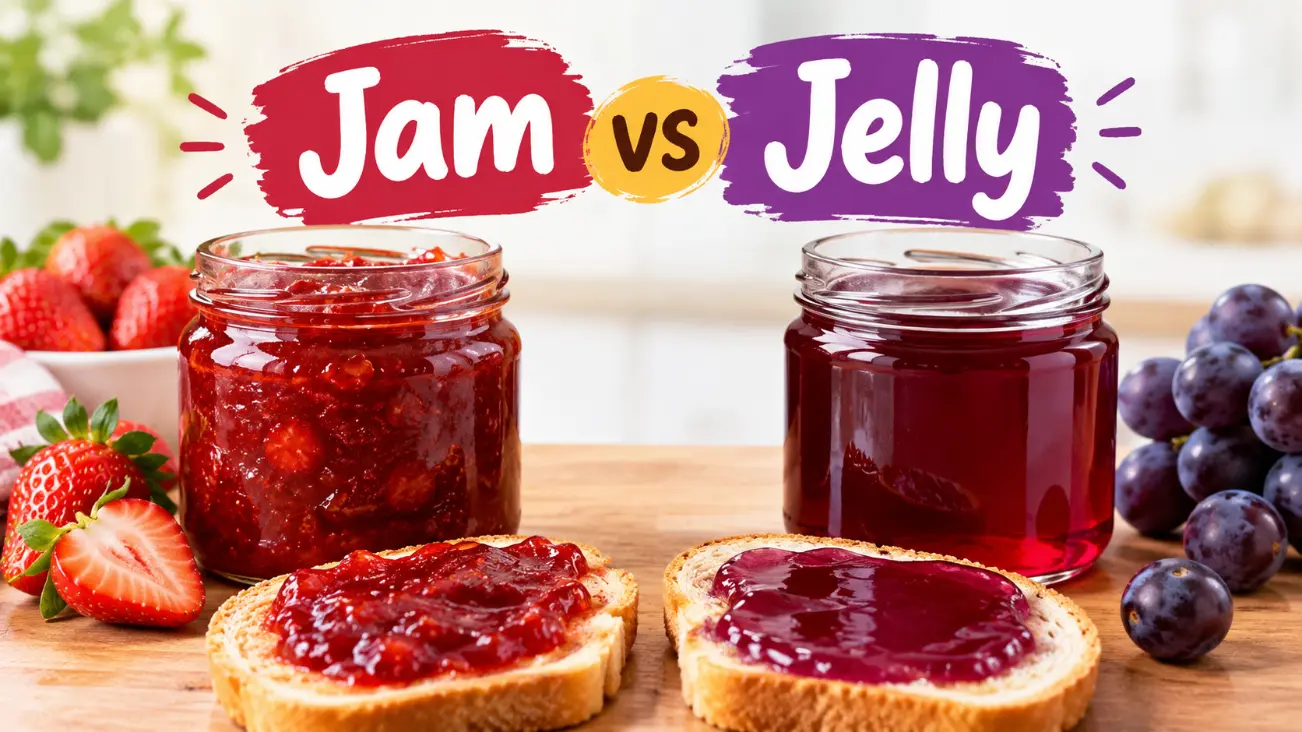
Jam and jelly are both fruit spreads, but the main difference is how the fruit is processed. Jam is made from crushed, chopped, or mashed fruit, so it contains fruit pulp and has a thicker, textured consistency.
Jelly is made from strained fruit juice, giving it a smoother, clearer, firmer texture. Both commonly use sugar, acid, and pectin to create their characteristic consistency.
Key Takeaways
- Jam contains crushed or chopped fruit, while jelly is made from strained fruit juice.
- Jam is usually thicker and more opaque, while jelly is smooth, firm, and translucent.
- Both can contain fruit, sugar, acid, and pectin, although recipes vary.
- Jam works especially well when you want fruit texture and a fuller fruit flavor.
- Jelly is useful when you want a smooth, uniform spread or glaze.
- In many everyday applications, you can substitute one for the other, but the texture and final appearance may change.
Jam vs Jelly: What’s the Difference?
At first glance, jam and jelly can look almost identical on a grocery-store shelf. Both are sweet fruit spreads, both come in familiar flavors such as strawberry and grape, and both are commonly served with toast or sandwiches.
The important difference is what happens to the fruit.
Jam keeps crushed, chopped, or mashed fruit in the finished product. Jelly uses fruit juice that has been strained to remove most of the solid fruit material. That difference affects almost everything you notice when eating them, including texture, appearance, firmness, and mouthfeel.
| Feature | Jam | Jelly |
|---|---|---|
| Main fruit component | Crushed, chopped, or mashed fruit | Strained fruit juice |
| Fruit pulp | Usually present | Removed |
| Texture | Thick and soft | Smooth and firm |
| Appearance | Usually opaque | Usually clear or translucent |
| Fruit pieces | May be present | No solid fruit pieces |
| Consistency | Spreadable and less firm | Gel-like and more firm |
| Common ingredients | Fruit, sugar, pectin, acid | Fruit juice, sugar, pectin, acid |
| Flavor | Often fuller and fruitier | Smooth and consistent |
U.S. federal standards also distinguish fruit jelly from preserves and jams based on the fruit material used. The federal definition of fruit jelly specifies fruit juice ingredients, while the standard for preserves and jams covers prepared fruit ingredients.
💡 Key Takeaway:
Think “fruit” for jam and “juice” for jelly. That simple distinction makes the rest of the differences much easier to remember.
What Is Jam?
Jam is a thick fruit spread made by cooking crushed, chopped, or mashed fruit with sugar and other ingredients needed to create the desired consistency.
Because the fruit itself remains in the mixture, jam usually contains fruit pulp. Depending on the fruit and recipe, you may also notice tiny fruit pieces or seeds.
The National Center for Home Food Preservation describes jam as a thick, sweet spread made by cooking crushed or chopped fruit with sugar. Jam generally holds its shape but is less firm than jelly.
How Is Jam Made?
A typical jam-making process involves:
- Preparing the fruit.
- Crushing, chopping, or mashing it.
- Combining it with sugar.
- Adding acid or pectin when needed.
- Cooking the mixture until it reaches the desired consistency.
Pectin plays an important role because it helps fruit mixtures form a gel. Some fruits naturally contain enough pectin, while others may need additional pectin. Acid and sugar also contribute to proper gel formation.
What Does Jam Look and Feel Like?
Jam is generally:
- Thick
- Soft
- Spreadable
- Opaque or less translucent
- Textured because of fruit pulp
- Less firm than jelly
Strawberry jam, raspberry jam, peach jam, and blueberry jam are familiar examples.
Because jam keeps more of the fruit’s physical material, it can provide a more noticeable fruit texture than jelly.
🍓 Tip:
Choose jam when you want a spread with noticeable fruit texture and a thicker, more fruit-filled consistency.
What Is Jelly?
Jelly is a fruit spread made primarily from strained fruit juice rather than crushed fruit.
The fruit is processed to extract its juice, and the solid pieces are removed. The resulting juice is then combined with sugar and ingredients such as pectin and acid as needed to produce a firm gel.
The National Center for Home Food Preservation defines fruit jelly as a semi-solid mixture of fruit juice and sugar that is clear and firm enough to hold its shape.
How Is Jelly Made?
The basic process is different from jam:
- Fruit is prepared and cooked to release juice.
- The juice is extracted and strained.
- The clear juice is combined with sugar and other ingredients.
- Pectin and acidity help create the gel.
- The mixture is cooked and allowed to set.
Pectin is a natural substance found in fruits that helps create the gel structure. Commercial pectin can also be added when the fruit does not provide enough natural pectin for the desired result.
What Does Jelly Look and Feel Like?
Jelly is generally:
- Smooth
- Firm
- Gel-like
- Translucent or clear
- Free of visible fruit pulp
- Easy to spread in an even layer
Grape jelly is one of the most familiar examples in the United States.
💡 Important:
Jelly is not simply jam that has been cooked longer. The key distinction is that jelly uses strained fruit juice, while jam retains crushed or chopped fruit.
Jam vs Jelly: Key Differences Explained
1. Fruit Content
The biggest difference is the form of the fruit.
Jam: Uses crushed, chopped, or mashed fruit.
Jelly: Uses strained fruit juice.
This is why a spoonful of jam may contain visible fruit material while jelly has a much more uniform appearance.
2. Texture and Consistency
Jam tends to be soft, thick, and spreadable.
Jelly tends to be firmer, smoother, and more gel-like.
A good jelly can hold its shape when removed from its container, while jam generally has a softer consistency.
3. Appearance
Jam is usually opaque because fruit pulp remains in the mixture.
Jelly is usually translucent because the solid fruit material has been strained out.
This difference is particularly easy to see when you place a jar of strawberry jam beside a jar of grape jelly.
4. Flavor and Mouthfeel
Jam can provide a more noticeable fruit texture because it retains fruit pulp.
Jelly has a cleaner, smoother mouthfeel because the fruit solids have been removed.
However, flavor varies considerably by fruit, recipe, sugar level, cooking method, and brand. It is too broad to say that every jam tastes stronger than every jelly.
5. Pectin
Both jam and jelly can rely on pectin to create their gel structure.
Pectin is not the same thing as gelatin. It is a natural substance found in plants, and commercial pectin is commonly made from sources such as apples and citrus fruits.
The amount of pectin needed depends partly on the fruit being used. Some fruits naturally provide more pectin than others.
🔎 Key Takeaway:
The difference between jam and jelly isn’t simply “thick vs. thin.” The most important distinction is crushed fruit versus strained fruit juice. Texture and appearance follow from that difference.
Jam vs Jelly: Which One Should You Use?
There is no universal choice because the better option depends on what you’re making.
For Toast and Bagels
Both work well.
Choose jam if you like a thicker spread with fruit texture.
Choose jelly if you prefer a smooth layer that spreads easily and evenly.
For Peanut Butter and Jelly Sandwiches
In the United States, the classic name is PB&J, but the “J” does not necessarily have to mean jelly.
You can use grape jelly, strawberry jelly, strawberry jam, raspberry jam, or another fruit spread. The result will simply have a different texture and flavor.
If you prefer a completely smooth sandwich, jelly may be more suitable. If you enjoy fruit texture, jam is an easy alternative.
For Baking
Jam can be especially useful when you want a thick fruit filling.
For example, jam can work well in:
- Thumbprint cookies
- Pastries
- Cake fillings
- Layered desserts
- Toasted pastries
Jelly can be useful when a recipe benefits from a smooth, uniform fruit layer.
For Glazes and Sauces
Jelly can be convenient when a smooth finish is important.
Jam can also be heated and incorporated into sauces or glazes, but fruit pieces may remain unless the mixture is strained.
🍴 Tip:
Before substituting one for the other, ask: Does this recipe need fruit pieces, or does it need a smooth gel? That usually tells you which spread will work better.
Can You Substitute Jam for Jelly?
Often, yes-but not always.
For simple uses such as toast, bagels, sandwiches, and some desserts, jam and jelly can frequently be substituted without a major problem.
The biggest change will be texture.
If you replace jelly with jam, the result may be:
- Thicker
- More opaque
- More textured
- More fruit-forward
If you replace jam with jelly, the result may be:
- Smoother
- More uniform
- More translucent
- Less textured
For recipes where appearance or consistency is important, the substitution may matter more.
For home canning, however, don’t casually swap ingredients in a tested preservation recipe. Sugar, pectin, fruit, acidity, cooking method, and processing all affect the final product and preservation process. The National Center for Home Food Preservation recommends following tested recipes and specific processing instructions.
Jam vs Jelly vs Preserves vs Marmalade
Jam and jelly are only two members of the larger fruit-spread family.
| Fruit spread | Main characteristic |
|---|---|
| Jelly | Strained fruit juice; clear, firm gel |
| Jam | Crushed or chopped fruit; thick, spreadable |
| Preserves | Whole or large pieces of fruit |
| Marmalade | Citrus fruit and peel suspended in a soft jelly |
Preserves generally contain larger pieces of fruit than jam. Marmalade is commonly associated with citrus fruits and includes pieces of citrus peel.
This makes the basic distinction easy:
Jelly → juice
Jam → crushed fruit
Preserves → larger fruit pieces
Marmalade → citrus + peel
💡 Key Takeaway:
If you remember only one comparison, remember this: jelly is smooth and juice-based, jam is fruit-based and textured, preserves have larger fruit pieces, and marmalade features citrus peel.
Is Jam or Jelly Healthier?
It’s difficult to say that one is automatically healthier because nutrition varies by brand, fruit, serving size, recipe, and added sugar.
Both jam and jelly can contain substantial amounts of sugar. The fact that one contains fruit pulp does not automatically make it a low-sugar food.
Jam may retain some fruit material that is removed when juice is strained for jelly, but the nutritional difference between specific products can vary. If nutrition is your main concern, compare the Nutrition Facts label and ingredient list rather than choosing based only on the word “jam” or “jelly.”
For either product, useful things to compare include:
- Added sugars
- Total sugars
- Serving size
- Calories
- Fiber
- Ingredient list
Some reduced-sugar products are made using modified pectin or other formulations, so they should be evaluated individually rather than assuming all jam or jelly has the same nutritional profile.
Frequently Asked Questions
Is jam thicker than jelly?
Generally, jam is softer and more textured, while jelly is firmer and more gel-like. Jam contains crushed or chopped fruit, whereas jelly is made from strained fruit juice. The exact consistency can vary by recipe and brand, but this is the standard distinction.
Can I use jam instead of jelly in a PB&J?
Yes. Jam can be used instead of jelly in a peanut butter and jam sandwich. The main difference is texture: jam usually contains fruit pulp, while jelly is smooth and gel-like. Your sandwich may therefore have a thicker, more textured filling.
Why is jelly clear but jam isn’t?
Jelly is made from fruit juice that has been filtered or strained to remove solid fruit material. Jam keeps crushed or chopped fruit in the mixture. Because jelly contains much less solid fruit material, it typically has a clearer, more translucent appearance.
Are jam and jelly made from the same fruit?
They can be. Strawberries, grapes, raspberries, apples, peaches, and other fruits can be used to make either type of spread. What changes is how the fruit is processed. Jam retains crushed or chopped fruit, while jelly uses strained fruit juice.
Does jam have more fruit than jelly?
Not necessarily in every commercial product, so the label matters. The defining difference is the form of the fruit, not simply which product has “more fruit.” U.S. standards distinguish jelly through its fruit-juice ingredient and jams/preserves through prepared fruit ingredients.
Is pectin the same as gelatin?
No. Pectin and gelatin are different substances. Pectin is a plant-derived gelling substance commonly used in fruit spreads, while gelatin is a protein-based gelling ingredient. Traditional jam and jelly recipes can use pectin to achieve their characteristic gel.
Which is better for baking: jam or jelly?
It depends on the recipe. Jam can be useful when you want a thick fruit filling with texture, while jelly can be preferable when a smooth, uniform filling or glaze is needed. Always consider the recipe’s intended consistency before substituting one for the other.
Conclusion
The jam vs jelly difference comes down mainly to how the fruit is processed.
Jam is made with crushed, chopped, or mashed fruit, so it usually has a thick, soft texture and may contain visible fruit pieces or pulp.
Jelly is made from strained fruit juice, creating a smooth, firm, and often translucent gel. Both can use sugar, acid, and pectin to achieve their characteristic consistency.
For toast and sandwiches, either can work. For baking and cooking, your choice should depend on if you want fruit texture or a smooth finish.
The easiest way to remember the difference is simple: jam keeps the fruit; jelly keeps the juice.