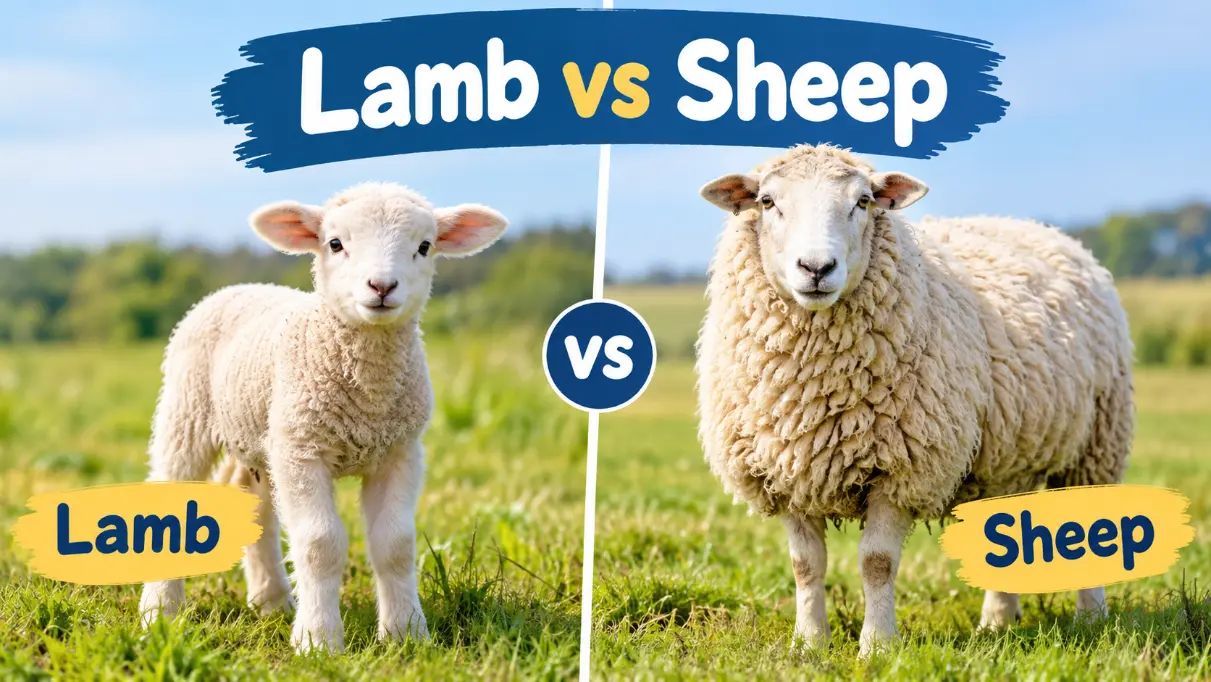
A lamb is a young sheep, while sheep is the broader name for the animal species and is often used for mature animals.
In everyday use, a lamb is generally a sheep less than about one year old. As it grows, it becomes an adult sheep.
They are not different species; the main distinction is the animal’s age and stage of development.
Key Takeaways
- 🐑 A lamb is a young sheep, not a separate animal species.
- Sheep can refer to the species generally or, in everyday conversation, an adult animal.
- Age is the biggest difference between a lamb and an adult sheep.
- Adult male sheep are called rams, while adult females are called ewes.
- Meat from young sheep is called lamb, while meat from older sheep is generally called mutton.
- Formal livestock classifications can use different age and physical criteria, so “one year” is a useful everyday guideline rather than a universal cutoff.
What Is the Difference Between Lamb and Sheep?
The simplest answer is that a lamb is a young sheep.
Both lambs and adult sheep belong to the same domesticated species, Ovis aries. The word “lamb” describes an early life stage, while “sheep” is the broader animal term. In everyday English, people commonly use “sheep” when talking about mature animals.
Think of it this way:
Every lamb is a sheep, but not every sheep is a lamb.
A newborn sheep is called a lamb. As it grows and matures, it eventually becomes an adult sheep.
The Simple Definition
| Term | Simple meaning |
|---|---|
| Lamb | A young sheep |
| Sheep | The broader name for the animal/species, often referring to adults |
| Ram | Adult male sheep |
| Ewe | Adult female sheep |
| Mutton | Meat from mature sheep |
The exact terminology can vary depending on whether you’re talking about farming, meat classification, or everyday English. USDA livestock standards, for example, use specific age and tooth-development criteria for market classifications.
💡 Key Takeaway: A lamb and a sheep are not two different animals. A lamb is simply a sheep at a young stage of life.
Lamb vs Sheep: Quick Comparison
| Feature | Lamb | Sheep |
|---|---|---|
| Life stage | Young/immature | Usually mature, or the general species |
| Age | Commonly under 1 year in everyday use | Often refers to animals 1 year and older |
| Species | Ovis aries | Ovis aries |
| Size | Smaller and still growing | Larger and fully developed |
| Coat | Young, often softer fleece | Mature fleece varies by breed |
| Male name | Ram lamb | Ram |
| Female name | Ewe lamb | Ewe |
| Meat | Lamb | Mutton when from mature sheep |
| Reproduction | Generally immature | Mature sheep may reproduce |
One important detail is that formal classifications are more precise than everyday speech. USDA standards classify lambs, yearlings, and sheep using both age and physical indicators such as permanent teeth.
What Is a Lamb?
A lamb is a young sheep.
In U.S. agricultural usage, lamb commonly means a sheep less than one year old, although some formal classifications use different criteria. USDA APHIS materials describe a lamb as a sheep less than 1 year old for one of its livestock studies.
Lambs are smaller than adult sheep and are still developing physically. Very young lambs depend heavily on their mothers for milk and care. As they grow, they gradually transition toward forage and other solid feeds.
A lamb may be male or female.
How Old Is a Lamb?
There is no single age rule that applies to every context.
For everyday understanding, under one year old is a useful guideline. USDA’s meat and livestock terminology, however, can use age together with physical development. Its market standards define a lamb as an immature ovine, usually under 14 months old, that has not cut its first pair of permanent incisor teeth.
This explains why you may see slightly different age ranges online.
What Are Male and Female Lambs Called?
A young male sheep can be called a ram lamb, while a young female can be called an ewe lamb.
After reaching adulthood:
- Male sheep are called rams.
- Female sheep are called ewes.
- Castrated male sheep are called wethers.
So sex and age are separate parts of sheep terminology.
📌 Important: “Lamb” describes a young sheep’s life stage; it does not mean the animal is female or male.
What Is a Sheep?
Sheep is the broader name for the domesticated animal.
In scientific and agricultural contexts, sheep belong to the species Ovis aries. The word can describe sheep as a group or species, regardless of age. In ordinary conversation, however, “sheep” often makes people think specifically of a mature animal.
Sheep are raised for several purposes, including:
- Wool
- Meat
- Milk
- Breeding
- Grazing and agricultural production
Adult sheep are generally much larger and more physically developed than newborn lambs.
Adult Male and Female Sheep
Adult sheep have specific names based on sex:
Ram: An uncastrated male sheep.
Ewe: A female sheep.
Wether: A male sheep that was castrated when young.
These terms are different from “lamb,” which primarily describes age or developmental stage.
💡 Tip: If you are unsure whether to say “lamb” or “sheep,” think about age first. A very young animal is a lamb; a mature animal is generally called a sheep.
Lamb vs Sheep: Key Differences
Age and Life Stage
The most important difference is age.
A lamb is immature and still growing. An adult sheep has reached a later stage of physical development.
For everyday English, “lamb” commonly refers to a sheep in its first year, while “sheep” is often used for adults or for the species as a whole.
Size and Physical Development
Lambs are smaller because they have not finished growing.
Adult sheep are larger and have mature body proportions. Their size can vary greatly according to breed, sex, nutrition, and management, so size alone should not be used as a precise way to determine age.
Wool and Coat
Lambs can have a soft, fine fleece. As sheep mature, their fleece characteristics can change.
The type and quality of wool also depend heavily on breed. Some sheep are specifically bred for wool, while hair sheep have hair rather than a traditional wool fleece.
Therefore, wool texture is a useful visual clue but not a universal way to distinguish every lamb from every adult sheep.
Maturity and Reproduction
Young lambs are still developing and are generally not sexually mature.
Mature sheep can participate in breeding. Adult females are ewes, while adult males are rams.
🔎 Key Takeaway: Age is the clearest distinction between a lamb and an adult sheep, while size, coat, teeth, and maturity provide additional clues.
Lamb vs Sheep Meat: Are They Different?
Yes, but the difference comes from the age of the sheep.
In food terminology, lamb refers to meat from younger sheep. Mutton generally refers to meat from older sheep.
The USDA explains that lamb comes from younger animals and typically has a milder flavor than mutton. It also notes that many lambs reach market at around six to eight months, although production practices vary.
Lamb Meat
Lamb is generally associated with:
- Younger animals
- A milder flavor
- Tender texture
- Cuts such as lamb chops, leg of lamb, and rack of lamb
Mutton
Mutton comes from more mature sheep and generally has a stronger, more developed flavor.
So when someone asks “lamb vs sheep meat,” they may actually be asking about lamb vs mutton.
The animal itself is still a sheep. The food name changes according to the animal’s age and the classification being used.
🍽️ Important: Lamb is not meat from a different species. It is meat from a younger sheep.
Lamb, Sheep, Yearling, and Mutton Explained
These terms can become confusing because different agricultural systems use slightly different classifications.
A simple way to understand them is:
- Lamb – young sheep.
- Yearling – a sheep in an intermediate age category.
- Adult sheep – mature sheep.
- Mutton – meat from mature sheep.
USDA market standards distinguish lambs, yearlings, and sheep using both age and tooth development rather than relying only on a simple birthday cutoff.
That is why a statement such as “a lamb becomes a sheep exactly on its first birthday” is useful as a simple explanation but can be too broad for formal livestock classification.
Lamb vs Sheep vs Goat
Lambs are sometimes confused with baby goats because the animals can look similar.
They are different animals.
| Animal | Young animal | Adult female | Adult male |
|---|---|---|---|
| Sheep | Lamb | Ewe | Ram |
| Goat | Kid | Doe | Buck |
A lamb is a young sheep, while a kid is a young goat.
Sheep and goats are both domesticated ruminants, but they are different animals with different physical and biological characteristics.
💡 Tip: Remember it this way: baby sheep = lamb; baby goat = kid.
Common Examples of Lamb and Sheep
Understanding the words becomes easier when you see them in context.
Example 1:
“The farmer found a lamb beside its mother.”
Here, “lamb” indicates a young sheep.
Example 2:
“The sheep were grazing in the pasture.”
“Sheep” can refer to adult animals or the group more generally.
Example 3:
“We had roasted lamb for dinner.”
Here, “lamb” refers to the meat rather than necessarily describing a living animal.
Example 4:
“The ewe stayed close to her lamb.”
A ewe is an adult female sheep, while her young offspring is a lamb.
Frequently Asked Questions
Is a lamb a baby sheep?
Yes. A lamb is a young sheep. In everyday and many agricultural contexts, the term generally refers to a sheep less than one year old. USDA sources also use “lamb” for immature sheep, although formal market classifications can involve both age and physical characteristics.
What is the main difference between lamb and sheep?
The main difference is life stage. A lamb is a young or immature sheep, while “sheep” is the broader name for the species and is commonly used for mature animals. Both belong to Ovis aries.
At what age does a lamb become a sheep?
For simple everyday usage, one year is a useful guideline. However, formal livestock classifications do not always use exactly the same cutoff. USDA market standards consider age along with physical signs such as the development of permanent incisors.
Is lamb meat from a baby sheep?
Lamb meat comes from younger sheep. USDA describes lamb as meat from younger animals and notes that lambs commonly reach market at around six to eight months, although practices vary.
What is the difference between lamb and mutton?
Both come from sheep, but lamb comes from younger animals, while mutton generally comes from mature sheep. Lamb tends to have a milder flavor, while mutton has a stronger flavor.
What is a male sheep called?
An adult male sheep is called a ram. A young male can be called a ram lamb. A castrated male sheep is called a wether.
What is a female sheep called?
An adult female sheep is called a ewe. A young female can be called an ewe lamb.
Do lambs have wool?
Yes. Lambs of wool-producing sheep breeds grow fleece. Young fleece can be soft and fine, while fleece characteristics change as the animal matures. Some sheep breeds are hair sheep and do not produce a conventional wool fleece.
Is a lamb a sheep or a goat?
A lamb is a sheep, not a goat. A young goat is called a kid.
Final Takeaway
The lamb vs sheep difference is mainly about age and life stage, not species. A lamb is a young sheep, while sheep is the broader term for the animal and is commonly used for mature individuals.
As a lamb grows, it develops into an adult sheep; males are called rams and females are called ewes.
The same age distinction also helps explain food terminology: meat from younger sheep is called lamb, while meat from older sheep is generally called mutton.
Formal agricultural classifications can be more detailed than everyday language, so age, teeth, and physical development may all matter when livestock are officially classified.
The easiest rule to remember is simple: a lamb is a young sheep, and every lamb is a sheep-but not every sheep is a lamb.