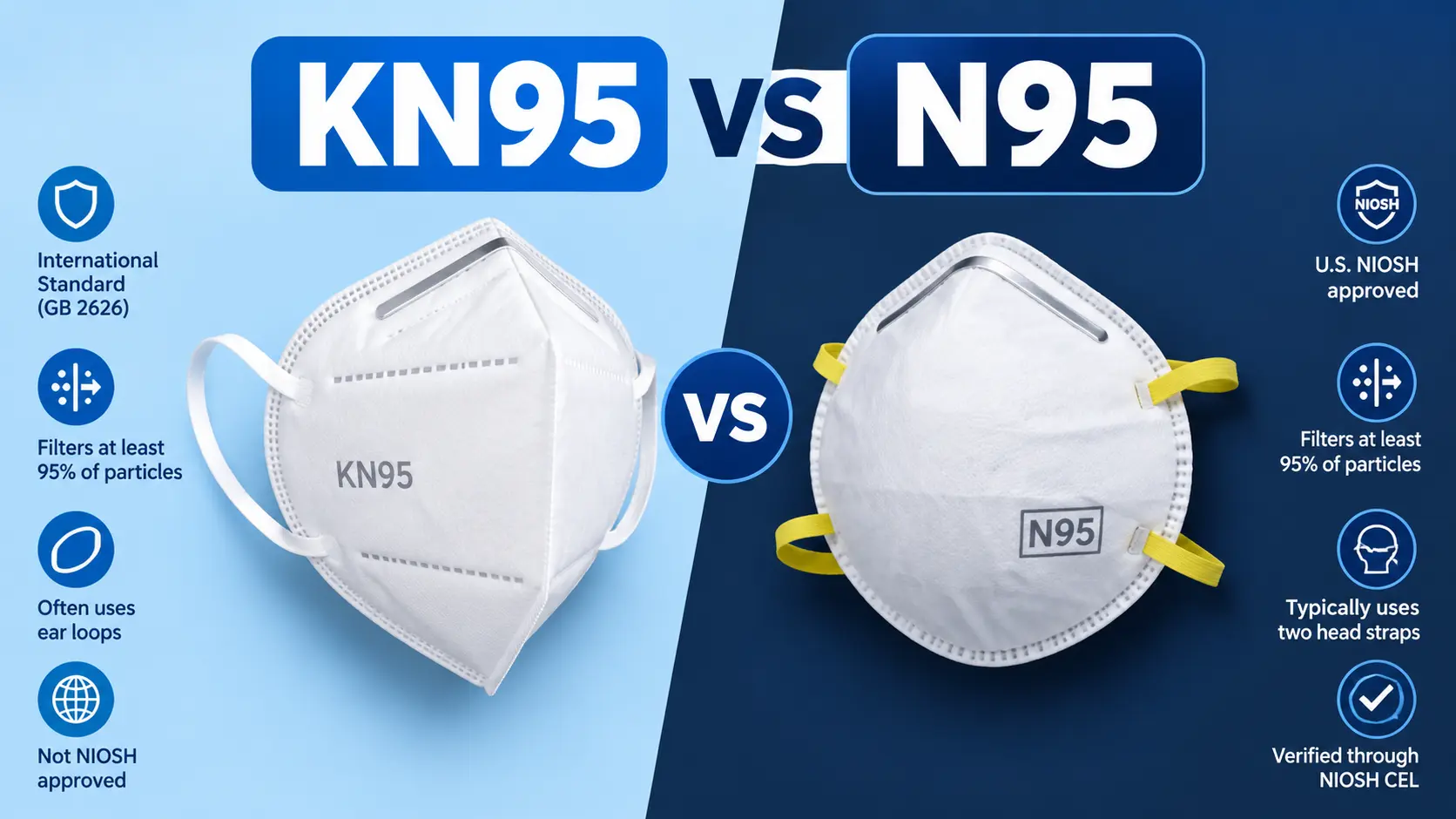
KN95 and N95 respirators are similar in their intended particle-filtration performance, but they are certified under different standards.
N95 respirators are tested and approved by NIOSH in the United States, while KN95 respirators are made to an international standard, commonly China’s GB 2626 standard.
Fit, certification, manufacturing quality, and proper use can affect real-world protection.
Key Takeaways
- N95 refers to a NIOSH-approved U.S. respirator classification when the product carries valid NIOSH approval.
- KN95 is an international filtering facepiece respirator designation and is not NIOSH-approved simply because it says “KN95.”
- Both types are designed to filter particles, but fit is extremely important because gaps can allow air to bypass the filter.
- Many N95s use two headbands, while many KN95s use ear loops, although designs vary.
- In the United States, you can verify a NIOSH-approved N95 through the NIOSH Certified Equipment List.
1. KN95 vs N95: What Is the Difference?
At first glance, KN95 vs N95 can seem like a simple comparison because both names contain “95.” However, the two terms describe respirators tested under different certification systems.
A NIOSH-approved N95 is evaluated according to U.S. requirements established by the National Institute for Occupational Safety and Health (NIOSH). NIOSH requires N95 filtering facepiece respirators to achieve at least 95% filtration efficiency under its test conditions and also applies quality-assurance requirements.
A KN95 is an international filtering facepiece respirator designed to meet the applicable standard under which it is manufactured. KN95 respirators are commonly associated with China’s GB 2626 standard. OSHA has previously identified KN/KP95 respirators certified under the Chinese standard as products similar in performance classification to N95 respirators.
The important point is that KN95 and N95 are not simply two brand names for the exact same certification.
N95 respirators
The “N” in N95 means the filter is not resistant to oil, while “95” refers to a minimum filtration efficiency of 95% under the NIOSH classification system. NIOSH-approved N95 respirators are intended to provide tight-fitting particle protection when properly worn.
KN95 respirators
KN95 is an international respirator classification. A legitimate KN95 can provide high particle filtration when it meets its applicable standard and fits properly, but NIOSH does not approve KN95s as N95 respirators.
Key Takeaway: The biggest difference isn’t simply “95 vs. 95.” It is the standard, certification system, quality assurance, and actual fit of the respirator.
2. KN95 vs N95 Comparison Table
| Feature | N95 | KN95 |
|---|---|---|
| Common certification system | U.S. NIOSH | International; commonly GB 2626 |
| U.S. NIOSH approval | Yes, when properly approved | No |
| Particle filtration classification | At least 95% | Common KN95 standard targets at least 95% |
| Intended protection | Airborne particles | Airborne particles |
| Fit | Tight-fitting | Tight-fitting |
| Common strap design | Two headbands | Often ear loops |
| U.S. workplace use | NIOSH approval is generally required when OSHA requires a respirator | Not automatically a substitute for a NIOSH-approved respirator |
| Verification | NIOSH approval number and Certified Equipment List | Verify the applicable standard and manufacturer information |
| Quality assurance | NIOSH approval includes rigorous requirements | Depends on applicable standard and manufacturer |
NIOSH states that NIOSH-approved filtering facepiece respirators meet its requirements for filtration and manufacturing quality, while international respirators such as KN95s are tested according to their respective standards and may not have the same NIOSH quality-assurance requirements.
3. Do KN95 and N95 Masks Filter the Same?
This is one of the most common questions about KN95 vs N95.
A genuine respirator meeting its applicable KN95 standard can have a minimum filtration requirement comparable to the 95% classification associated with an N95. OSHA has identified China’s KN/KP95 classification under GB 2626 as similar to the N95 classification in certain regulatory contexts.
However, filter material performance is only one part of respiratory protection.
The respirator also needs to fit closely against your face. CDC/NIOSH explains that gaps around the edges can allow air to enter without passing through the filtering material. Facial hair, an incorrectly sized respirator, glasses, or improper placement can contribute to gaps.
This means you should not assume that a respirator labeled “95” will automatically provide the same real-world protection as every other respirator carrying a similar rating.
Why fit matters
Imagine two respirators with highly effective filter material.
If one fits closely against your face while the other leaves noticeable gaps, contaminated air can bypass the filter through those gaps.
That is why CDC emphasizes both filtration and fit when choosing a respirator.
Important: A high filtration rating does not eliminate the need for a proper facial seal. Fit is a critical part of respirator performance.
4. Fit and Design Differences
Ear loops vs. head straps
One of the most noticeable physical differences is the strap system.
Many KN95 respirators use ear loops, which can make them quick and convenient to put on.
Many N95 respirators use two headbands-one positioned above the ears and another around the back of the neck. NIOSH notes that most NIOSH-approved N95 respirators have two headband straps rather than ordinary ear loops.
The design itself does not tell you everything about filtration performance, but strap tension can affect how closely the respirator seals against the face.
Why facial fit matters
CDC recommends checking for gaps each time an N95 is put on.
After positioning the respirator, you can place your hands over it and breathe out. If you feel air escaping around the edges, the respirator may not be providing a proper seal. CDC also recommends adjusting the respirator or trying another size or style if you cannot obtain a snug fit.
Facial hair can also interfere with the seal.
5. NIOSH Approval vs. International Standards
This is where the KN95 vs N95 distinction becomes especially important for people in the United States.
NIOSH is the federal agency responsible for testing and approving respirators used in U.S. workplace settings. NIOSH-approved respirators must satisfy specified performance and quality-assurance requirements.
A KN95 does not become NIOSH-approved simply because the packaging says “95,” “CDC,” or “NIOSH.”
NIOSH specifically warns about products that misrepresent international respirator assessments as NIOSH approval.
For workplace respiratory protection, this distinction can be especially important. OSHA states that when employers are required to provide respiratory protection, NIOSH-approved respirators are generally part of the required respiratory protection framework.
Tip: If you need a respirator for a U.S. workplace where NIOSH approval is required, don’t rely only on the words “N95” or “KN95” printed on the package. Verify the actual approval.
6. How to Identify a Genuine NIOSH-Approved N95
If you are buying an N95 in the United States, checking the markings is an important step.
According to CDC/NIOSH, approved filtering facepiece respirators should have required information such as:
- NIOSH marking
- Manufacturer or approval-holder information
- Model or part number
- Filter classification, such as N95
- A TC approval number, such as TC-84A-XXXX
- Lot information where required
NIOSH recommends using its Certified Equipment List (CEL) to verify an approval.
Be cautious if a product uses phrases such as “NIOSH tested” or “CDC approved” without providing legitimate NIOSH approval information.
NIOSH has documented examples of products that used test results or international certifications in ways that could make buyers believe the respirators were NIOSH-approved when they were not.
7. Which Features Should You Consider When Choosing a Respirator?
Rather than focusing only on KN95 vs N95, consider these factors:
1. Certification
For a U.S. workplace requiring NIOSH-approved respiratory protection, look for an actual NIOSH approval and verify it through the Certified Equipment List.
2. Fit
A respirator should fit snugly around your nose, cheeks, and chin.
If you repeatedly feel air escaping around the edges, consider a different size or model.
3. Strap design
Consider whether the strap system allows you to achieve a secure fit.
Two headbands are common on NIOSH-approved N95s, while many KN95s use ear loops.
4. Condition
Do not use a respirator that is visibly damaged, wet, or dirty, or one whose straps have become too loose to maintain a proper fit. CDC recommends replacing an N95 when it no longer fits snugly or becomes wet, dirty, or damaged.
5. Intended hazard
N95 and KN95 respirators are designed for particles, not gases or vapors. If you are dealing with chemical vapors or gases, a particulate respirator alone may not provide the protection you need.
Key Takeaway: Choose based on certification, fit, design, condition, and the hazard you need protection from, not simply the letters printed on the front.
8. Common Mistakes to Avoid
Assuming every N95 is automatically genuine
A product can be labeled “N95” without actually being NIOSH-approved. Check the required markings and verify the approval.
Assuming every KN95 is identical
KN95 products can vary in design, manufacturer, fit, and quality. The term alone does not tell you everything about a particular product.
Ignoring fit
Even an approved respirator cannot provide its intended protection if it does not seal properly against the face.
Wearing a damaged respirator
Inspect the respirator before use. CDC recommends replacing it when it is damaged, dirty, wet, or no longer maintains a snug fit.
Confusing respirators with ordinary masks
Loose-fitting surgical and disposable masks are different from tight-fitting respirators. FDA notes that surgical masks do not provide the same reliable protection against aerosolized particles because of their loose fit.
9. Frequently Asked Questions
Are KN95 and N95 masks the same?
No. They are both filtering facepiece respirators designed for particle protection, but they are certified under different standards. N95 respirators are approved by NIOSH when they meet the applicable U.S. requirements, while KN95 respirators follow an international standard and are not NIOSH-approved simply because they carry the KN95 label.
Is a KN95 as good as an N95?
A KN95 made to its applicable standard can have comparable filtration-class performance, but the products are not certified through the same system. Real-world protection also depends heavily on fit, manufacturing quality, and correct use. For a U.S. workplace that requires NIOSH approval, a KN95 should not automatically be treated as a NIOSH-approved N95.
Are KN95 masks approved by NIOSH?
No. NIOSH does not approve respirators solely certified to international standards such as the KN95 standard. A KN95 should not be advertised as NIOSH-approved unless it separately meets the requirements for a NIOSH approval.
Do N95 masks filter 95% of particles?
NIOSH-approved N95 filtering facepiece respirators are required to achieve at least 95% filtration efficiency under NIOSH’s testing requirements. The “95” refers to the filter classification, while the “N” indicates that the filter is not resistant to oil.
Why do many N95 masks have two straps?
Two headbands help the respirator maintain a close facial seal. CDC notes that most NIOSH-approved N95 respirators use two headband straps rather than ordinary ear loops.
How do I know if my N95 is NIOSH approved?
Look for the required NIOSH markings, including the manufacturer or approval holder, model or part number, N95 designation, and TC approval number. You can then verify the product through the NIOSH Certified Equipment List.
10. Conclusion
The KN95 vs N95 comparison is more complicated than simply asking which one has better filtration. Both are tight-fitting particulate respirators, but they belong to different certification systems.
A NIOSH-approved N95 has been evaluated under U.S. NIOSH requirements, while a KN95 is an international respirator designation. Although a compliant KN95 can have a comparable filtration classification, the certification, quality-assurance process, design, and fit can differ.
For U.S. workplace applications where NIOSH approval is required, verify the respirator through the NIOSH Certified Equipment List. For any respirator, pay close attention to fit, condition, correct use, and the specific hazard involved.