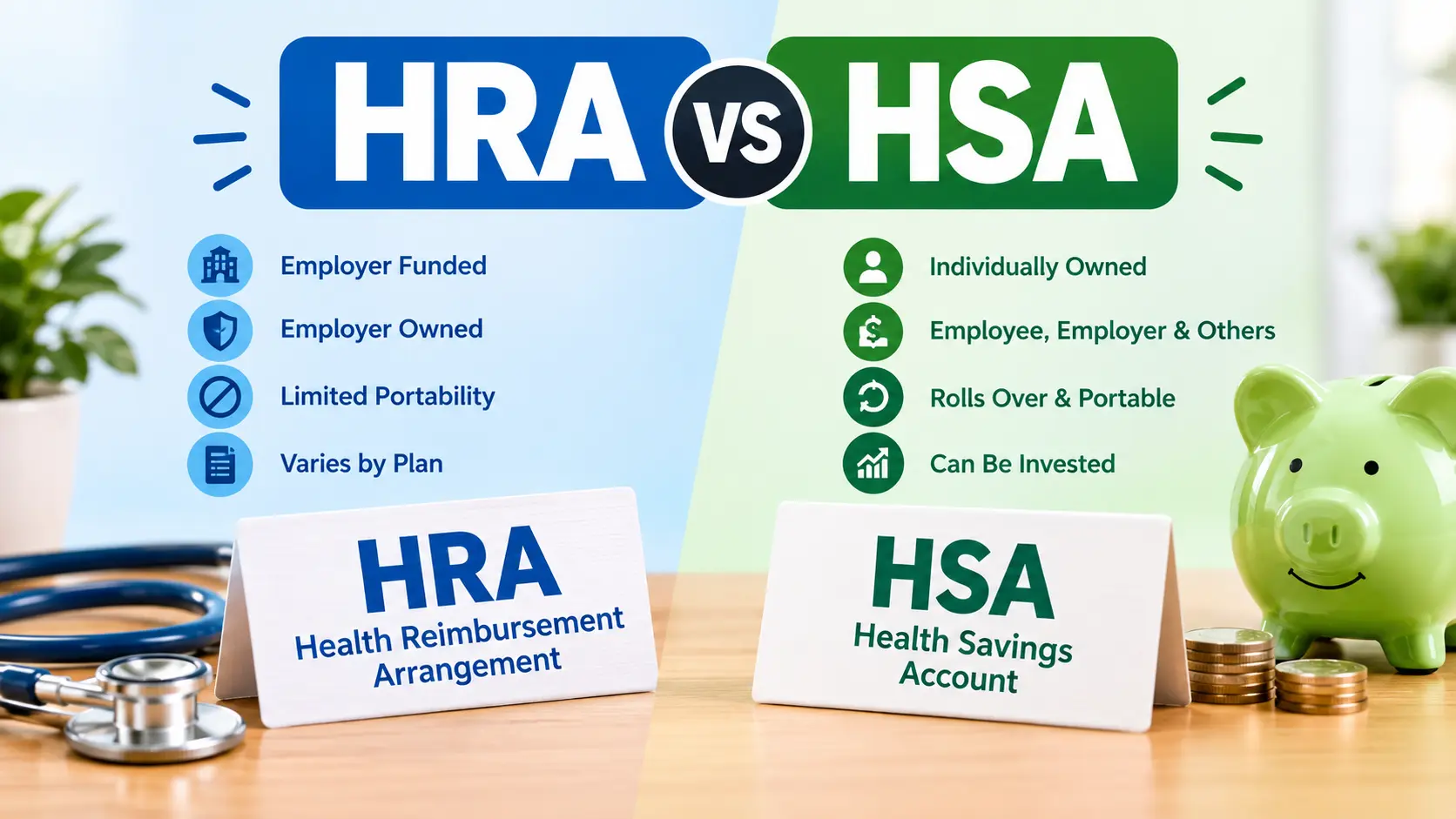
An HRA (Health Reimbursement Arrangement) is an employer-funded benefit that reimburses employees for eligible medical expenses, while an HSA (Health Savings Account) is an individually owned account that can receive contributions from the employee, employer, and others.
HSAs require specific eligibility, including qualifying HDHP coverage, while HRA rules depend on the type of HRA and employer plan.
Key Takeaways
HRA: Generally funded and controlled by the employer.
HSA: Owned and controlled by the individual account holder.
HSA eligibility generally requires coverage by an HSA-qualified high-deductible health plan.
HSA money generally rolls over from year to year and remains yours if you change jobs.
HRA rollover and portability depend on the employer’s plan terms.
A general-purpose HRA can generally prevent you from contributing to an HSA, although certain HRA designs can be HSA-compatible.
1. What Is an HRA?
A Health Reimbursement Arrangement (HRA) is an employer-funded health benefit that reimburses employees for eligible medical expenses.
Unlike an HSA, an HRA is generally established and funded by the employer. The employer determines the amount available and the expenses that qualify under the particular arrangement.
HealthCare.gov describes HRAs as account-based health plans that employers can offer to reimburse employees for medical expenses. Depending on the type of HRA, eligible expenses can include certain medical costs and, in some arrangements, health insurance premiums.
How an HRA Works
The basic process is usually:
- Your employer establishes an HRA.
- The employer makes a specified amount available.
- You incur an eligible medical expense.
- You submit the expense according to the plan’s reimbursement rules.
- The HRA reimburses you for the eligible amount.
The exact rules can vary significantly because there are different types of HRAs.
For example, a QSEHRA is designed for certain small employers and has specific annual reimbursement limits. For 2026, the QSEHRA maximum is $6,450 for self-only coverage and $13,100 for family coverage.
Key Takeaway: An HRA is primarily an employer-funded reimbursement benefit, so the specific plan document matters when determining what expenses are covered and what happens to unused funds.
2. What Is an HSA?
A Health Savings Account (HSA) is a tax-advantaged account that individuals can use to save money for qualified medical expenses.
Unlike an HRA, the HSA belongs to the individual account holder. Eligible contributions can come from the employee, employer, or other permitted sources, subject to the annual IRS contribution limit.
HSA funds can generally be used for qualified medical expenses such as deductibles, copayments, coinsurance, and certain dental and vision expenses. HSA funds generally cannot be used to pay health insurance premiums.
HSA Eligibility in 2026
To contribute to an HSA, you generally must be covered by an HSA-qualified high-deductible health plan (HDHP) and meet other IRS requirements.
For 2026, an HSA-qualified HDHP must generally have:
| Requirement | Self-Only | Family |
|---|---|---|
| Minimum deductible | $1,700 | $3,400 |
| Maximum out-of-pocket expenses | $8,500 | $17,000 |
| HSA contribution limit | $4,400 | $8,750 |
The $4,400 and $8,750 limits include contributions from all sources, not simply the amount you personally deposit. People age 55 or older generally have an additional $1,000 catch-up contribution available.
Important: Having an HDHP alone does not automatically guarantee HSA eligibility. Other coverage, including certain HRAs or health FSAs, can affect whether you can contribute.
3. HRA vs HSA: Key Differences
The biggest difference between an HRA and HSA is who owns the account and controls the funds.
Ownership and Control
With an HRA, the employer generally owns the arrangement and determines its rules.
With an HSA, you own the account. The money belongs to you even if your employment situation changes.
Contributions
For a standard HRA, employees generally cannot make their own contributions. The employer funds the arrangement.
With an HSA, both employees and employers can generally contribute, provided the total stays within the applicable annual IRS limit.
Eligibility
HRA eligibility is primarily determined by the employer’s plan and the type of HRA being offered.
HSA eligibility is governed by federal rules. A qualifying individual generally needs HSA-eligible HDHP coverage and cannot have disqualifying additional coverage.
Rollover and Portability
HSA funds generally roll over automatically from year to year. They are not lost simply because you do not spend them during the year.
HRAs work differently. Some plans permit unused amounts to carry forward, while others do not. The IRS notes that some, but not all, HRAs permit balances to carry over.
Tip: If portability matters to you, pay close attention to the account’s ownership rules. An HSA is individually owned, while an HRA is generally tied to the employer’s arrangement.
4. HRA vs HSA Comparison Table
| Feature | HRA | HSA |
|---|---|---|
| Full name | Health Reimbursement Arrangement | Health Savings Account |
| Account ownership | Generally employer | Individual |
| Who funds it? | Generally employer | Employee, employer, or other permitted contributors |
| Requires an HDHP? | Not generally | Yes, for HSA eligibility |
| Employee contributions | Generally no | Yes |
| Annual federal contribution limit | Depends on HRA type | $4,400 self-only / $8,750 family in 2026 |
| Rollover | Depends on plan | Yes |
| Portable after changing jobs | Generally not | Yes |
| Investment potential | Generally no | May be available |
| Qualified medical expenses | Yes, according to plan rules | Yes |
| Employer controls plan rules | Yes | No, although employer plan rules can affect contributions |
| Can affect HSA eligibility? | Yes | N/A |
The exact HRA rules can vary because different HRA structures have different requirements.
5. HRA vs HSA Eligible Expenses
Both accounts can help with qualified medical expenses, but the exact rules are not identical.
Common HRA Expenses
Depending on the plan, an HRA may reimburse expenses such as:
- Deductibles
- Copayments
- Coinsurance
- Prescription expenses
- Certain medical services
- Certain health insurance premiums under applicable HRA designs
The employer’s plan determines which expenses are reimbursable.
Common HSA Expenses
HSA funds can generally be used for qualified medical expenses, including:
- Deductibles
- Copayments
- Coinsurance
- Certain prescription expenses
- Dental expenses
- Vision expenses
- Other IRS-qualified medical costs
HSA funds generally cannot be used for health insurance premiums, although there are specific exceptions under federal tax rules.
Key Takeaway: Never assume that every medical expense qualifies simply because you have an HRA or HSA. Check the applicable plan rules and IRS requirements before using the funds.
6. Can You Have an HRA and HSA Together?
Sometimes, yes. But the type of HRA is important.
A general-purpose HRA that reimburses medical expenses can generally make you ineligible to contribute to an HSA because it can be considered disqualifying coverage.
However, certain HRA designs can work with an HSA. Examples can include a limited-purpose HRA that is restricted to certain expenses, such as eligible dental and vision expenses, or a post-deductible HRA that follows applicable requirements.
This means you should not look only at whether your employer says “HRA.” You need to know what type of HRA you have and what expenses it reimburses.
7. HRA vs HSA: What Happens When You Leave Your Job?
This is one of the most important practical differences.
If You Leave a Job With an HRA
HRA funds generally do not automatically follow you to your next employer. Whether you can continue using the balance depends on the specific HRA and employer plan.
Some arrangements may provide continued benefits under certain circumstances, but you should check the Summary Plan Description and your employer’s rules.
If You Leave a Job With an HSA
Your HSA belongs to you. Changing employers does not normally cause you to lose the account balance.
You can generally continue using existing HSA funds for qualified medical expenses even after changing jobs, subject to the applicable tax rules.
Important: Do not assume that an unused HRA balance works like an HSA balance. HSA portability is a feature of individual ownership; HRA treatment depends on the employer’s plan.
8. HRA vs HSA: What Should You Consider?
There is no single account structure that fits every employee. Compare the actual benefits attached to your health plan rather than looking at the account name alone.
Consider these questions:
1. How much will your employer contribute?
A generous employer-funded HRA can substantially reduce your out-of-pocket medical costs.
2. Can you contribute your own money?
If you want to make personal contributions toward future qualified medical expenses, an HSA may provide that option if you meet the eligibility rules.
3. Do you expect to change jobs?
An HSA generally stays with you because you own the account. HRA treatment after employment ends depends on the plan.
4. Do you want to save for future health expenses?
HSA balances can remain in the account and generally roll over year after year. Some HSA providers also offer investment options.
5. What does the health insurance plan cost?
Do not compare the HRA or HSA in isolation. Look at the premium, deductible, employer contribution, out-of-pocket maximum, copays, coinsurance, and expected medical spending together.
9. Frequently Asked Questions
Is an HRA or HSA better?
Neither is universally better. An HRA is employer-funded and its rules are established by the employer’s plan, while an HSA is individually owned and subject to federal eligibility and contribution rules. Compare the employer contribution, health plan costs, eligible expenses, rollover provisions, and portability before deciding which arrangement is more useful for your circumstances.
Does HRA money roll over?
It depends on the HRA. Some HRAs allow unused amounts to carry over to a future year, while others do not. The IRS specifically notes that some, but not all, HRAs permit balances to carry forward. Check your plan documents for the exact rule.
Does an HSA stay with you when you change jobs?
Yes. An HSA is individually owned, so changing employers generally does not cause you to lose your HSA balance. You can continue using the funds for qualified medical expenses, although your ability to make new contributions depends on whether you remain HSA-eligible.
Can you have both an HRA and HSA?
Yes, in some circumstances. However, a general-purpose HRA can make you ineligible to contribute to an HSA. Certain limited-purpose, post-deductible, or otherwise HSA-compatible HRAs may allow HSA contributions.
What are the HSA contribution limits for 2026?
For 2026, the HSA contribution limit is $4,400 for self-only HDHP coverage and $8,750 for family HDHP coverage. Individuals who are age 55 or older generally can make an additional $1,000 catch-up contribution. These limits include contributions from all eligible sources.
Do you need a high-deductible plan for an HRA?
Generally, no. An HRA does not have the same universal HDHP requirement that applies to HSA eligibility. HRA rules depend on the particular type of HRA and the employer’s plan.
10. Conclusion
The main difference between an HRA vs HSA comes down to ownership, funding, eligibility, and portability.
An HRA is generally an employer-funded reimbursement arrangement, with rules determined by the employer’s plan.
An HSA is an individually owned account that requires HSA eligibility and can accept contributions from eligible sources within IRS limits.
For 2026, HSA contributions are limited to $4,400 for self-only coverage and $8,750 for family coverage, with an additional $1,000 catch-up contribution generally available at age 55 or older.
If your employer offers one or both options, compare the complete health benefits package not just the account label. Look at premiums, deductibles, employer contributions, eligible expenses, rollover provisions, and what happens if you change jobs.