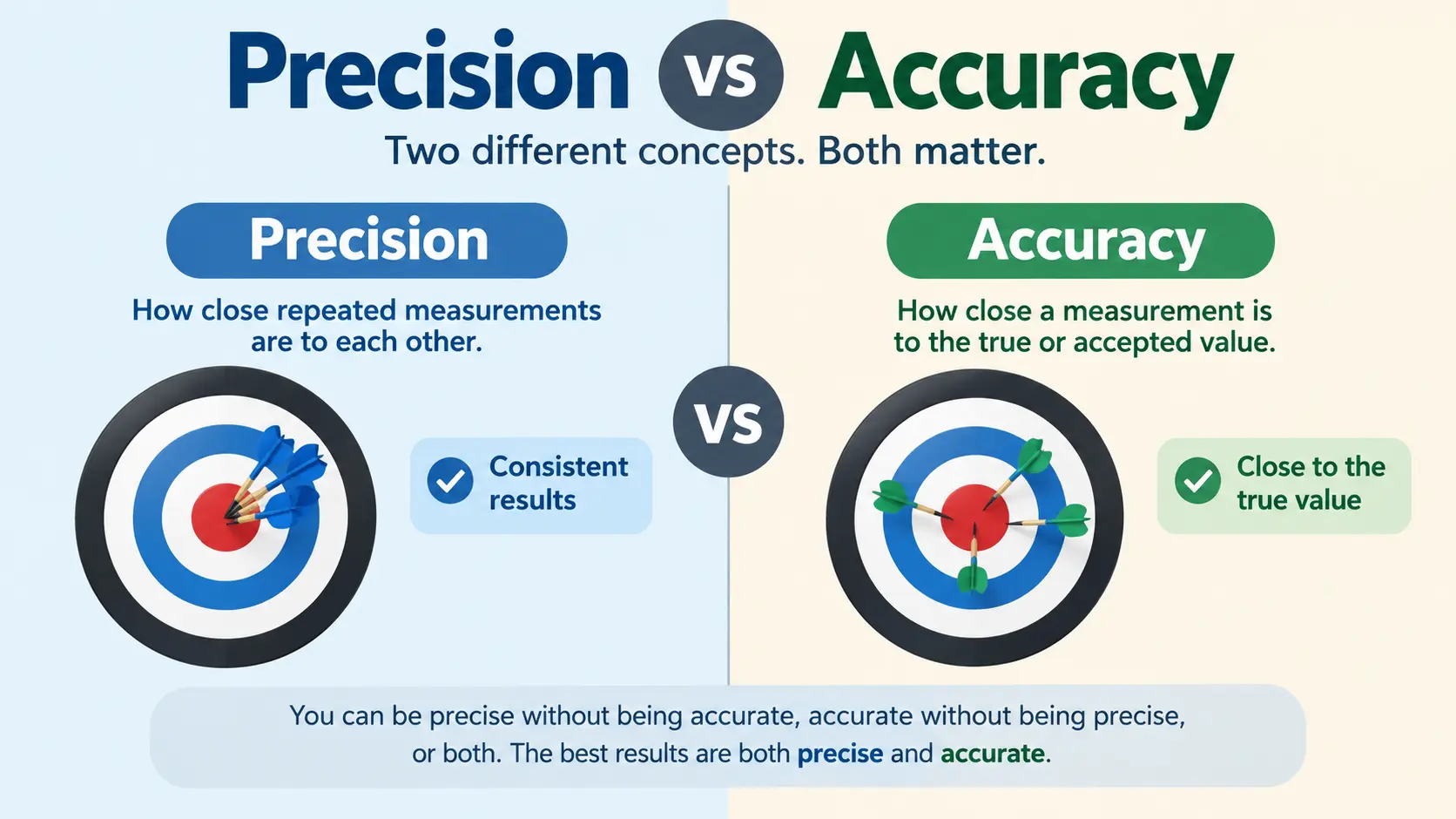
Precision vs accuracy describes two different qualities of measurement.
Accuracy means how close a measurement is to a true or accepted value, while precision means how closely repeated measurements agree with one another.
A result can be accurate but not precise, precise but not accurate, both, or neither.
Key Takeaways
Accuracy = closeness to the correct or accepted value.
Precision = consistency among repeated measurements.
A measurement can be precise without being accurate.
Random variation mainly affects precision, while systematic bias can shift results away from the correct value.
The ideal measurement is both accurate and precise.
1. Precision vs Accuracy: The Quick Difference
The words precision and accuracy are often used as if they mean the same thing. In science and measurement, however, they describe different properties.
The easiest way to separate them is:
Accuracy asks: “How close am I to the correct value?”
Precision asks: “How close are my repeated results to each other?”
For example, imagine that the actual mass of an object is 100 grams.
If a scale gives readings of 99.9 g, 100.1 g, and 100.0 g, the measurements are close to the accepted value and close to one another. They are both accurate and precise.
But if the scale repeatedly gives 105.0 g, 105.1 g, and 105.0 g, the readings are very consistent. They are precise, but they are not accurate because they are consistently away from the accepted value.
This distinction is fundamental in scientific measurement, laboratory work, engineering, and quality control.
2. What Is Accuracy?
Accuracy is the closeness of a measurement or result to a true or accepted reference value.
In simple terms, accuracy is about correctness.
Suppose you know that a standard object has a mass of exactly 50.0 grams. You measure it and get 50.1 grams. That result is close to the accepted value, so it has good accuracy.
Accuracy is judged by comparing a result with a reference or accepted value. NIST describes accuracy in terms of agreement with an accepted reference value and notes that, in metrology, accuracy is a qualitative concept rather than a number that should simply be assigned to a measurement.
Simple Example of Accuracy
Imagine you are measuring a table that is known to be 6 feet long.
Your measurements are:
- 6.01 feet
- 5.99 feet
- 6.02 feet
These values are close to 6 feet, so they show good accuracy.
Think: Accuracy = close to the target.
3. What Is Precision?
Precision is the degree to which repeated measurements agree with each other.
In simple terms, precision is about consistency or repeatability.
Suppose you measure an object several times and get:
- 24.51 g
- 24.50 g
- 24.52 g
- 24.51 g
The readings are tightly grouped. Even before knowing the object’s true mass, you can see that the measurements are highly consistent.
That means they are precise.
However, precision alone does not tell you whether the measurements are correct. If the actual mass is 25.00 grams, those tightly grouped readings are precise but inaccurate.
Think: Precision = close to each other.
4. Precision vs Accuracy: Side-by-Side Comparison
| Feature | Accuracy | Precision |
|---|---|---|
| Basic meaning | Closeness to the true or accepted value | Closeness of repeated measurements to one another |
| Main idea | Correctness | Consistency |
| Requires repeated measurements? | Not necessarily | Usually evaluated from repeated measurements |
| Compared with | A reference or accepted value | Other measurements |
| Can be high while the other is low? | Yes | Yes |
| Example | Measuring 10.01 g when the accepted value is 10.00 g | Measuring 9.81, 9.82, and 9.81 g repeatedly |
| Common concern | Bias or systematic error | Random variation |
| Ideal result | High accuracy | High precision |
The two properties are related, but they should not be treated as interchangeable. A measurement system can have high precision while still producing results that are systematically shifted away from the accepted value.
5. The Four Possible Measurement Outcomes
There are four useful ways to think about precision and accuracy.
Accurate and Precise
This is the ideal situation.
Your repeated measurements are:
- close to the accepted value, and
- close to one another.
For example, if the accepted value is 20.00 g:
- 20.01 g
- 20.00 g
- 19.99 g
These results are both accurate and precise.
Accurate but Not Precise
Here, the measurements are generally close to the correct value, but they are spread out from one another.
For example:
- 19.5 g
- 20.4 g
- 20.1 g
- 19.9 g
If the accepted value is 20.0 g, the results are centered around the correct value but have noticeable variation.
This represents accuracy without strong precision.
Precise but Not Accurate
This is one of the most important concepts to understand.
Imagine the accepted value is 50.0 g, but your measurements are:
- 47.2 g
- 47.2 g
- 47.3 g
- 47.2 g
The measurements are very close to each other, so they are precise.
But they are consistently far from 50.0 g, so they are not accurate.
A calibration problem can create this type of result.
Important: A consistent result is not automatically a correct result.
Neither Accurate Nor Precise
This is the weakest combination.
For example, if the accepted value is 100 g and your measurements are:
- 91 g
- 106 g
- 95 g
- 110 g
The results are scattered and generally far from the target.
They show neither strong accuracy nor strong precision.
6. Precision vs Accuracy Examples in Real Life
Using a Bathroom Scale
Suppose your actual weight is represented by a reference value of 150 lb.
A scale gives:
149.9, 150.1, 150.0 lb
The readings are close to the reference and close to one another. They demonstrate both accuracy and precision.
Now imagine another scale gives:
155.0, 155.1, 155.0 lb
Those readings are highly consistent, so the scale is precise. But if the reference value is 150 lb, the readings are not accurate.
This example shows why repeating a measurement does not automatically make it correct.
Measuring With a Ruler
Suppose a known object has a length of 10.0 cm.
If your measurements are:
- 9.99 cm
- 10.01 cm
- 10.00 cm
they are close to the accepted value and closely grouped.
A ruler or measurement method can also produce consistent readings that are shifted because of calibration or technique. In that case, precision can remain high while accuracy suffers.
Laboratory Measurements
Precision and accuracy are especially important in laboratory experiments.
Scientists may repeat a measurement several times to determine how consistently the procedure produces a result. They can then compare the results with a known or accepted value.
For example, analytical chemistry commonly distinguishes precision as reproducibility of measurements and accuracy as closeness to the true or accepted value.
7. How Errors Affect Precision and Accuracy
Understanding random error and systematic error makes the distinction easier.
Random Error
Random error causes measurements to vary from one attempt to another.
For example, a person may read a scale slightly differently each time, or environmental conditions may cause small changes.
Random variation generally affects precision because it makes repeated measurements less consistent.
Repeating measurements and improving measurement technique can help characterize or reduce the impact of random variation.
Systematic Error
A systematic error pushes measurements in a consistent direction.
For example, imagine a scale that consistently reads 2 pounds too high.
You might get:
- 152 lb
- 152.1 lb
- 151.9 lb
The readings are tightly grouped, so they are precise. But if the accepted value is 150 lb, they are not accurate.
Calibration problems are a common way to understand this concept.
Key Takeaway:
A measurement can be very consistent and still be wrong if a systematic bias affects the entire measurement process.
8. How to Improve Precision and Accuracy
Improving both qualities usually requires addressing different problems.
To Improve Precision
Focus on reducing unwanted variation.
Helpful approaches include:
- Repeat measurements under consistent conditions.
- Use the same measurement procedure each time.
- Improve operator technique.
- Control environmental conditions when possible.
- Use appropriate instruments.
- Analyze the spread of repeated results.
Statistical measures such as standard deviation can help describe the variability of repeated measurements.
To Improve Accuracy
Focus on getting measurements closer to the accepted value.
Useful steps may include:
- Calibrate instruments properly.
- Check the instrument against a known reference.
- Identify systematic sources of error.
- Follow validated measurement procedures.
- Use appropriate standards or reference materials.
- Check whether the measurement method itself introduces bias.
Improving precision does not automatically fix a systematic error. A poorly calibrated instrument can produce extremely consistent results that remain wrong.
9. Easy Way to Remember Precision vs Accuracy
If you keep mixing up the two terms, use this simple memory trick:
Accuracy = Aim
Think about hitting the correct target.
Precision = Pattern
Think about getting the same result repeatedly.
A classic dartboard analogy makes this easy to visualize:
- Darts near the bullseye: accurate
- Darts close together: precise
- Darts tightly grouped at the bullseye: accurate and precise
- Darts tightly grouped away from the bullseye: precise but not accurate
- Darts scattered around the bullseye: potentially accurate on average but not precise
- Darts scattered and far from the bullseye: neither
The dartboard example is widely used because it separates closeness to the target from closeness to each other.
10. Frequently Asked Questions
What is the main difference between precision and accuracy?
Accuracy describes how close a measurement is to a true or accepted value. Precision describes how closely repeated measurements agree with each other. A measurement can have one quality without having the other. Ideally, scientific measurements are both accurate and precise.
Can something be precise but not accurate?
Yes. A set of measurements can be tightly grouped but consistently different from the accepted value. For example, if the correct value is 10.0 and repeated measurements are 9.0, 9.0, and 9.1, the results are precise because they are close to each other but inaccurate because they are far from the correct value.
Can a measurement be accurate but not precise?
Yes. Measurements can vary substantially while being centered around or close to an accepted value. In that situation, the results may have reasonable accuracy but poor precision because they are not closely grouped.
Is precision or accuracy more important?
They serve different purposes, so neither term can simply replace the other. Accuracy matters when you need a result to agree with a reference value, while precision matters when you need measurements to be consistent. In many scientific applications, the goal is to achieve both.
Do repeated measurements improve accuracy?
Not necessarily. Repeating measurements can help you understand and reduce random variation, which can improve precision. But repeated measurements do not automatically correct a systematic bias. A consistently miscalibrated instrument can produce many precise measurements that remain inaccurate.
What is the easiest way to remember accuracy and precision?
Remember “accuracy = target” and “precision = consistency.” Accuracy asks how close the result is to the correct value. Precision asks how close repeated results are to each other.
11. Conclusion
The key to understanding precision vs accuracy is to separate correctness from consistency.
Accuracy tells you how close a measurement is to a true or accepted value. Precision tells you how closely repeated measurements agree with each other.
That means you can have results that are accurate but not precise, precise but not accurate, both, or neither. Random variation can reduce precision, while systematic bias can cause consistent measurements to miss the correct value.
For reliable scientific measurements, the goal is generally to achieve both high accuracy and high precision. Once you remember accuracy = close to the target and precision = close to each other, the difference becomes much easier to recognize.