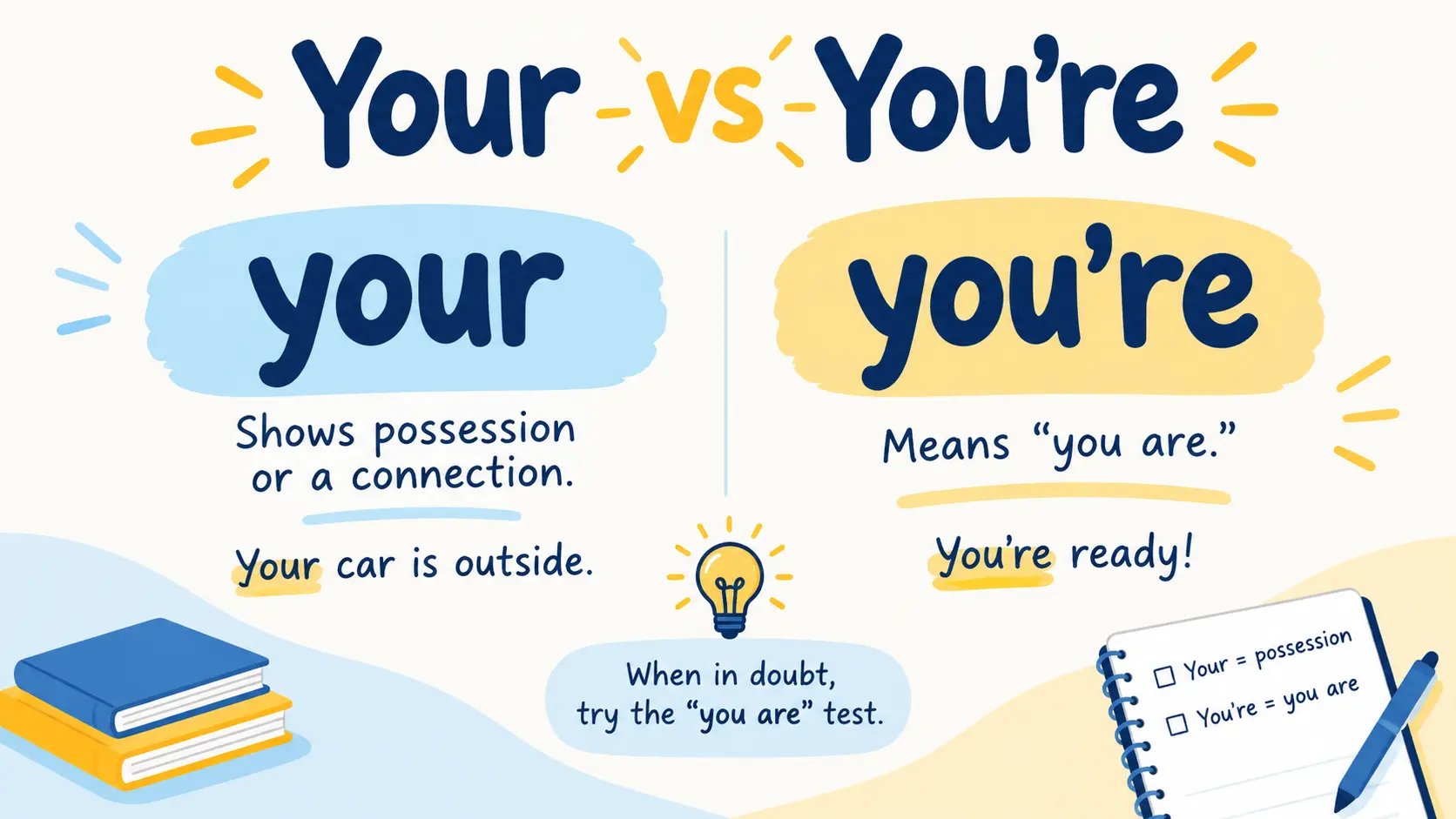
Your shows that something belongs to or is connected with you, as in “your phone” or “your idea.” You’re is the contraction of “you are,” as in “you’re ready” or “you’re helpful.”
A simple way to choose is to replace you’re with you are. If the sentence still makes sense, use you’re; otherwise, use your.
Key Takeaways
Your shows possession or a connection: “your car,” “your opinion.”
You’re is short for “you are.”
The apostrophe in you’re marks the contraction.
Use the “you are” test whenever you are unsure.
“Your welcome” is incorrect; the correct phrase is “You’re welcome.”
1. Your vs You’re: The Quick Difference
The words your and you’re are easy to confuse because they sound very similar in everyday speech. However, they have different meanings and grammatical functions.
The easiest rule is:
Your = belongs to or relates to you
You’re = you are
For example:
- Your jacket is on the chair.
- You’re wearing a jacket.
In the first sentence, your identifies whose jacket it is. In the second, you’re means “you are.”
Grammar references commonly explain the distinction in these same terms: your is possessive, while you’re is a contraction of you are.
💡 Tip: When you are unsure, don’t decide based on how the word sounds. Use the “you are” test instead.
2. When to Use “Your”
What Does “Your” Mean?
Your is used to show that something belongs to, relates to, or is associated with the person being addressed.
It usually comes before a noun or noun phrase.
Examples:
your house
your phone
your family
your favorite movie
your opinion
your name
your shoes
your idea
Consider this sentence:
I like your new car.
The word your tells us that the car belongs to or is associated with the person being spoken to.
Another example:
What is your favorite color?
Here, your connects the favorite color with the person being addressed.
Examples of Your in Sentences
| Sentence | Why “your” is correct |
|---|---|
| Is this your bag? | The bag belongs to or is associated with you. |
| I like your shoes. | The shoes are yours. |
| What is your name? | The name is associated with you. |
| Please check your email. | The email belongs to or is associated with you. |
| Your answer is correct. | The answer is associated with you. |
A useful pattern is to compare your with words such as my, his, her, or their. For example:
my book
your book
his book
her book
their book
The word your does not need an apostrophe to show this relationship.
🔑 Key Takeaway: Use your when you are talking about something belonging to or connected with you.
3. When to Use “You’re”
You’re Means “You Are”
You’re is a contraction of you are.
The apostrophe represents letters that have been omitted when the two words are combined.
You are → You’re
For example:
You are ready. → You’re ready.
You are late. → You’re late.
You are helpful. → You’re helpful.
You are going home. → You’re going home.
Because you’re means you are, you can normally replace it with those two words to check whether it is correct. This replacement test is also recommended in grammar-learning resources.
Examples of You’re in Sentences
| Sentence | Full form |
|---|---|
| You’re very kind. | You are very kind. |
| You’re going to love this movie. | You are going to love this movie. |
| I think you’re right. | I think you are right. |
| You’re doing a great job. | You are doing a great job. |
| If you’re ready, we can leave. | If you are ready, we can leave. |
Notice that you’re is not showing ownership.
Instead, it describes what someone is, does, or is doing.
💡 Tip: Whenever you see you’re, mentally expand it to you are. If the sentence still works, you have probably chosen the correct word.
4. Your vs You’re Comparison Table
| Feature | Your | You’re |
|---|---|---|
| Meaning | Belonging to or associated with you | You are |
| Grammatical role | Possessive determiner | Contraction |
| Apostrophe | No | Yes |
| Basic test | Usually comes before a noun | Replace with “you are” |
| Example | Your car is outside. | You’re outside. |
| Another example | I like your idea. | You’re creative. |
The key difference is therefore possession versus “you are.” Purdue OWL similarly identifies your as possessive and you’re as the contraction for you are.
5. The Easy “You Are” Test
The “you are” test is the fastest way to decide between your and you’re.
Step 1: Look at the sentence
Suppose you write:
I think your very talented.
You are unsure whether your is correct.
Step 2: Replace the word with “you are”
The sentence becomes:
I think you are very talented.
That sentence makes sense.
Therefore:
✅ I think you’re very talented.
Now try another example:
I like you’re new haircut.
Replace you’re with you are:
I like you are new haircut.
That does not work.
Therefore:
✅ I like your new haircut.
The Simple Rule
Ask yourself:
Can I replace “you’re” with “you are”?
- Yes → use you’re
- No → use your
This is particularly useful because the two forms can sound the same or very similar in ordinary speech, making pronunciation an unreliable way to choose the spelling.
🔑 Key Takeaway: Don’t guess from pronunciation. Expand you’re to you are and let the sentence tell you which word you need.
6. Common Your vs You’re Mistakes
“Your Welcome” vs. “You’re Welcome”
One of the most common mistakes is writing:
❌ Your welcome.
The correct version is:
✅ You’re welcome.
Why?
Because the sentence means:
You are welcome.
Since you’re = you are, the apostrophe is required.
“Your Going” vs. “You’re Going”
Incorrect:
❌ Your going to love this.
Correct:
✅ You’re going to love this.
The full sentence is:
You are going to love this.
Therefore, you’re is correct.
However:
✅ I like your new shoes.
Here, your is correct because it describes the shoes associated with you.
“You’re Keys” vs. “Your Keys”
Incorrect:
❌ Where are you’re keys?
Correct:
✅ Where are your keys?
You cannot say:
❌ Where are you are keys?
The sentence requires the possessive word your.
Compare:
- Your keys are on the table.
- You’re looking for your keys.
The first your identifies the keys. The second sentence contains you’re = you are and also your to identify the keys.
7. Your and You’re in the Same Sentence
Sometimes both words appear in one sentence, which makes the distinction easier to see.
Example 1
You’re going to need your passport.
Break it down:
- You’re = you are
- your passport = the passport associated with you
Example 2
You’re responsible for your homework.
- You’re = you are
- your homework = homework associated with you
Example 3
I hope you’re enjoying your vacation.
- you’re = you are
- your vacation = the vacation associated with you
These examples show why the two words cannot simply be treated as interchangeable.
💡 Tip: If both words appear in the same sentence, check each one independently. One can be you’re while the other is your.
8. Practice Quiz: Your or You’re?
Try choosing the correct word before checking the answers.
- Is this ___ phone?
- I think ___ going to enjoy the movie.
- ___ one of my closest friends.
- Please bring ___ identification.
- I hope ___ feeling better.
- Where did you put ___ keys?
- ___ probably right about that.
- I like ___ new haircut.
- Make sure ___ ready before we leave.
- What is ___ favorite restaurant?
Answers
- your – your phone
- you’re – you are going to enjoy
- you’re – you are one of my closest friends
- your – your identification
- you’re – you are feeling better
- your – your keys
- you’re – you are probably right
- your – your new haircut
- you’re – you are ready
- your – your favorite restaurant
If you can consistently apply the “you are” test, most of these choices become quick and automatic.
9. Frequently Asked Questions
What is the difference between your and you’re?
Your shows possession or a relationship with the person being addressed, such as “your book.” You’re is a contraction meaning “you are,” such as “you’re ready.” The easiest way to tell them apart is to replace you’re with you are and see whether the sentence still makes sense.
Is “your welcome” correct?
No. The standard expression is “You’re welcome” because it means “You are welcome.” Writing “your welcome” incorrectly treats your as though it were the contraction of “you are.”
Is “you’re” short for “you are”?
Yes. You’re is the contraction of you are. For example, “You’re late” can be written as “You are late.”
Is “your” a possessive word?
Yes. Your is used to indicate that something belongs to or is associated with the person being addressed. Examples include your house, your name, your opinion, and your family. In modern grammar terminology, it is commonly described as a possessive determiner.
How can I remember your vs. you’re?
Remember one simple rule:
Your = belongs to you
You’re = you are
When you are unsure, expand you’re to you are. If the sentence works, choose you’re. Otherwise, choose your.
Does “your” have an apostrophe?
No. Your does not use an apostrophe. You’re does because the apostrophe marks the contraction of you are. Purdue OWL specifically notes that contractions such as you’re use an apostrophe.
10. Conclusion
The difference between your and you’re is simple once you remember what each word does.
Your shows possession or association:
Your car is outside.
You’re means you are:
You’re waiting outside.
When you are unsure, use the “you are” test. Replace you’re with you are. If the sentence still makes sense, you’re is correct. If it does not, you probably need your.
With a little practice, this common grammar confusion becomes much easier to catch in schoolwork, emails, social media posts, and everyday writing.