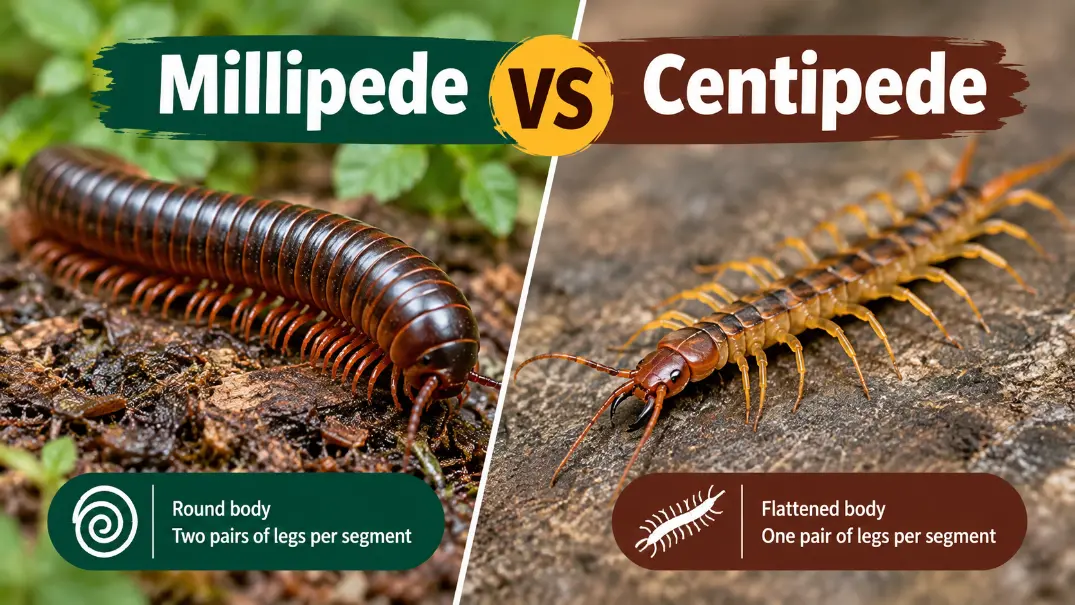
Millipede vs centipede: The easiest way to tell them apart is by their legs and body shape. Centipedes have one pair of legs per body segment, flattened bodies, and move quickly.
Millipedes usually have two pairs of legs per segment, rounded or cylindrical bodies, and move slowly. Centipedes are predators, while millipedes mainly feed on decaying plant material.
Key Takeaways
- 🐛 Centipedes have one pair of legs per body segment, while millipedes usually have two.
- ⚡ Centipedes are generally fast-moving predators; millipedes are slow-moving decomposers.
- 🌀 Millipedes commonly curl up when disturbed; centipedes generally run away.
- 🦷 Centipedes can bite, while millipedes do not bite people.
- 💧 Both are commonly associated with moist environments, although they have different diets and lifestyles.
1. Millipede vs Centipede: Quick Comparison
At first glance, millipedes and centipedes can look almost identical. Both are long, segmented arthropods with many legs, and both may appear in damp areas around homes and gardens.
The easiest way to separate them is to look at how their legs are arranged.
| Feature | Millipede | Centipede |
|---|---|---|
| Legs per body segment | Usually 2 pairs | 1 pair |
| Body shape | Rounded or cylindrical | Flattened |
| Movement | Slow | Fast |
| Main diet | Decaying plant material | Insects and other small animals |
| Reaction to disturbance | Often curls up | Usually runs away |
| Can bite? | No | Yes |
| Main defense | Defensive chemical secretion in some species | Venom delivered through modified front legs |
| Common habitat | Soil, mulch, leaf litter | Damp soil, under rocks, logs, and buildings |
| Ecological role | Decomposer | Predator |
These characteristics are consistent with descriptions from U.S. university extension programs and integrated pest management sources.
Tip: If you only remember one rule, remember this: one pair of legs per segment = centipede; two pairs per segment = millipede.
2. How to Tell a Millipede From a Centipede
Check the Legs
The legs provide the most reliable quick identification clue.
A centipede has one pair of legs on each body segment. Its legs usually extend outward from the sides of its flattened body.
A millipede generally has two pairs of legs on most body segments. Its legs are shorter and sit closer underneath its body. Some millipede segments can have different arrangements, especially near the front, so counting every leg is not always practical.
Look at the Body Shape
Centipedes generally have a flattened body, which helps them move through narrow spaces and under objects.
Millipedes tend to have a rounded or cylindrical body. Their overall shape often resembles a small tube.
This difference can be especially useful when the creature is moving too quickly for you to count its legs.
Watch How It Moves
Movement is another easy clue.
Centipedes are usually quick and agile. A house centipede, for example, can suddenly race across a floor, wall, or ceiling.
Millipedes move much more slowly. Their numerous legs create a noticeable wave-like movement as they travel.
See How It Reacts When Disturbed
A millipede commonly responds to disturbance by curling into a spiral or coil.
Centipedes generally do not coil up. Instead, they tend to move quickly toward a dark hiding place.
Key Takeaway: Body shape plus movement can help you identify the creature from a distance, but legs per body segment are the clearest structural difference.
3. Millipede vs Centipede: Legs and Body Structure
Millipede Legs
The name “millipede” suggests that these animals have 1,000 legs, but that is not generally true.
Most millipedes have two pairs of legs on most body segments. Some groups have four pairs on certain segments, and the first few segments have different arrangements.
Millipede legs are usually short and positioned underneath the body. As the animal walks, the legs move in coordinated waves.
Centipede Legs
Centipedes have one pair of legs per body segment.
Their legs tend to project outward, making the animal look more spread out than a millipede.
Centipedes also have a distinctive first pair of appendages called forcipules. These are modified structures used to deliver venom and help subdue prey.
Why the Names Are Misleading
“Centipede” roughly means “hundred feet,” while “millipede” means “thousand feet.”
Neither name should be taken literally.
The number of legs varies among species, and the names are historical descriptions rather than precise measurements. UC IPM notes that the actual number of legs on many centipedes is closer to 30 than 100.
Important: Don’t identify one of these animals only by total leg count. The number of legs per body segment is much more useful.
4. What Do Millipedes and Centipedes Eat?
Their diets are one of the biggest differences between them.
Millipede Diet
Millipedes mainly feed on decaying organic material.
This can include:
- 🍂 Dead leaves
- 🌿 Decaying plant material
- 🪵 Rotting wood
- Compost and other organic matter
- Fungi and related material
Because of this diet, millipedes are important decomposers in many ecosystems. They help break down dead plant material and return nutrients to the environment.
Centipede Diet
Centipedes are predators.
They hunt other small animals, including:
- Insects
- Spiders
- Other arthropods
- Other small soil-dwelling creatures
House centipedes may therefore be found in places where other small insects are available as prey. U.S. extension sources describe centipedes as beneficial predators in gardens and around homes.
Tip: If the creature is eating or associated with dead leaves and decaying plant material, millipede is more likely. If it is actively hunting other small creatures, centipede is more likely.
5. Do Millipedes and Centipedes Bite?
Millipedes
Millipedes do not bite people.
Instead, some species defend themselves by releasing chemicals from their bodies. These secretions can irritate skin and may be especially problematic if they get into the eyes.
For that reason, it is still a good idea to wash your hands after handling a millipede and avoid touching your eyes.
Centipedes
Centipedes can bite.
Their modified front appendages, called forcipules, can deliver venom used to subdue prey. Most encounters with people do not result in serious injury, and bites are relatively uncommon. However, some larger centipedes can cause painful bites with localized swelling or other symptoms.
A house centipede is generally considered much less concerning than larger centipede species.
Venom vs Defensive Chemicals
This distinction is important:
- Centipede: uses venom to capture prey and can bite when threatened.
- Millipede: does not bite; some species release defensive chemicals.
So, when people ask whether millipedes are “venomous,” they are usually confusing their chemical defense with the venom-delivery system of centipedes.
Important: Avoid handling either animal with bare hands. If a centipede bite causes severe or worsening symptoms, seek appropriate medical care.
6. Why Are They in Your House or Yard?
Why Millipedes Appear
Millipedes prefer cool, damp environments containing organic material.
You may find them around:
- Leaf litter
- Mulch
- Compost
- Rocks
- Boards
- Soil
- Damp foundations
- Basements or garages
Heavy rainfall or changes in soil moisture can sometimes cause millipedes to move from their normal outdoor habitat and appear in or around buildings.
Why Centipedes Appear
Centipedes also prefer damp hiding places.
Around homes, they may occur in:
- Basements
- Bathrooms
- Damp closets
- Under rocks
- Under logs
- Dark cracks and crevices
Because centipedes hunt insects and other arthropods, their presence can also be related to the availability of prey.
Key Takeaway: Finding either one around a home can point to moisture or favorable hiding conditions, but centipedes may also be attracted by other small arthropods that provide food.
7. Are Millipedes or Centipedes Dangerous?
For most people, neither should be considered a major household threat.
Millipedes generally pose little health risk, although their defensive secretions can irritate skin or eyes.
Centipedes are different because they can bite. Larger species can cause painful bites, but U.S. extension sources describe bites as uncommon and note that many household encounters involve species that are not considered highly dangerous to people.
Both animals are also part of natural ecosystems.
Millipedes help process decaying organic matter, while centipedes help control populations of other small arthropods.
Tip: Don’t assume that every many-legged creature indoors needs chemical treatment. Identification, moisture control, exclusion, and removing outdoor harborage are often useful first steps.
8. How to Keep Millipedes and Centipedes Away
If you regularly see these creatures around your home, focus on making the area less attractive to them.
Reduce Moisture
Fix leaks and improve ventilation in damp areas.
For outdoor areas, avoid unnecessary overwatering and allow soil near the foundation to dry when appropriate.
Remove Outdoor Hiding Places
Reduce conditions that provide shelter, such as excessive:
- Leaf litter
- Mulch
- Decaying vegetation
- Boards
- Rocks
- Other damp debris near the foundation
These changes can reduce favorable habitat around the structure.
Seal Entry Points
Check for gaps around:
- Doors
- Windows
- Foundation cracks
- Screens
- Other openings near ground level
Door sweeps, weather stripping, screens, and appropriate sealing can help reduce entry.
Vacuum Indoor Visitors
If you find an occasional millipede or centipede indoors, physically removing it with a vacuum or broom is often a simple option.
9. Frequently Asked Questions
Is a millipede the same as a centipede?
No. They are different groups of arthropods. Centipedes have one pair of legs per body segment and are predators, while millipedes generally have two pairs per segment and primarily feed on decaying organic material.
Which one bites, a millipede or centipede?
Centipedes can bite; millipedes do not. Centipedes have modified front appendages that deliver venom. Millipedes instead rely on behaviors such as curling up and, in some species, releasing defensive chemicals.
How can I tell a centipede from a millipede quickly?
Look at the body. A centipede usually has a flattened body, long outward-pointing legs, and fast movement. A millipede usually has a rounded body, shorter legs underneath, and slow movement. If you can see the segments clearly, one pair of legs per segment indicates a centipede, while two pairs usually indicate a millipede.
Do millipedes really have 1,000 legs?
Usually not. The name “millipede” means thousand-foot, but actual leg counts vary by species and the body segments do not all have the same arrangement. The name is not a literal description of the typical number of legs.
Do centipedes really have 100 legs?
Not necessarily. Centipede species have varying numbers of legs, and the total is generally not exactly 100. The more useful identification feature is that centipedes have one pair of legs per body segment.
Why do I keep finding millipedes in my house?
Millipedes are associated with moist outdoor environments and may enter buildings through cracks, gaps, windows, or doors. Excess moisture around a foundation can make the surrounding area more favorable to them.
Why do I keep finding centipedes in my house?
Centipedes prefer damp, dark hiding places and may enter homes where suitable moisture and prey are available. Basements, bathrooms, closets, cracks, and other damp areas can provide favorable conditions.
10. Conclusion
The easiest way to understand millipede vs centipede is to focus on their body structure and behavior. Centipedes have one pair of legs per body segment, flattened bodies, fast movement, and a predatory diet.
Millipedes generally have two pairs of legs per segment, rounded bodies, slower movement, and a diet based largely on decaying plant material.
The two also defend themselves differently. Centipedes can bite using venom-delivering forcipules, while millipedes do not bite and some species use defensive chemical secretions.
If you find either one around your home, reducing excess moisture, removing damp debris, and sealing entry points can help limit unwanted encounters.