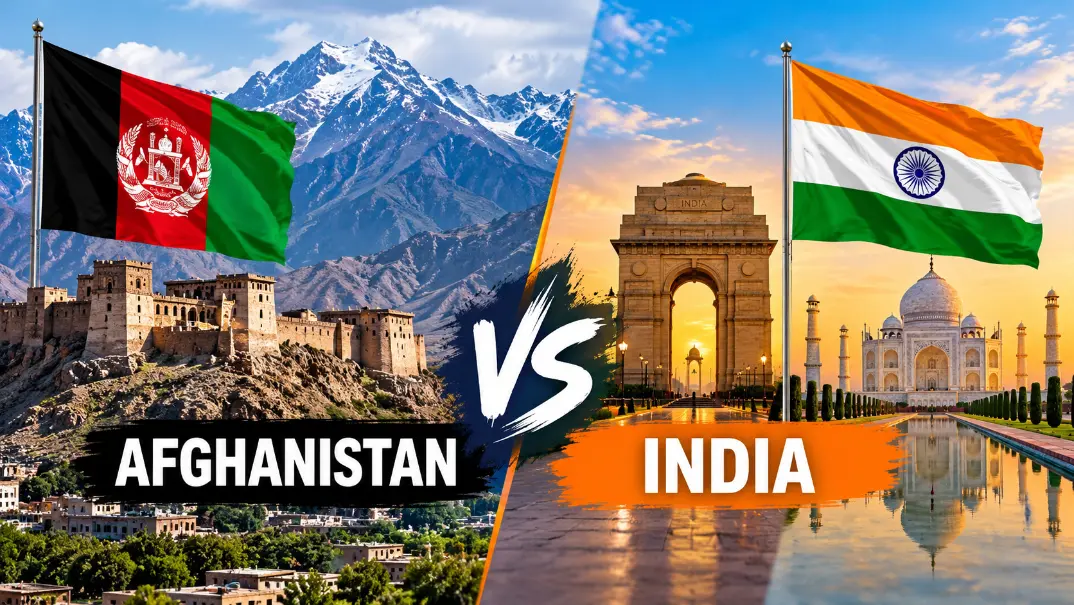
Afghanistan vs India is a comparison between two Asian countries with very different geographic, demographic, and economic profiles.
India is substantially larger in both population and total area, while Afghanistan is a landlocked country known for its mountainous terrain. India also has a much larger economy. The two countries have historical, cultural, diplomatic, development, and cricket connections.
Key Takeaways
- India is much larger than Afghanistan in both population and total area.
- World Bank data puts India’s population at about 1.46 billion in 2025, compared with roughly 43.8 million for Afghanistan.
- India’s 2025 GDP was approximately $3.96 trillion, while Afghanistan’s economy remains far smaller and more fragile.
- Afghanistan is landlocked and mountainous, while India has a much larger and more geographically diverse territory.
- Afghanistan and India have long-standing diplomatic and development ties, while cricket has become another important connection between the two countries.
- In their major men’s international cricket meetings through September 2026, India has maintained a strong record against Afghanistan, including wins in the 2026 Test, ODI, and T20I series.
1. Afghanistan vs India: Quick Comparison
The easiest way to understand Afghanistan vs India is to compare their population, geography, and economic size.
| Category | Afghanistan | India |
|---|---|---|
| Region | Asia | Asia |
| Capital | Kabul | New Delhi |
| Geography | Landlocked, mountainous | Large and geographically diverse |
| Population | About 43.8 million (2025) | About 1.46 billion (2025) |
| Area | About 652,230 km² | About 3.29 million km² |
| GDP | Much smaller economy | About $3.96 trillion (2025) |
| GDP per capita | Much lower | About $2,702 (2025) |
| Life expectancy | About 66 years | About 72 years |
| Cricket status | Full ICC member | Full ICC member |
World Bank data reports India’s 2025 population at about 1.46 billion and its current-dollar GDP at approximately $3.96 trillion. Afghanistan’s World Bank data shows a population of about 43.8 million in 2025, while its economy remains affected by structural and financial constraints.
Population and Area
India has roughly 33 times the population of Afghanistan based on the latest World Bank figures. India is also about five times larger by total area.
Key Takeaway: India is considerably larger than Afghanistan in both population and geographic size.
2. Geography: Afghanistan vs India
Afghanistan and India are both located in Asia, but their physical geography is quite different.
Afghanistan is landlocked, meaning it has no coastline. Much of the country consists of mountains, highlands, valleys, and dry regions. The Hindu Kush mountain system is one of its most important geographical features.
India has a much more varied physical landscape. It includes the Himalayan mountains in the north, the Indo-Gangetic Plain, the Thar Desert, the Deccan Plateau, extensive coastlines, and numerous rivers.
India’s geographical diversity also contributes to its wide range of climates, agricultural regions, ecosystems, and population centers.
Afghanistan’s mountainous geography has historically affected transportation, agriculture, settlement patterns, and connections between different parts of the country.
Is Afghanistan bigger than India?
No. Afghanistan covers roughly 652,230 square kilometers, while India covers approximately 3.29 million square kilometers. India is therefore about five times larger in area.
3. Population and Demographics
Population is one of the clearest differences in an Afghanistan vs India comparison.
According to the World Bank, Afghanistan had approximately 43.8 million people in 2025, while India’s population was approximately 1.46 billion.
India’s population is spread across thousands of cities, towns, and rural communities. Major population centers include Mumbai, Delhi, Bengaluru, Kolkata, Chennai, and Hyderabad.
Afghanistan has a much smaller population concentrated in urban centers such as Kabul, Kandahar, Herat, Mazar-i-Sharif, and Jalalabad, alongside extensive rural communities.
The countries also differ in population growth. World Bank figures show Afghanistan’s population growth rate was considerably higher than India’s in 2025.
Life expectancy also differs. The World Bank reports approximately 66 years for Afghanistan and 72 years for India using 2024 data.
Important: Population estimates can vary between international datasets, especially for Afghanistan, so figures should be treated as estimates rather than exact population counts.
4. Economy and Development
The economic difference between Afghanistan and India is substantial.
The World Bank reports India’s 2025 GDP at approximately $3.96 trillion, with GDP per capita of about $2,702.50. India’s economy has also recorded strong recent growth, with 2025 growth reported at 7.6%.
Afghanistan’s economy is considerably smaller. The World Bank says Afghanistan’s economy has been recovering, with growth projected at 4.3% in 2025 after 2.5% growth in 2024. However, it continues to face challenges involving the banking sector, declining external aid, trade deficits, unemployment, and limited economic participation among women.
India has a highly diversified economy covering:
- Information technology
- Manufacturing
- Pharmaceuticals
- Agriculture
- Financial services
- Retail
- Telecommunications
- Automotive production
- Energy
- Services
Afghanistan’s economy has stronger dependence on areas such as agriculture, mining, construction, and services. The World Bank identifies these sectors among the drivers of recent Afghan economic growth.
The comparison therefore involves not just the size of the two economies but also their different levels of economic diversification and infrastructure.
Key Takeaway: India has a vastly larger and more diversified economy, while Afghanistan’s economy is smaller and continues to face significant structural constraints.
5. Afghanistan and India Relations
Afghanistan and India have a long history of cultural and economic connections.
India’s Ministry of External Affairs describes the relationship as being based on historical links, cultural relations, and people-to-people connections. India has also supported development and reconstruction projects in Afghanistan.
India’s development involvement has included infrastructure, humanitarian assistance, education, health-related support, and other projects.
More recently, India has continued humanitarian assistance to Afghanistan. India’s 2024 annual report, for example, records shipments including 50,000 metric tons of wheat and 300 tonnes of medicines and medical/surgical supplies since August 2021.
The relationship has also evolved with Afghanistan’s changing political circumstances. India’s engagement since 2021 has included humanitarian assistance and diplomatic contacts while regional security and political issues remain important parts of the relationship.
The countries do not share a current internationally recognized land border. Afghanistan is separated from India by Pakistan-controlled territory, and the two countries’ geographic relationship is therefore different from that of directly neighboring states.
6. Afghanistan vs India in Cricket
For many people searching “Afghanistan vs India,” cricket is actually the intended topic.
Afghanistan has developed into a major international cricket team, while India has one of the sport’s largest cricket systems and a long Test, ODI, and T20I history.
The two teams have met in major international tournaments and bilateral series.
Recent 2026 Results
In June 2026, India hosted Afghanistan for a one-off Test and a three-match ODI series.
India won the Test by an innings and 300 runs.
India then won all three ODIs:
- India won by 7 wickets on June 13.
- India won by 170 runs on June 17.
- India won by 9 wickets on June 20.
The teams then played a three-match T20I series in September 2026. India won the first two matches by 7 wickets and the third by 127 runs.
Their men’s T20I series was followed by an Asian Games quarter-final meeting on September 28, 2026, which was abandoned.
These results show why Afghanistan vs India cricket is an important interpretation of the search term.
7. Afghanistan vs India: Biggest Differences
The main differences can be summarized simply:
Size
India is approximately five times larger in area than Afghanistan.
Population
India has more than one billion additional people compared with Afghanistan.
Economy
India’s economy is measured in trillions of U.S. dollars, while Afghanistan’s economy is much smaller and faces significant structural challenges.
Geography
Afghanistan is landlocked and dominated by mountainous terrain. India has mountains, plains, deserts, plateaus, forests, islands, and a long coastline.
Cricket
India has historically had a stronger overall international record against Afghanistan, while Afghanistan has become increasingly competitive in international cricket and has developed a strong reputation in the limited-overs formats.
8. Frequently Asked Questions
Is Afghanistan bigger than India?
No. Afghanistan covers about 652,230 square kilometers, while India covers roughly 3.29 million square kilometers. India is approximately five times larger by area.
Which country has more people, Afghanistan or India?
India has far more people. World Bank data puts India’s 2025 population at about 1.46 billion compared with roughly 43.8 million in Afghanistan.
Which economy is larger, Afghanistan or India?
India’s economy is much larger. The World Bank reports India’s 2025 GDP at approximately $3.96 trillion. Afghanistan’s economy is substantially smaller and continues to face major development and financial challenges.
Afghanistan and India do not currently have a directly accessible internationally recognized land border. Afghanistan is separated from India by territory administered by Pakistan.
Who has the better Afghanistan vs India cricket record?
In men’s international cricket, India has won the majority of completed meetings between the two teams. In 2026, India won the Test, all three ODIs, and all three T20Is against Afghanistan.
Why do Afghanistan and India have close relations?
Their relationship includes historical and cultural connections as well as development, humanitarian, diplomatic, and people-to-people ties. India has provided significant development and humanitarian assistance to Afghanistan over many years.
Conclusion
The Afghanistan vs India comparison highlights two Asian countries with very different scales and circumstances.
India is considerably larger in area and population and has a much larger, more diversified economy. Afghanistan is smaller, landlocked, and heavily shaped by its mountainous geography and recent economic and political challenges.
At the same time, the two countries have longstanding cultural and diplomatic connections, including India’s development and humanitarian engagement in Afghanistan.
Cricket has added another major dimension to their relationship, with the teams meeting regularly in international competition.
For someone searching Afghanistan vs India, the intended topic may therefore be either a country comparison or a cricket matchup. Looking at both provides a clearer picture of the similarities, differences, and connections between the two countries.