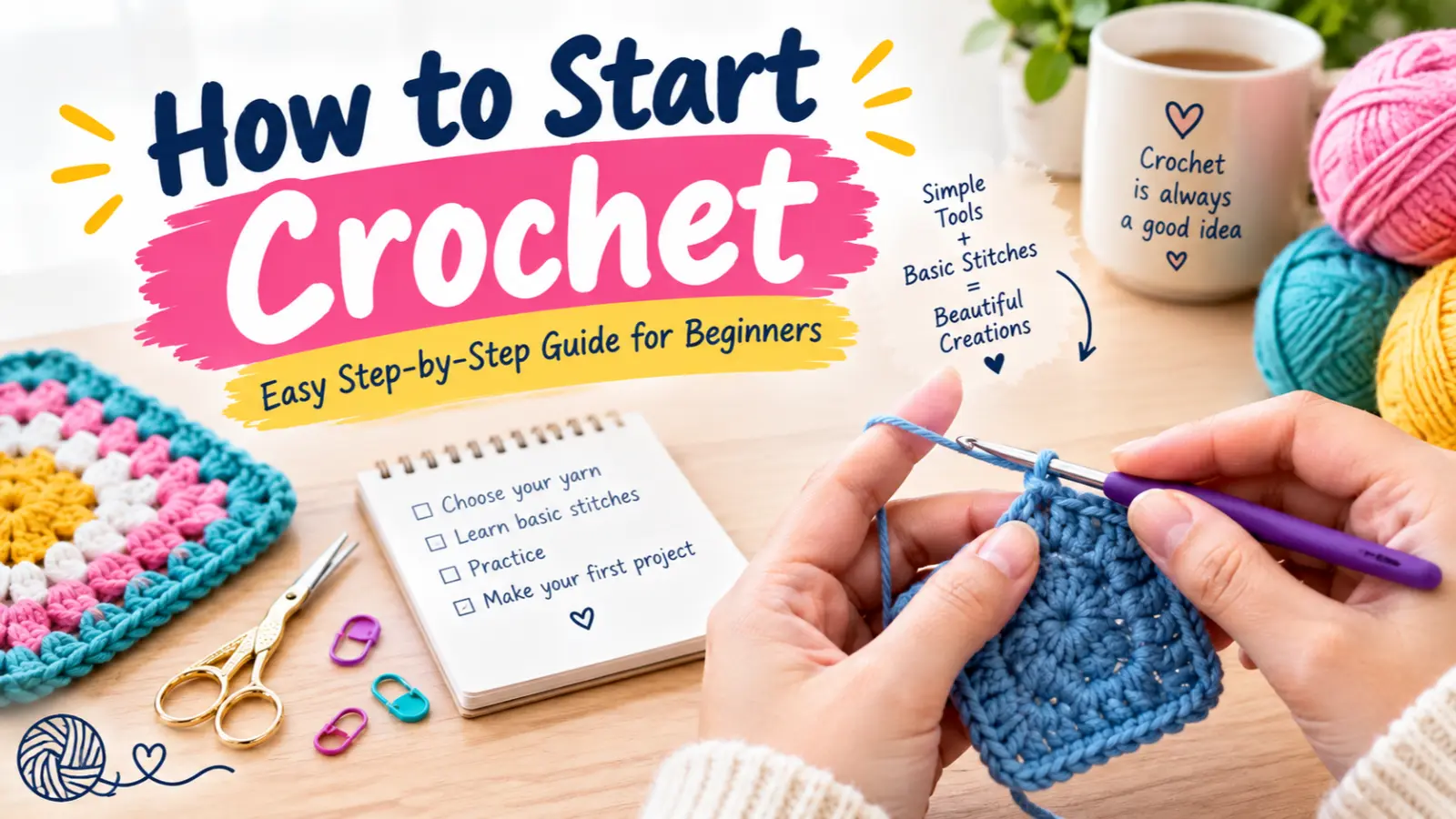
To start crochet, you need a crochet hook, smooth medium-weight yarn, scissors, and preferably a yarn needle.
Begin by learning a slip knot, foundation chain, and single crochet.
Practice short rows until you can control your tension and count stitches, then move on to a simple project such as a coaster, dishcloth, or small square.
Key Takeaways
- 🧶 Start with smooth, medium-weight yarn in a light or solid color.
- 🪝 A 5 mm or 5.5 mm hook is a practical starting point for many medium-weight yarns, but always check the yarn label.
- Learn slip knot → chain → single crochet → double crochet in that order.
- Focus on even tension and stitch counting, not speed.
- Choose a small, simple first project instead of starting with a blanket or complicated garment.
What You Need to Start Crochet
One of the biggest beginner mistakes is buying too many supplies before learning the basics. You can start with just a few inexpensive tools.
Choose the Right Yarn
For practice, choose a smooth, medium-weight yarn, often labeled #4 medium or worsted weight in the U.S.
A light or solid color is especially helpful because you can see the individual loops and stitches more easily.
The Craft Yarn Council classifies medium yarn as weight 4 and gives a general crochet hook range of about 4.5–5.5 mm for that category. These ranges are guidelines, so the yarn label and project instructions should take priority.
Avoid very fuzzy, dark, extremely thin, or novelty yarn when you’re learning. Those materials can make it harder to see where your hook should go.
Pick a Beginner-Friendly Crochet Hook
A 5 mm (H-8) or 5.5 mm (I-9) hook is a convenient starting point with many medium-weight yarns.
Hook size is measured in millimeters, and the Craft Yarn Council notes that millimeter sizing is the most reliable way to identify hook size because letter and number systems can vary.
Look for a hook that feels comfortable in your hand. You may naturally prefer a pencil-style grip or a knife-style grip, so comfort matters more than copying someone else’s exact technique.
Other Basic Supplies
You can begin with:
- Crochet hook
- Yarn
- Small scissors
- Yarn or tapestry needle
- Stitch markers, optional
You do not need a large crochet kit on your first day.
💡 Tip: Start with one hook and one easy-to-see yarn. Learning the movements is more important than collecting supplies.
Learn These Crochet Basics First
You don’t need to memorize dozens of stitches. Start with a small group of techniques and build from there.
Make a Slip Knot
The slip knot creates the adjustable starting loop that goes onto your crochet hook.
A simple method is:
- Make a loop with the yarn.
- Pull a section of the working yarn through the loop.
- Place the new loop on your hook.
- Gently tighten it around the hook.
It should be snug enough to stay on the hook but loose enough for the hook to move through it.
Create a Foundation Chain
The chain stitch (ch) is one of the first skills you’ll use.
To make a chain:
- Hold the hook with the slip knot on it.
- Bring the working yarn over the hook. This is called a yarn over.
- Pull the yarn through the loop already on your hook.
- Repeat.
Each completed pull-through creates another chain.
Try making a chain of 10–20 stitches without worrying about perfection. Your goal is to become comfortable controlling the yarn.
Learn Single Crochet
In U.S. crochet terminology, single crochet (sc) is one of the most useful beginner stitches.
After making a foundation chain:
- Insert the hook into the appropriate chain stitch.
- Yarn over.
- Pull up a loop.
- Yarn over again.
- Pull through both loops on the hook.
That’s one single crochet.
Repeat across the chain.
Single crochet creates a relatively short, compact fabric and is a common starting point for beginners. The Craft Yarn Council lists sc as the U.S. abbreviation for single crochet.
Add Double Crochet and Slip Stitch
Once single crochet feels comfortable, learn:
- Half double crochet (hdc)
- Double crochet (dc)
- Slip stitch (sl st)
These stitches give you more options for patterns and projects.
One important point for U.S. readers: crochet terminology can change between countries. For example, U.S. single crochet (sc) is called double crochet (dc) in UK terminology, while U.S. double crochet is called treble crochet in UK terminology. Always check which terminology a pattern uses.
⭐ Key Takeaway: Don’t try to learn every crochet stitch at once. Master the chain and single crochet first, then add new stitches gradually.
How to Start Your First Crochet Practice
Before beginning a large project, make a small practice swatch.
Start with about 15–20 chain stitches. Then work rows of single crochet.
Your first swatch may look uneven. That’s completely normal.
Focus on three things:
1. Keep your loops consistent.
Try not to make some stitches extremely tight and others very loose.
2. Count your stitches.
If you started with 20 stitches, check that you still have the expected number at the end of each row.
3. Practice turning.
At the end of a row, follow the pattern’s turning-chain instructions, turn your work, and crochet back across.
Repeat this for several rows.
The goal isn’t to make a beautiful square immediately. You’re teaching your hands how the hook, yarn, and tension work together.
Understand Crochet Tension and Stitch Counting
Two things cause many beginner problems: tension and counting.
How to Keep Your Tension Even
Tension means how tightly or loosely you hold and work the yarn.
If your stitches are extremely tight, your hook may be difficult to insert. If they’re very loose, the fabric can become uneven.
Try these habits:
- Relax your hands and shoulders.
- Don’t pull every stitch tightly.
- Let the hook move naturally.
- Practice slowly before trying to crochet quickly.
- Use the same yarn and hook while practicing.
Your tension will usually become more consistent with practice.
How to Stop Losing Stitches
Beginners often accidentally skip the first or last stitch of a row.
A stitch marker can help you identify the first or last stitch. You can also count your stitches at the end of every row.
If your practice rectangle keeps getting narrower, you’re probably missing stitches. If it keeps getting wider, you may be accidentally crocheting extra stitches.
Don’t immediately restart the entire project. Find where the stitch count changed and practice that section again.
⚠️ Important: Speed is not the goal when you’re learning crochet. Slow, consistent stitches are much more useful than fast, uneven ones.
Choose an Easy First Crochet Project
Once you can make a chain and several rows of basic stitches, choose a small project.
Good beginner choices include:
| Project | Why It’s Beginner-Friendly |
| Small square | Great for practicing rows |
| Coaster | Small and quick to finish |
| Dishcloth | Uses simple stitches |
| Bookmark | Requires little yarn |
| Simple scarf | Repeats basic rows |
| Granny square | Introduces working in rounds |
A small square or coaster is often a better first project than a blanket because you can practice the fundamentals without committing to hundreds of rows.
Don’t worry if your first finished item isn’t perfect. Finishing a small project teaches you how to start, maintain, and end your work.
Common Beginner Crochet Mistakes
Holding the Yarn Too Tightly
Tight tension can make it difficult to insert your hook.
Fix: Relax your grip and allow the yarn to move through your fingers.
Choosing Difficult Yarn
Fuzzy, very dark, or highly textured yarn can hide your stitches.
Fix: Use smooth, light-colored yarn while learning.
Using the Wrong Hook
A hook that is too small for your yarn can make your stitches unnecessarily tight.
Fix: Check the recommended hook size on the yarn label or pattern.
Forgetting to Count
It’s easy to lose a stitch when you’re focused on learning the movement.
Fix: Count your stitches at the end of every row.
Starting With a Complicated Pattern
A sweater, detailed amigurumi figure, or intricate blanket can introduce too many techniques at once.
Fix: Begin with a small project using one or two basic stitches.
How to Read a Simple Crochet Pattern
After learning the basic stitches, you can start using beginner patterns.
Crochet patterns often use abbreviations to keep instructions short. Common U.S. abbreviations include:
| Abbreviation | Meaning |
| ch | Chain |
| sl st | Slip stitch |
| sc | Single crochet |
| hdc | Half double crochet |
| dc | Double crochet |
| st | Stitch |
| yo | Yarn over |
| rnd | Round |
These abbreviations are part of the standardized U.S. crochet terminology documented by the Craft Yarn Council.
Before starting a pattern, check:
- The recommended yarn
- Hook size
- Gauge, if required
- Stitch abbreviations
- Special instructions
- Whether the pattern is written in U.S. or UK terminology
For a wearable or size-specific project, gauge becomes particularly important because it helps determine whether your finished piece will match the intended measurements. The Craft Yarn Council recommends checking your gauge against the pattern’s gauge and adjusting hook size when necessary.
🧶 Tip: Keep a small note beside your project with the hook size, yarn, stitch type, and row count. This makes it easier to return to your work without guessing.
FAQs About Starting Crochet
How do I start crocheting as a complete beginner?
Start with a medium-weight yarn and a comfortable hook. Learn how to make a slip knot, foundation chain, and single crochet. Practice a few short rows before attempting a finished project. This gives you time to develop basic tension and stitch-counting skills.
What is the easiest crochet stitch for beginners?
A single crochet is one of the easiest stitches for beginners to learn. Its basic movement is simple, and the resulting fabric makes it relatively easy to see individual stitches. Once you understand single crochet, you can move on to half double and double crochet.
What size crochet hook should a beginner use?
A 5 mm or 5.5 mm hook is a practical starting point when working with many medium-weight yarns. However, there isn’t one universal beginner hook. Check the yarn label and pattern instructions because recommended hook sizes depend on the yarn and the desired fabric.
What yarn is best for learning crochet?
A smooth, medium-weight yarn in a light or solid color is a good choice for practice. It makes individual stitches easier to see and is generally easier to handle than very thin, fuzzy, or highly textured yarn.
What should I crochet first?
Try a small square, coaster, dishcloth, bookmark, or simple scarf. Choose something that repeats one or two basic stitches. A small project lets you practice without becoming overwhelmed by a large amount of yarn or complicated shaping.
Is crochet hard to learn?
The basic movements are relatively simple, but beginners usually need practice to coordinate the hook, yarn, tension, and stitch counting. You don’t need to master everything immediately. Learning one technique at a time makes the process much easier.
Conclusion
Learning how to start crochet doesn’t require an expensive kit or dozens of complicated stitches. Begin with a comfortable hook, smooth medium-weight yarn, scissors, and a yarn needle.
Then learn the basics in a simple order: slip knot, chain, single crochet, and eventually double crochet and slip stitch.
Your first rows may be uneven, and that’s okay. Concentrate on relaxed tension, accurate stitch counting, and repeating the same movements until they feel natural.
Once you can make a few consistent rows, move to a small project such as a coaster, dishcloth, bookmark, or simple square.
From there, you can gradually learn patterns, rounds, shaping, and more advanced stitches.
The most important beginner crochet skill is patience. Start small, practice often, and let your hands learn the rhythm. 🧶