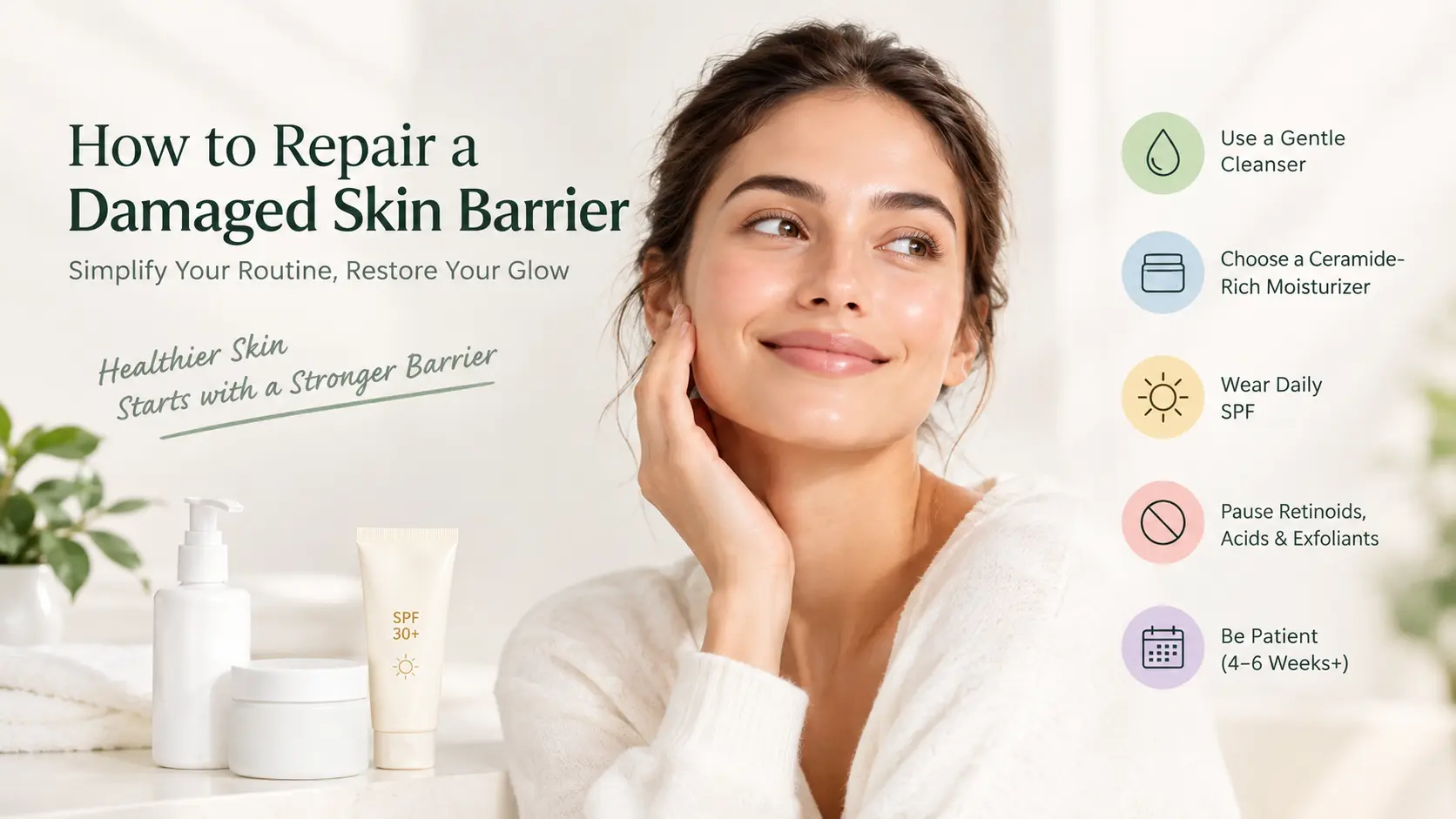
If your skin has started stinging when you apply products it used to tolerate just fine, or feels tight and flaky no matter how much moisturizer you layer on, you may be dealing with a damaged skin barrier.
It’s a frustrating place to be, your usual routine suddenly seems to be working against you, and the instinct to “fix it” with more products often makes things worse, not better.
The good news is that a damaged skin barrier is very repairable.
It just requires a different approach than most people expect: doing less, not more, and giving your skin real time to recover rather than chasing a quick fix.
This guide walks through exactly what the skin barrier is, how to recognize when it’s damaged, what typically causes it, and the step-by-step routine that actually helps it heal.
What Is the Skin Barrier?
To understand how to repair the skin barrier, it helps to understand what it actually is and where it sits within your skin’s structure.
Skin is made up of three main layers. The epidermis is the outermost layer, the one you can see and touch. Beneath it sits the dermis, which contains nerves, hair follicles, and blood vessels. Below that is the subcutaneous layer, made of fatty tissue that cushions and insulates the body.
The skin barrier itself lives within the outermost part of the epidermis, a layer called the stratum corneum. This is often described using a “brick and mortar” model: skin cells act as the bricks, while lipids, primarily ceramides and fatty acids, act as the mortar holding everything together. Together, they form a cohesive, protective shield.
That shield does two critical jobs at once. First, it locks moisture in, preventing water from evaporating out of deeper skin layers, a process called transepidermal water loss. Second, it keeps harmful things out, acting as your body’s first line of defense against bacteria, pollutants, allergens, and UV damage.
When the barrier is intact and healthy, skin generally looks and feels plump, smooth, and hydrated, and tolerates a normal skincare routine without excessive reaction. When the “mortar” between skin cells is stripped away whether through harsh products, environmental stress, or overuse of actives that protective seal breaks down, and both of the barrier’s core jobs start to fail simultaneously.
💡 Tip: A healthy skin barrier helps keep moisture in while keeping potential irritants out.
Signs Your Skin Barrier Is Damaged
A compromised skin barrier tends to announce itself fairly clearly, though the signs can range from mild irritation to more visible, persistent symptoms.
Redness, blotchiness, or persistent flushing. Skin that looks consistently flushed or irritated, even without an obvious trigger, is one of the most common early signs.
Stinging or burning with familiar products. This is often the clearest signal. If a cleanser, serum, or moisturizer you’ve used for weeks or months suddenly starts stinging or burning on application, your barrier’s protective function has likely weakened.
Persistent tightness, itchiness, or dryness. When moisturizer stops helping or only helps briefly before your skin feels tight and parched again it’s often because the barrier can’t hold onto that hydration anymore, not because you’re using the wrong product.
Increased sensitivity to weather or mild products. Skin that used to handle wind, cold, or product changes without issue may suddenly react strongly to the same conditions.
Breakouts and clogged pores. A weakened barrier lets dirt, bacteria, and pollutants settle more easily into pores, while excess oil (often produced to compensate for dryness) creates ideal conditions for breakouts.
Scaly or rough patches. Visibly flaky or textured areas, especially around the nose, cheeks, or forehead, often indicate the barrier isn’t retaining moisture properly.
Thinning or fragility. In more severe or prolonged cases, skin can start to feel visibly thinner and more delicate, making it more prone to sun damage and irritation.
If you’re noticing several of these signs together, especially stinging with familiar products, it’s a strong indicator your barrier needs attention.
🔑 Key Takeaway: Stinging, persistent dryness, redness, and increased sensitivity are important signs to pay attention to.
What Causes Skin Barrier Damage?
Understanding what damaged your barrier in the first place can help you avoid repeating the same mistakes once your skin has recovered.
Over-exfoliation. This is one of the most common culprits. Both physical exfoliants (scrubs, brushes) and chemical ones (AHAs, BHAs) work by removing or disrupting skin cells on the surface. Used too frequently, or in combination with each other, they strip away more of the protective “mortar” than your skin can replace, leaving it vulnerable.
Overuse of active ingredients. Retinoids, AHAs, BHAs, and vitamin C are genuinely effective ingredients, but they’re also some of the most common causes of barrier damage when introduced too quickly or layered together without adjustment. These activities work by speeding up cell turnover, which is beneficial in moderation but disruptive when overdone.
Harsh or stripping cleansers. Cleansers with high amounts of drying alcohol, strong surfactants, or a foaming formula can strip away natural oils along with dirt and makeup, weakening the barrier over time with repeated use.
Hot water and over-washing. Hot showers and frequent face-washing feel satisfying but can strip natural oils more aggressively than lukewarm water, contributing to cumulative barrier stress.
Environmental factors. Cold, dry weather, wind, pollution, and prolonged sun exposure all place ongoing stress on the barrier, sometimes compounding damage that’s already been caused by product overuse.
Underlying skin conditions. Conditions like eczema, psoriasis, and rosacea can make the barrier inherently more prone to disruption, meaning flare-ups may require a different, more cautious approach than typical barrier repair.
⚠️ Important: Understanding the likely cause of barrier damage can help you avoid repeating the same triggers.
The Core Repair Strategy: Simplify First
If there’s one universal piece of advice across dermatologists and skincare experts on barrier repair, it’s this: simplify before you do anything else. When skin is compromised, more products, even good ones, typically create more irritation, not less.
Why less is more. A damaged barrier is, by definition, more vulnerable to disruption. Every additional active ingredient, fragrance, or unfamiliar formula is another potential source of irritation for skin that’s already struggling to protect itself. Stripping your routine down removes variables, giving your skin the space to actually recover rather than constantly reacting to new inputs.
What to pause immediately. Retinoids, AHAs, BHAs, vitamin C, and physical scrubs should all be set aside while your barrier heals. These ingredients work specifically by speeding up cell turnover or exfoliating the skin’s surface exactly the kind of disruption a compromised barrier doesn’t need right now, however beneficial they normally are.
Building a minimal recovery routine. During this phase, your entire routine should shrink down to the essentials: a gentle cleanser, a hydrating serum or moisturizer, and daily SPF. Resist the temptation to add in a new “barrier repair” product every few days looking for faster results even well-intentioned additions can slow things down if your skin hasn’t stabilized yet.
How long to stay simplified. Most guidance suggests sticking with this pared-back routine for at least 2 to 3 weeks before even considering reintroducing activities, though full repair can take longer depending on the extent of the damage, something we’ll cover in more detail later in this guide.
💡 Tip: When your skin barrier is compromised, a simple routine is easier for your skin to tolerate and easier for you to monitor.
Step-by-Step Repair Routine
With your routine simplified, here’s exactly how to structure your daily skincare while your barrier heals.
Step 1: Choose a gentle, pH-balanced cleanser
Look for a creamy, non-foaming formula that removes impurities without stripping natural oils. Avoid cleansers with high alcohol content or strong surfactants, since these can undo the progress you’re trying to make.
Step 2: Cleanse properly
Use lukewarm water rather than hot, which can further strip already-vulnerable skin. After cleansing, pat your skin dry with a clean towel rather than rubbing, which can create additional irritation on sensitive skin.
Step 3: Apply hydrating, barrier-supporting products
Follow cleansing with a hydrating serum or mist containing humectants like hyaluronic acid, which draw moisture into the skin. This step adds water content that your next step will help lock in.
Step 4: Moisturize with occlusive, barrier-supporting ingredients
Choose a rich, ointment-based moisturizer over thin lotions, especially if your skin stings easily. Look specifically for ceramide-rich formulas, since ceramides help rebuild the barrier’s structural “mortar” rather than just adding surface hydration.
Step 5: Protect with daily SPF
Finish your morning routine with a broad-spectrum SPF 30 or higher. Sun exposure adds unnecessary stress to skin that’s already working to heal, so this step isn’t optional: choose a formula that feels comfortable and doesn’t sting on application.
Optional: extra soothing measures
Some people find relief from cool compresses or chilling their moisturizer in the fridge before application, which can provide a calming, temporary reduction in stinging or inflammation on particularly reactive days.
🔑 Key Takeaway: Keep your recovery routine simple: cleanse gently, hydrate, moisturize, and protect with daily SPF.
Key Ingredients That Support Barrier Repair
Not all “hydrating” ingredients do the same job. Some add moisture, while others actually help rebuild the barrier’s structure and understanding the difference helps you choose products more effectively during recovery.
Ceramides. These are one of the most important ingredients for barrier repair specifically, since they directly replenish the lipids that make up the barrier’s protective “mortar.” Look for ceramide-rich moisturizers as a foundation of your recovery routine.
Fatty acids and cholesterol. These work alongside ceramides to fortify the barrier’s structure. Together, ceramides, fatty acids, and cholesterol form the three core lipids your skin needs to maintain a healthy barrier.
Niacinamide. This versatile ingredient helps reduce redness, supports healthy skin cell function, and can improve overall skin resilience making it a useful addition once your skin can tolerate active ingredients again, and often even during the recovery phase itself in gentle formulations.
Hyaluronic acid and glycerin. Both are humectants, meaning they draw moisture into the skin from the environment and deeper layers. They add hydration but don’t rebuild the barrier structure on their own, which is why pairing them with ceramides matters.
Squalane. A lightweight, non-comedogenic oil that moisturizes while helping prevent water loss, without the heaviness of some occlusive ingredients.
Colloidal oatmeal. Known for its calming properties, this ingredient can reduce inflammation and soothe irritated, reactive skin.
Dimethicone. A skin protectant that forms a barrier on the skin’s surface to reduce water loss while your natural barrier rebuilds underneath.
Ingredients to avoid during repair. Steer clear of high concentrations of drying alcohol, added fragrance, and harsh surfactants, all of which can undermine your recovery efforts.
💡 Tip: Ceramides, fatty acids, and cholesterol are especially important when choosing barrier-supporting products.
What to Avoid While Healing
Knowing what to skip during barrier repair matters just as much as knowing what to add and a few common habits can quietly slow down or even reverse your progress.
Retinoids, AHAs, BHAs, and vitamin C. These active ingredients are genuinely beneficial for skin long-term, but they all work by increasing cell turnover or exfoliating the surface exactly the kind of disruption a healing barrier doesn’t need. Set these aside completely until your skin feels stable again, rather than trying to use them at a “reduced” frequency.
Physical scrubs and exfoliating tools. Facial brushes, scrub particles, and other manual exfoliation methods can create micro-tears in already-compromised skin. Even gentle-seeming tools should be paused during recovery.
Hot showers and hot water on the face. As tempting as a hot shower feels, high water temperatures strip natural oils more aggressively than lukewarm water, adding cumulative stress to skin that’s trying to rebuild its lipid barrier.
Introducing new, untested products. It’s tempting to try a new “barrier repair” serum the moment you spot one, but introducing multiple new products at once makes it difficult to know what’s helping and what might be causing further irritation. Stick to your simplified routine and change one variable at a time, if at all.
Over-cleansing. Double cleansing, washing your face more than twice a day, or using additional toning steps can all strip away progress your skin has made. During recovery, simpler and less frequent cleansing is almost always better.
Skipping SPF. Some people assume sunscreen might irritate healing skin, but skipping it entirely leaves skin exposed to UV stress that actively works against repair.
⚠️ Important: Avoid adding multiple new products while your skin is still reactive.
How Long Does Skin Barrier Repair Take?
One of the most common questions during barrier repair is simply: how long is this going to take? The honest answer involves a range, but there are some reliable general benchmarks.
Typical timeline. With a consistent, pared-back routine, most people notice meaningful improvement within 4 to 6 weeks. This isn’t necessarily when the barrier is fully, completely healed, but it’s generally when symptoms like stinging, redness, and tightness become noticeably less frequent and less severe.
More severe cases take longer. If barrier damage has been building for months through consistent over-exfoliation or heavy active use, recovery may extend beyond the typical 4-to-6-week window. Chronic, long-term damage naturally takes more time to reverse than damage from a single harsh treatment or a few weeks of overuse.
Factors that affect healing speed. Several variables influence your personal timeline: how severe the damage is, how consistently you stick to a simplified routine, your skin’s individual healing capacity, and whether you continue any barrier-stressing habits (like hot showers or occasional exfoliation) during the recovery period.
Why patience matters more than intensity. It can be tempting to try to speed things up by adding more “repair” products or switching formulas frequently in search of faster results. In reality, this kind of product-hopping often works against recovery by reintroducing variables your skin has to adjust to. Consistency with a simple routine typically outperforms an aggressive, multi-product approach.
Visible improvement vs. full repair. Don’t be discouraged if your skin looks noticeably better within a couple of weeks but isn’t fully back to its baseline tolerance yet surface improvement often comes before the barrier is fully rebuilt underneath.
🔑 Key Takeaway: Visible improvement may come before complete barrier repair, so consistency and patience matter.
Reintroducing Actives After Repair
Once your skin feels calmer and more resilient, you’ll likely want to bring back the activities you paused but doing this too quickly can undo weeks of progress, so a gradual approach matters.
How to know your barrier has healed. Look for a consistent absence of stinging, burning, or reactivity to your simplified routine for at least a week or two. Skin should feel comfortable, not tight, and tolerate your gentle cleanser and moisturizer without any noticeable irritation before you consider adding anything new.
Gradual reintroduction strategy. Rather than jumping back into your full previous routine, bring back one active ingredient at a time, starting with a lower frequency than you used before for example, once or twice a week rather than daily. Give your skin several days to a week to show how it responds before adding anything else.
Order of reintroduction. Many people find it easiest to start with gentler activities, like a low-percentage niacinamide or a mild vitamin C, before moving on to stronger options like retinoids or chemical exfoliants. Retinoids and exfoliating acids tend to be more likely to trigger irritation, so introducing them last, and slowly, gives your rebuilt barrier the best chance of tolerating them well.
Signs you’ve reintroduced too soon. If stinging, redness, or tightness returns after adding a product back, that’s a clear signal to pause that specific ingredient again and give your skin more recovery time. This isn’t a failure, it simply means your barrier needs a bit longer before it can handle that level of activity again.
💡 Tip: Reintroduce only one active at a time so you can clearly see how your skin responds.
Professional and In-Office Options
For most cases, at-home care is enough to fully repair a damaged skin barrier. But in more persistent or severe situations, professional treatment can offer support that a home routine alone can’t.
When at-home care isn’t enough. If you’ve maintained a genuinely simplified, gentle routine for several weeks with little to no improvement, or if symptoms are worsening rather than stabilizing, it’s a sign that professional input is worth considering rather than continuing to wait it out.
LED light therapy. Some skincare professionals offer LED light therapy as a complementary treatment during barrier repair. This is generally used to support cell renewal and calm inflammation, and is often recommended alongside not instead of a proper at-home recovery routine.
Dermatologist-recommended treatments. A dermatologist can assess the extent of your barrier damage directly, which is especially useful if you’re unsure whether you’re dealing with straightforward barrier disruption or something else entirely, like a reaction, infection, or an underlying skin condition that mimics barrier damage.
Prescription options for severe cases. In certain situations particularly where inflammation is significant or an underlying condition like eczema or rosacea is contributing to the damage a dermatologist may recommend prescription-strength treatments tailored to your specific skin. This isn’t something to self-diagnose or pursue without professional guidance, since the right treatment depends heavily on what’s actually driving the irritation.
The bottom line on professional care. Think of in-office options as a supplement to, not a replacement for, the fundamentals covered earlier: simplifying your routine, supporting hydration, and protecting your skin daily while it heals.
⚠️ Important: Persistent or worsening irritation may need professional evaluation rather than continued experimentation.
Preventing Future Barrier Damage
Once your skin barrier has recovered, the goal shifts from repair to prevention building habits that keep your barrier resilient long-term rather than cycling through damage and recovery repeatedly.
Build sustainable skincare habits. Rather than reaching for every trending active ingredient at once, introduce new products slowly and give your skin time to adjust before adding the next one. A routine that changes constantly makes it much harder for your barrier to stay stable.
Patch-test new products. Before applying a new active or unfamiliar formula to your entire face, test it on a small area first like the inside of your wrist or along your jawline and wait 24 to 48 hours to check for a reaction. This simple habit can catch potential irritants before they affect your whole face.
Avoid over-layering activities. Combining multiple strong activities in a single routine, say, a retinol, an AHA, and vitamin C all in one day significantly increases the risk of cumulative irritation. Space out strong ingredients across different days, or alternate them, rather than using everything at once.
Adjust your routine seasonally. Skin often needs different support in winter versus summer. Cold, dry air can strip moisture more aggressively, while heat and humidity change how your skin tolerates certain products. Being willing to lighten or richen your routine with the seasons helps prevent barrier stress before it starts.
Listen to your skin’s feedback. Mild stinging or increased sensitivity is often an early warning sign, not something to push through. Treating these signals seriously by pausing a product or simplifying temporarily can prevent a minor issue from becoming a full barrier breakdown.
💡 Tip: Introduce new skincare products slowly and pay attention to early signs of irritation.
Common Mistakes People Make
Even well-intentioned skincare routines can accidentally work against barrier repair. Here are the mistakes that show up most often.
Over-exfoliating “to fix” irritated skin. It’s a common but counterproductive instinct, skin looks dull or textured, so the response is to exfoliate more. When the underlying issue is actually barrier damage, additional exfoliation only strips away more of the protective lipids your skin desperately needs, making the problem worse rather than better.
Piling on new products to solve a reaction. When skin starts reacting, it’s tempting to add serum after serum searching for the one that calms things down. In reality, each new product introduces another variable your compromised skin has to process, often extending irritation rather than resolving it.
Confusing hydration with barrier repair. Drinking more water or applying a hydrating serum can make skin feel temporarily better, but hydration alone doesn’t rebuild the barrier’s lipid structure. Without ceramides and fatty acids specifically, skin may keep losing that added moisture as quickly as it’s applied.
Skipping SPF during recovery. Some people assume sunscreen will irritate already-sensitive skin, so they skip it while healing. In reality, unprotected UV exposure adds ongoing stress that works directly against repair. The better move is finding a gentle, comfortable SPF formula rather than avoiding sunscreen altogether.
Giving up on a routine too early. Because visible improvement can take weeks, some people abandon a simplified routine after just a few days, assuming it isn’t working, and jump to a different approach. Switching too frequently resets the clock and makes it harder to know what’s actually helping.
🔑 Key Takeaway: One of the biggest barriers to recovery is repeatedly changing your routine before your skin has time to respond.
When to See a Dermatologist
Most skin barrier damage responds well to a simplified, consistent at-home routine. But there are clear situations where professional input is genuinely worth seeking out rather than continuing to self-treat.
Signs of infection. If your skin shows increasing pain, pus, spreading redness, warmth, or a wound-like area that isn’t healing, this goes beyond typical barrier damage and warrants prompt medical attention. Infections can develop when compromised skin becomes more vulnerable to bacteria, and these situations generally need more than a gentle skincare routine to resolve.
Irritation that doesn’t improve after two or more weeks. While full barrier repair can take 4 to 6 weeks or longer, you should generally see some gradual improvement within the first couple of weeks of a simplified routine. If symptoms are staying the same or getting worse despite consistent, gentle care, it’s a sign something more than standard barrier damage may be at play.
Underlying conditions that mimic barrier damage. Conditions like eczema, psoriasis, rosacea, or contact dermatitis can look similar to typical barrier disruption but often require targeted treatment beyond a general repair routine. A dermatologist can help distinguish between these possibilities and recommend an approach suited to what’s actually happening with your skin.
When professional treatment is worth the appointment. If you’ve tried simplifying your routine, focusing on hydration and barrier-supporting ingredients, and protecting with SPF, but you’re still struggling after a reasonable amount of time, a dermatologist can offer prescription-strength options and a more precise diagnosis than at-home trial and error allows.
When in doubt, checking in with a professional costs little and can save weeks of continued discomfort.
⚠️ Important: Signs such as increasing pain, pus, spreading redness, warmth, or a wound-like area should not be treated as ordinary barrier damage.
FAQs
How long does it take to repair a damaged skin barrier?
Most people see meaningful improvement within 4 to 6 weeks with a consistent, simplified routine. More severe or long-standing damage may take longer.
What are the first signs of a damaged skin barrier?
Stinging or burning with products you used to tolerate, persistent tightness or dryness, redness, and increased sensitivity to weather or mild products are usually the earliest signals.
Can a damaged skin barrier heal on its own?
Skin can regenerate naturally to some extent, but without a supportive routine simplified products, hydration, and SPF irritation often persists or worsens rather than resolving on its own.
What ingredients help repair the skin barrier?
Ceramides, fatty acids, cholesterol, niacinamide, hyaluronic acid, glycerin, squalane, colloidal oatmeal, and dimethicone are all well-supported for barrier support and repair.
What should I avoid while my skin barrier heals?
Retinoids, AHAs, BHAs, vitamin C, physical scrubs, hot water, and introducing new untested products should all be paused until your skin feels stable again.
Is moisturizer enough to fix a damaged skin barrier?
Not entirely. Hydration adds moisture, but ceramide-rich, barrier-supporting ingredients are what actually help rebuild the barrier’s structure so skin can retain that moisture long-term.
When should I see a dermatologist about my skin barrier?
If you notice signs of infection, or irritation hasn’t improved after two or more weeks of a simplified routine, it’s worth getting a professional evaluation.
How do I know when it’s safe to reintroduce activities?
Once your skin tolerates your simplified routine with no stinging or irritation for at least a week or two, reintroduce one active at a time, starting slowly.
Conclusion
Repairing a damaged skin barrier starts with one simple principle: less is more.
When skin stings or reacts, adding more products or exfoliating can make things worse.
Instead, simplify your routine and give your skin time to recover.
A gentle cleanser, hydrating ceramide-rich moisturizer, and daily SPF provide the foundation for healing.
Pause retinoids, acids, and physical exfoliants until your skin feels calm and comfortable. Many people notice meaningful improvement within 4 to 6 weeks, although more severe damage may take longer.
Once your skin feels resilient again, reintroduce products gradually, adding one active ingredient at a time. Patch-test new products and listen to early signs of irritation.
If symptoms worsen, don’t improve, or include signs of infection, consult a dermatologist. Patience, consistency, and a gentle routine are essential for supporting skin barri