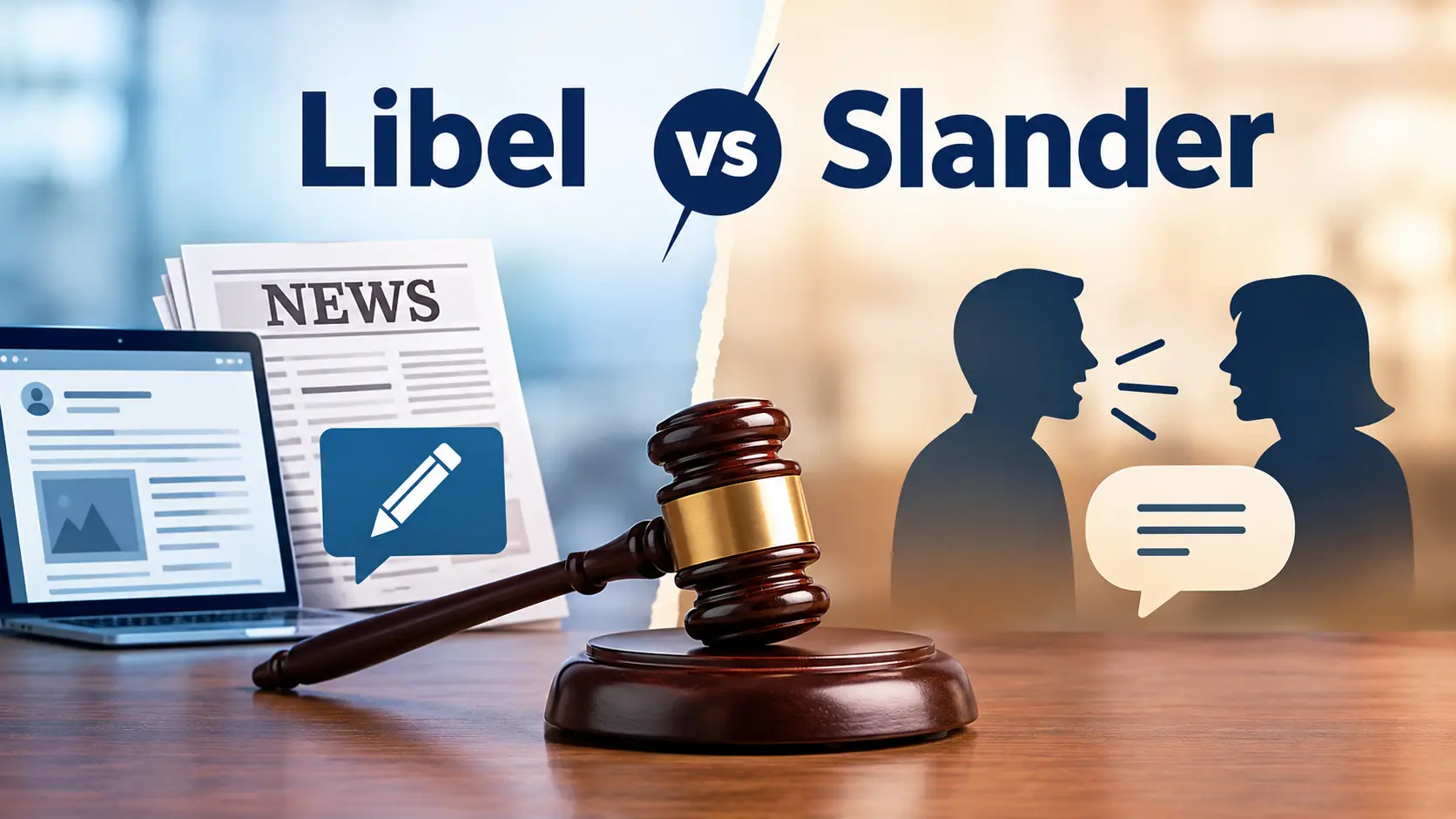
Libel and slander are both forms of defamation, but they traditionally differ in how the statement is communicated.
Libel generally involves a defamatory statement in written, printed, or otherwise fixed form, while slander generally involves a defamatory spoken statement.
In the United States, however, the exact legal rules vary by state and can depend on the type of communication, the person involved, and the circumstances.
Key Takeaways
- Libel generally refers to defamatory statements that are written, printed, published, or otherwise recorded in a fixed form.
- Slander generally refers to defamatory statements communicated through speech or other temporary oral communication.
- Both involve more than simply saying something negative: a defamation claim generally concerns a false statement of fact that is communicated to someone else and causes legally recognized harm.
- Truth is generally a complete defense to a defamation claim.
- Social media, podcasts, videos, and messaging have made the traditional libel-versus-slander distinction less straightforward.
What Is the Difference Between Libel and Slander?
The simplest way to remember libel vs slander is:
Libel is generally written or fixed; slander is generally spoken.
Both are forms of defamation, which is the broader legal concept involving statements that harm another person’s reputation.
| Feature | Libel | Slander |
|---|---|---|
| Traditional form | Written or fixed | Spoken |
| Common examples | Article, post, letter, printed review | Conversation, speech, verbal accusation |
| Usually preserved? | Yes | Often temporary |
| Defamation category | Yes | Yes |
| Governing law | Primarily state law | Primarily state law |
| Can occur online? | Yes | Yes, depending on the communication |
For example, suppose someone falsely posts online that a local business owner stole money from customers. Because the accusation appears in a written online post, it would generally be treated as libel.
If the same person falsely tells several customers in person that the business owner stole money, the statement would generally fall under slander.
The distinction is useful, but it is not always as simple as “anything digital is libel and anything involving sound is slander.” Modern forms of communication can blur the traditional categories.
What Is Libel?
Libel is a form of defamation involving a statement communicated in a written, printed, pictured, or otherwise fixed form.
Traditional examples include statements published in newspapers, magazines, books, letters, advertisements, and other permanent or recorded forms.
Today, potentially libelous statements can also appear in places such as:
- Websites
- Blogs
- Online reviews
- Social media posts
- Online comments
- Digital publications
- Emails
- Certain electronic messages
- Images or captions containing defamatory claims
The important point is that not every false or insulting written statement is automatically libel. Defamation law generally focuses on statements that can be understood as factual assertions and that satisfy the applicable legal requirements.
Examples of Libel
Consider these examples:
Example 1:
A newspaper falsely states that a restaurant owner was convicted of fraud.
Example 2:
A person posts online that a coworker stole money from the company when the accusation is false.
Example 3:
A website publishes a false claim that a licensed professional lost their license for misconduct.
These statements could potentially raise libel issues because they present potentially verifiable factual claims that may harm someone’s reputation.
However, context matters. A statement such as “That restaurant has terrible food” is generally different from a factual accusation such as “That restaurant knowingly served contaminated food.”
The first may be an expression of opinion. The second may be understood as an assertion of fact that could potentially be proven true or false.
Is Social Media Libel?
A false defamatory statement published through social media may potentially constitute libel, because social media commonly involves written or otherwise fixed communications.
For example:
“John stole $10,000 from his employer.”
If that statement is presented as a factual accusation, is false, refers to an identifiable person, and satisfies the other requirements of the applicable state’s law, it could potentially support a defamation claim.
Simply calling something an “opinion” does not automatically make it legally protected. Courts can consider whether a reasonable reader would understand the statement as asserting an objectively verifiable fact.
What Is Slander?
Slander generally refers to defamation communicated through spoken words or other oral communication.
Traditional examples include defamatory statements made:
- During a conversation
- At a meeting
- At a workplace
- During a public speech
- At a professional event
- During a phone conversation
- In certain broadcasts or other spoken communications
For example, imagine that someone tells several coworkers:
“Sarah falsified the company’s financial records.”
If the accusation is false and the other requirements for defamation are satisfied, the statement could potentially constitute slander.
Slander can be especially complicated because spoken statements may disappear unless someone records them or witnesses can testify about what was said.
Examples of Slander
Imagine a manager falsely tells a group of employees:
“David was fired because he stole company money.”
If David did not steal money and the statement damages his reputation, the communication could potentially raise a slander claim.
Another example would be someone falsely telling customers that a professional is unlicensed or incompetent.
Whether a statement is legally actionable depends on the applicable state’s law and the specific circumstances.
What Is Slander Per Se?
Slander per se refers to certain categories of spoken defamatory statements that traditionally may be actionable without the plaintiff having to prove certain types of specific economic loss.
Traditional categories can include false accusations involving serious criminal conduct, certain serious diseases, serious sexual misconduct, or matters affecting someone’s fitness for a profession.
The exact categories and consequences vary by jurisdiction, so slander per se should not be treated as a universal rule that applies identically across all 50 states.
Libel vs Slander: Side-by-Side Comparison
The easiest way to understand the difference is to focus on the traditional form of communication.
| Situation | Traditional Classification |
|---|---|
| False statement in a newspaper | Libel |
| False statement in a blog post | Libel |
| False accusation in a social media post | Generally libel |
| False statement in a printed letter | Libel |
| False accusation made during a conversation | Slander |
| False statement made during a speech | Slander |
| False accusation made verbally to coworkers | Slander |
| False statement in a recorded video | Depends on applicable law and how the communication is classified |
| False statement in a podcast | Depends on applicable law and circumstances |
The most important lesson is that the medium alone does not determine whether someone has a valid defamation claim.
A person generally needs to satisfy the applicable legal elements, and those elements differ among states.
What Makes a Statement Defamatory?
Understanding libel vs slander requires understanding the larger concept of defamation.
Although the precise requirements vary by jurisdiction, a typical defamation claim generally involves several important elements.
False Statement of Fact
A defamation claim generally concerns a statement that presents or implies a false fact.
That is different from simply expressing a negative opinion.
For example:
Potential factual claim:
“The doctor falsified patient records.”
Potential opinion:
“I don’t think this doctor provides good care.”
The first statement makes a factual accusation that could potentially be proven true or false. The second more clearly expresses an opinion.
But putting the words “I think” before a factual accusation does not automatically protect the statement. Courts can examine the overall context and whether the statement implies undisclosed facts.
Publication to a Third Party
“Publication” in defamation law does not necessarily mean publishing something in a newspaper or on a website.
Generally, communicating a defamatory statement to at least one third person can satisfy the publication requirement.
For example, telling one coworker a defamatory statement can potentially qualify, even though the statement was never posted publicly.
Fault
The required level of fault depends on the circumstances.
For example, constitutional rules impose a heightened actual malice requirement in certain cases involving public officials and public figures.
In this context, “actual malice” has a specific legal meaning: knowledge that the statement was false or reckless disregard for whether it was false.
It does not simply mean that the speaker disliked the person or intended to be mean.
Private individuals can be subject to different standards, and state law can affect the precise requirements.
Reputation or Legally Recognized Harm
Defamation law is concerned with legally recognized injury, particularly harm to reputation.
Depending on the type of claim and jurisdiction, the plaintiff may need to establish particular damages or satisfy rules that allow certain damages to be presumed.
This is one reason why it is risky to assume that every false statement automatically creates a lawsuit.
Libel and Slander in the Digital Age
The internet has made the traditional distinction between libel and slander more complicated.
Social Media Posts and Comments
A written Facebook, Instagram, X, Reddit, or similar social media statement will generally look more like traditional libel because it exists in a fixed digital form.
A defamatory comment, review, or post can potentially reach a large audience and remain accessible after publication.
Podcasts, Videos, and Recorded Speech
Podcasts and videos create more difficult classification questions.
A person may speak the allegedly defamatory words, but the communication may also be recorded, stored, published, and distributed digitally.
Because state law can differ, there is no universal rule that every podcast or video should automatically be classified the same way.
Text Messages and Private Messages
Text messages are another modern example.
They are written communications, but they may function more like private conversations than traditional published material.
For a potential defamation claim, the classification is only one part of the analysis. The statement’s content, who received it, whether it was false, the applicable fault standard, damages, and state law can all matter.
Common Defenses to Defamation
A statement that appears defamatory does not automatically mean the speaker is legally liable.
Several defenses and constitutional protections can be important.
Truth
Truth is generally a complete defense to defamation.
If a statement is substantially true, a plaintiff generally cannot establish the falsity required for a defamation claim.
This is why proving that a statement is actually false can be a central issue in a defamation dispute.
Opinion
The First Amendment protects many expressions of opinion.
A statement that cannot reasonably be interpreted as asserting an actual fact generally receives constitutional protection.
However, simply labeling a statement an “opinion” does not automatically protect it. A statement presented as an opinion may still create legal issues if it implies or asserts undisclosed facts that can be proven false.
Privilege
Certain communications can receive absolute or qualified privilege.
For example, statements made in certain judicial or legislative proceedings may receive absolute privilege when the legal requirements are satisfied.
Qualified privileges can also protect certain communications made under circumstances where the speaker and recipient have a legitimate interest in the information.
Because privilege rules vary by jurisdiction and context, they should be evaluated under the applicable state law.
Libel vs Slander FAQs
Is libel written or spoken?
Libel traditionally refers to defamatory statements in written, printed, pictured, or otherwise fixed form. Slander traditionally refers to defamatory spoken statements. Modern digital communications can make the distinction more complicated, and state law may determine how a particular communication is classified.
Is slander always spoken?
Slander traditionally involves spoken or oral communication. However, modern forms of recorded and digital communication can create classification questions. The legal treatment may depend on the specific communication and the law of the jurisdiction involved.
A written social media post will generally be treated as a form of libel because it is a fixed written communication. But classification is only one part of a defamation analysis. The statement must also satisfy the applicable requirements concerning falsity, publication, fault, harm, and other legal issues.
Can you sue someone for libel or slander?
Potentially, but simply being insulted or offended is not enough. A defamation claim generally requires a false factual statement, communication to a third party, the required level of fault, and legally recognized harm, although exact requirements vary by state.
Is defamation the same as libel?
No. Defamation is the broader category. Libel and slander are traditionally two forms of defamation. Libel generally concerns written or fixed statements, while slander generally concerns spoken statements.
Is an opinion considered libel or slander?
A genuine expression of opinion is generally protected from defamation liability because it cannot be objectively proven true or false. However, calling something an opinion does not automatically protect it if the statement reasonably implies or asserts a provably false factual claim.
What is the easiest way to remember libel vs slander?
Think “libel = lasting/fixed communication” and “slander = spoken.” This is a useful traditional shortcut, but actual U.S. defamation law is more complicated and varies by state.
Conclusion
The key difference in libel vs slander is traditionally the form of communication: libel generally involves written or otherwise fixed defamatory statements, while slander generally involves spoken defamatory statements.
Both fall under the broader concept of defamation. However, identifying something as libel or slander does not by itself establish a legal claim. Questions about falsity, publication, fault, reputational harm, privilege, protected opinion, and applicable state law can all affect the outcome.
Because defamation law varies significantly across the United States, anyone dealing with a real dispute should look at the law of the relevant state and consider professional legal advice when appropriate.