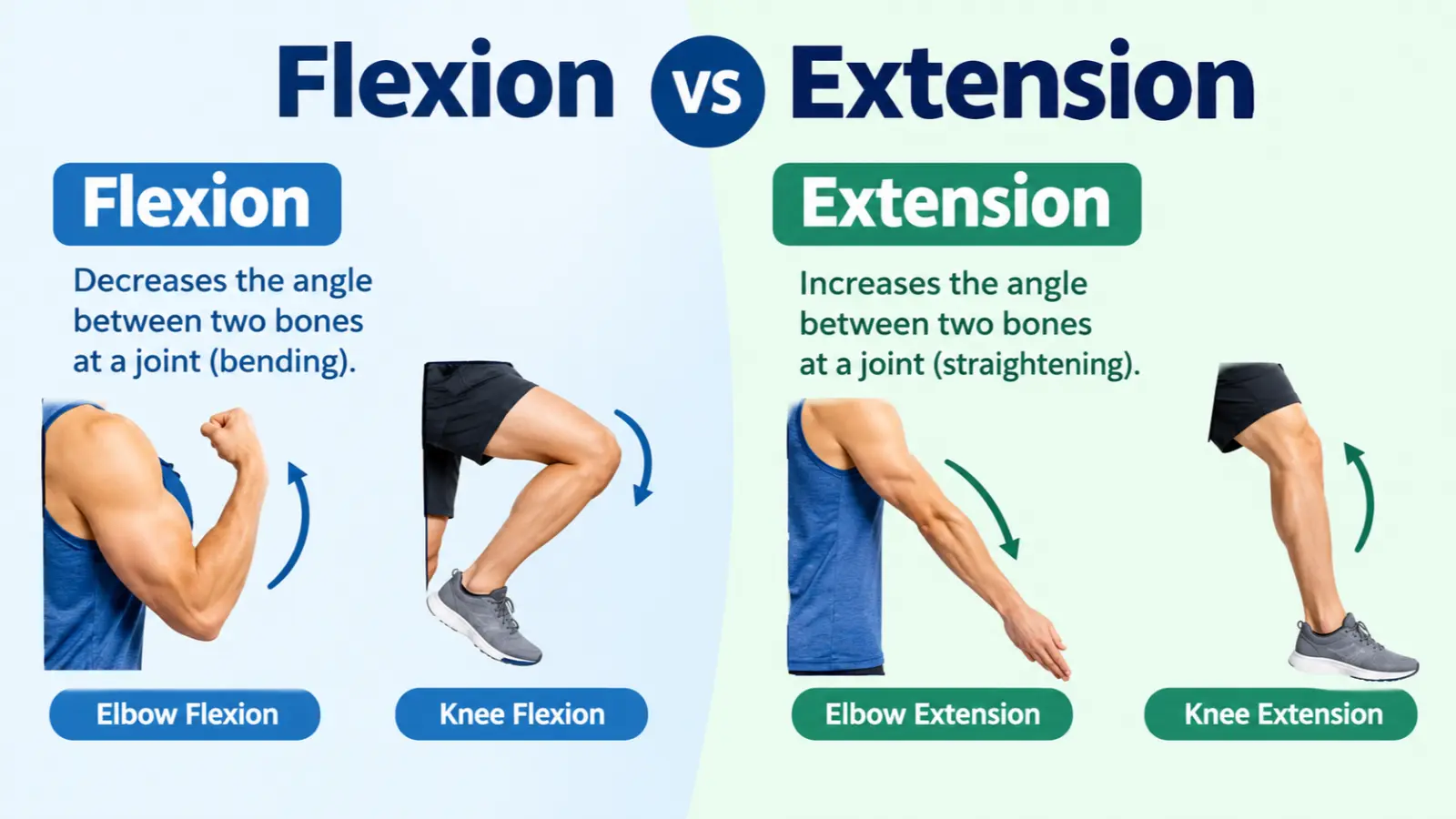
Flexion vs extension describes two opposite types of joint movement.
Flexion decreases the angle between two bones, usually by bending a joint, while extension increases the angle, usually by straightening it.
For example, bending your elbow is flexion, while straightening your elbow is extension. These movements occur at many joints throughout the body.
Key Takeaways
- Flexion decreases the angle between bones at a joint.
- Extension increases the angle between bones and usually straightens the joint.
- Bending your knee or elbow is an example of flexion.
- Straightening your knee or elbow is an example of extension.
- Flexion and extension commonly occur in the sagittal plane, although some joints have special movement patterns.
- Hyperextension means extending a joint beyond its usual anatomical range.
1. What Is Flexion?
Flexion is a movement that decreases the angle between two body segments or bones at a joint. In simple terms, flexion usually means bending a joint.
For example, when you bend your elbow and bring your hand toward your shoulder, the angle between your upper arm and forearm becomes smaller. That is elbow flexion.
Flexion occurs at many joints, including the elbow, knee, hip, shoulder, wrist, fingers, neck, and spine.
How Flexion Changes a Joint Angle
Imagine two bones meeting at a joint.
When the joint bends and the angle between those bones becomes smaller, the movement is generally called flexion.
Easy rule:
Flexion = angle gets smaller.
This definition is more reliable than simply thinking of flexion as “moving forward,” because the direction of movement can vary depending on which joint you are describing.
Everyday Examples of Flexion
You use flexion constantly during normal activities.
Examples include:
- Bending your elbow to bring a cup toward your mouth
- Bending your knee when sitting in a chair
- Bending your fingers to grip a pen
- Bending your hip when sitting down
- Bending your neck to look downward
- Bending your spine forward
These movements all involve decreasing an angle at the relevant joint or joint system.
2. What Is Extension?
Extension is a movement that increases the angle between two body segments or bones at a joint. It generally involves straightening a joint after it has been flexed.
For example, when you straighten your elbow after bending it, the angle between your upper arm and forearm increases. That is elbow extension.
Extension is the opposite movement of flexion in many joints.
How Extension Changes a Joint Angle
If flexion makes a joint angle smaller, extension does the opposite.
Easy rule:
Extension = angle gets bigger.
At a typical hinge joint such as the elbow or knee, extension brings the joint toward a straighter position.
Everyday Examples of Extension
Examples of extension include:
- Straightening your elbow after a biceps curl
- Straightening your knee when standing up
- Moving the thigh backward from a flexed hip position
- Straightening your fingers after making a fist
- Returning your trunk from a forward bend
- Moving your neck backward from a forward-bent position
These movements increase the relevant joint angle.
3. Flexion vs Extension: Key Differences
The simplest way to understand flexion vs extension is to look at what happens to the angle at the joint.
| Feature | Flexion | Extension |
|---|---|---|
| Basic meaning | Bending | Straightening |
| Joint angle | Decreases | Increases |
| Relationship | Opposite of extension | Opposite of flexion |
| Common example | Bending the elbow | Straightening the elbow |
| Knee example | Bending the knee | Straightening the knee |
| Spine example | Bending forward | Returning upright or bending backward |
| Typical plane | Sagittal plane | Sagittal plane |
Flexion and extension are classified as angular movements because they change the angle between body parts. They commonly occur in the sagittal plane, although spinal movement has some important variations.
The Easiest Way to Remember the Difference
Think of a biceps curl.
When you curl your hand toward your shoulder, your elbow bends and the angle gets smaller. That’s flexion.
When you lower the weight and straighten your elbow, the angle gets larger. That’s extension.
Remember:
Flexion → smaller angle
Extension → larger angle
💡 Tip: If you’re ever unsure whether a movement is flexion or extension, focus on the joint angle, not simply whether the body part moves forward or backward.
4. Flexion vs Extension at Different Joints
The basic definitions stay the same, but the actual movement looks different from one joint to another.
Elbow
At the elbow:
- Flexion: Bending the elbow and bringing the forearm toward the upper arm
- Extension: Straightening the elbow
The elbow is primarily a hinge joint, making flexion and extension especially easy to visualize.
Knee
At the knee:
- Flexion: Bending the knee and bringing the lower leg toward the back of the thigh
- Extension: Straightening the knee
For example, lowering yourself into a chair involves knee flexion, while straightening your knees to stand involves knee extension.
Hip
At the hip:
- Flexion: Moving the thigh forward and upward toward the torso
- Extension: Moving the thigh backward
Sitting, climbing stairs, and bringing your knee toward your chest involve hip flexion. Moving the thigh backward involves hip extension.
Shoulder
At the shoulder:
- Flexion: Moving the arm forward and upward
- Extension: Moving the arm backward from a flexed position
Because the shoulder is a ball-and-socket joint, it permits a much wider variety of movements than a simple hinge joint.
Spine and Neck
Spinal flexion usually means bending the trunk or neck forward.
Spinal extension generally means moving backward, straightening from a flexed position, or arching backward.
There is also lateral flexion, which means bending the neck or trunk toward the right or left side. This is different from the usual forward flexion discussed in basic anatomy.
Wrist and Fingers
At the wrist and fingers:
- Flexion generally bends the joint toward the palm side.
- Extension generally moves the joint back toward a straighter position.
For example, closing your fingers around an object involves finger flexion, while opening and straightening them involves extension.
5. Flexion and Extension in Exercise
Flexion and extension are not just anatomy terms. They are used frequently when describing exercise technique.
Common Flexion Movements
Examples include:
- Biceps curls – elbow flexion
- Leg curls – knee flexion
- Squats – hip and knee flexion during the lowering phase
- Lunges – hip and knee flexion
- Crunches – spinal flexion
Common Extension Movements
Examples include:
- Triceps extensions – elbow extension
- Leg extensions – knee extension
- Hip thrusts – hip extension
- Glute bridges – hip extension
- Back extensions – spinal extension
The exact muscles involved depend on the joint and movement. For example, elbow flexion involves muscles such as the brachialis, biceps brachii, and brachioradialis, while elbow extension is primarily produced by the triceps brachii and anconeus.
📌 Key Takeaway: Flexion and extension describe movement at a joint, not whether an exercise is automatically good or bad. Proper technique, joint range of motion, load, and individual circumstances all matter when exercising.
6. What Are Hyperflexion and Hyperextension?
You may also encounter the terms hyperflexion and hyperextension.
Hyperextension refers to extension beyond the normal anatomical range of motion. Hyperflexion similarly describes excessive flexion beyond the usual range.
The important point is that normal range of motion differs between joints and individuals. A movement that is normal for one joint may not be appropriate or possible for another.
For this reason, “more movement” does not automatically mean better movement.
7. Common Confusions About Flexion and Extension
Is bending flexion or extension?
Bending is generally flexion when it decreases the angle between the relevant body segments.
For example, bending your elbow or knee is flexion.
Is straightening extension?
Usually, yes. Straightening a joint generally increases its angle, making it extension.
For example, straightening your knee after sitting is knee extension.
Are flexion and extension opposites?
Yes. They are generally opposite angular movements.
Flexion decreases the joint angle, while extension increases it.
Are flexion and extension always forward and backward?
Not necessarily.
This is a common source of confusion. The meaning depends on the joint and anatomical reference position. The most dependable definition is based on the change in joint angle.
For example, flexion of the knee means bending it, while flexion of the hip means moving the thigh forward and upward.
What about the ankle?
Ankle terminology can be more confusing because the common movements are usually described as dorsiflexion and plantarflexion.
Dorsiflexion brings the foot upward toward the lower leg, while plantarflexion points the foot downward. These terms are more precise for describing ankle movement than simply using “flexion” and “extension.”
8. Frequently Asked Questions
What is the main difference between flexion and extension?
Flexion decreases the angle between two bones or body segments at a joint, while extension increases that angle. A simple example is the elbow: bending it is flexion, and straightening it is extension.
Is flexion bending or straightening?
Flexion is generally bending. It decreases the angle at a joint. Bending your knee, elbow, or fingers are common examples of flexion.
Is extension bending or straightening?
Extension is generally straightening. It increases the angle at a joint. Straightening your elbow or knee after bending it is an example of extension.
What is an example of flexion and extension?
A biceps curl provides an easy example. Curling the weight upward bends the elbow, producing elbow flexion. Lowering the weight until the elbow straightens produces elbow extension.
What is hyperextension?
Hyperextension is extension beyond a joint’s normal anatomical range. It is different from ordinary extension because the joint moves beyond its usual range.
Do flexion and extension happen at the same joints?
Many joints allow both movements. Examples include the elbow, knee, hip, shoulder, wrist, and finger joints. The amount and direction of available movement depend on the structure of each joint.
9. Conclusion
Understanding flexion vs extension becomes much easier when you focus on the joint angle.
Flexion decreases the angle, usually producing a bending movement.
Extension increases the angle, usually producing a straightening movement. You can see this clearly when bending and straightening the elbow or knee.
These movements are fundamental to everyday activities, exercise, sports, and anatomy.
Once you remember “flexion = smaller angle” and “extension = larger angle,” you can identify the movement at many different joints without memorizing every example.